


Public markets rarely offer clean exposure to a single major-league sports franchise. Most team ownership remains private, and the few listed sports companies usually bundle multiple assets, venues, or media rights into a single equity story. That changes this week.
Now, Madison Square Garden Sports’ (MSGS) plan to separate the Rangers from the Knicks puts the franchise’s business prospects in focus, with the proposed split designed to give shareholders two distinct companies to evaluate.
More Top Stocks Daily: Go behind Wall Street’s hottest headlines with Barchart’s Active Investor newsletter.
The separation puts MSGR in the spotlight, offering a way to own a stake in the Rangers business without also buying into the Knicks. That gives the hockey franchise an opportunity to establish its own investment appeal, beyond its identity on the ice.
Still, a celebrated team does not automatically make a winning investment. Will MSGR offer an attractive entry into professional hockey ownership, or will buyers pay too much for the name on the jersey? Let’s dive in.
What the Spinoff Means for Investors
The spinoff gives existing MSG Sports shareholders a direct stake in the Rangers without requiring another purchase. Under the announced terms, holders receive one Rangers share for every two MSGS shares owned on the Oct. 20 record date. The distribution was scheduled for Oct. 26, followed by regular trading under MSGR on Oct. 27. The remaining Knicks business became MSG Knickerbockers (MSGK-), trading under MSGK.
That changes what shareholders can choose to own. Instead of holding basketball and hockey together, they can keep both companies or sell one. MSGR offers exposure to the Rangers business, including its Hartford Wolf Pack affiliate, rather than a diversified collection of sports franchises. Its investment case therefore, rests more directly on the hockey operation.
Existing holders should not treat the distribution as an automatic reason to sell or double down. The transaction separates their ownership into two securities rather than handing them free economic value. It is intended to qualify as tax-free for U.S. federal income tax purposes, although fractional share payments generally remain taxable.
New buyers should let price drive the decision. The practical approach is to compare MSGR’s opening valuation with its standalone earnings, debt, and cash flow before committing. A clearer ownership structure makes the business easier to isolate. It does not, by itself, make the shares a bargain.
Breaking Down New York Rangers’ Business
The Rangers’ business runs on ticket sales, premium seating, sponsorships, merchandise, and broadcasting rights. It also includes the Hartford Wolf Pack and operates the Greenburgh training center. Madison Square Garden is not part of the deal. The Rangers play there under a licensing agreement, so shareholders are buying into the team’s business, not the arena.
Its revenue was estimated at $322 million for the 2024 to 2025 season, with EBITDA of $76 million. Those estimates use cash accounting and are net of revenue sharing and player escrow.
More recent results from Madison Square Garden Sports provide context, although they cover the Knicks and Rangers together. The parent reported fiscal 2026 revenue of $1.154 billion, up 11%, and operating income of $28.9 million, compared with $14.8 million a year earlier.
The parent also reported higher average spending across its arena revenue categories. However, the Knicks’ championship run and the NBA’s new national television agreements helped drive its performance. Those basketball benefits should not be treated as growth drivers for the standalone Rangers business.
Wall Street’s Take on MSGR’s Prospects
MSGR enters the market without a verified analyst consensus. Ahead of its debut, the Rangers’ issued listing showed no published analyst ratings, average price target, or annual earnings estimates, leaving buyers without a clear Wall Street benchmark for the standalone stock.
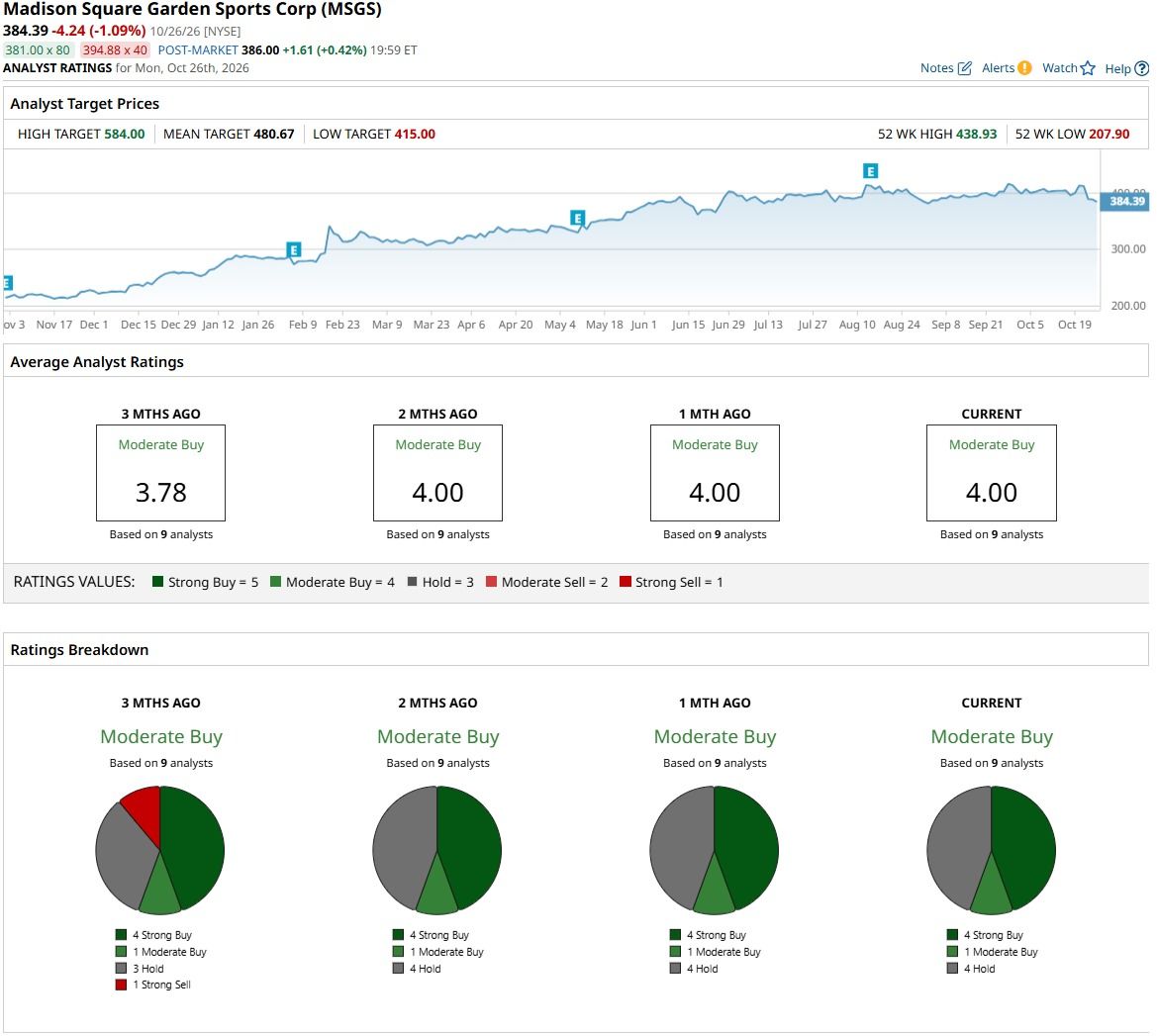
Wall Street’s view is still largely framed by the parent company, Madison Square Garden Sports Corp (MSGS), with a “Moderate Buy” consensus based on nine analysts. Their average price target of $480.67 implies approximately 25% upside from its current price of $384.39. That rating reflects cautious optimism around the separation’s potential to surface value.
 www.barchart.com
Conclusion
MSGR looks more like a stock to watch than chase at its debut. The Rangers have a strong brand and ticket demand, but those strengths do not settle the question of profitability or price. Early trading is likely to reflect excitement about owning the team before financial results take center stage. Existing shareholders can assess what they own, while new buyers should wait for a valuation. A familiar name is appealing, but buying at the right price matters much more.
On the date of publication, Ebube Jones did not have (either directly or indirectly) positions in any of the securities mentioned in this article. All information and data in this article is solely for informational purposes. For more information please view the Barchart Disclosure Policy here.