

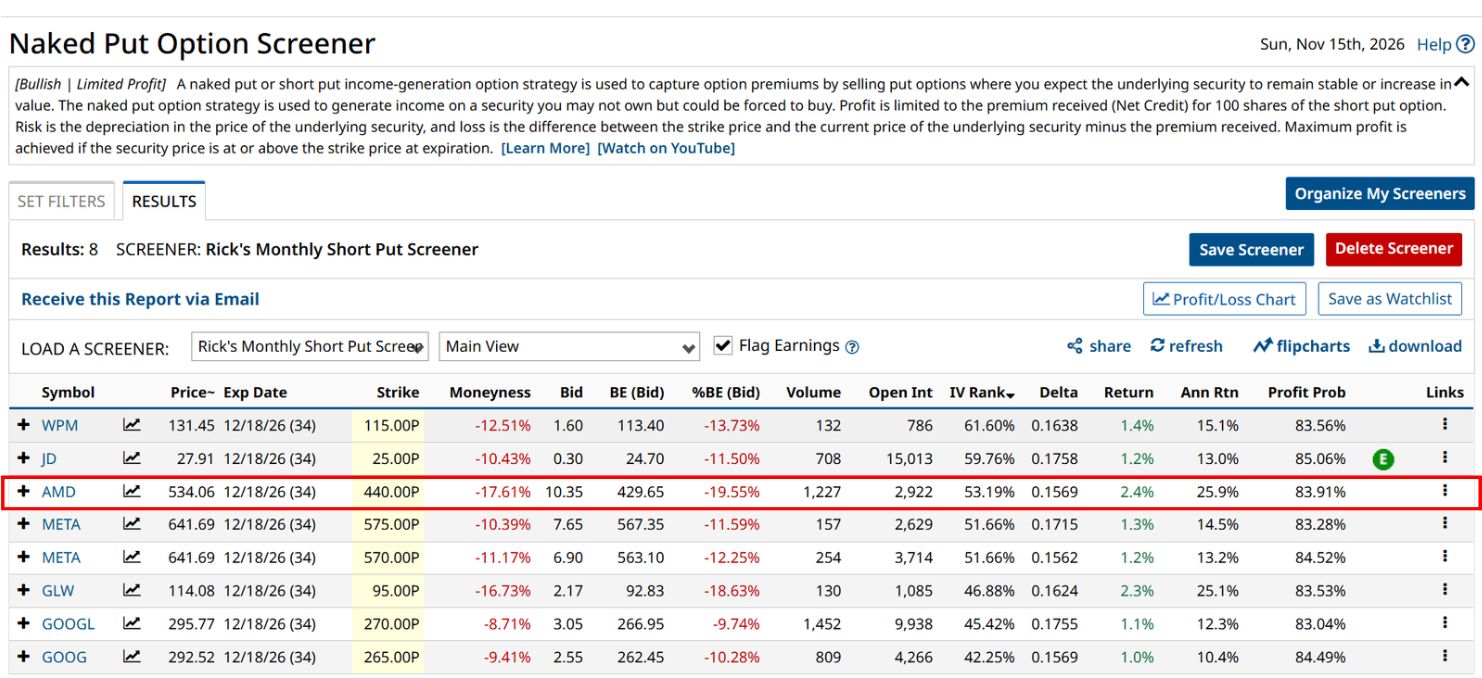
I was checking my monthly short put options screener for potential trades, and this trade immediatley caught my attention:
 Screenshot courtesy of www.barchart.com
So, what made this trade stand out?
Can’t Get Enough Options?: Join the list for Barchart’s daily unusual options report, delivered free.
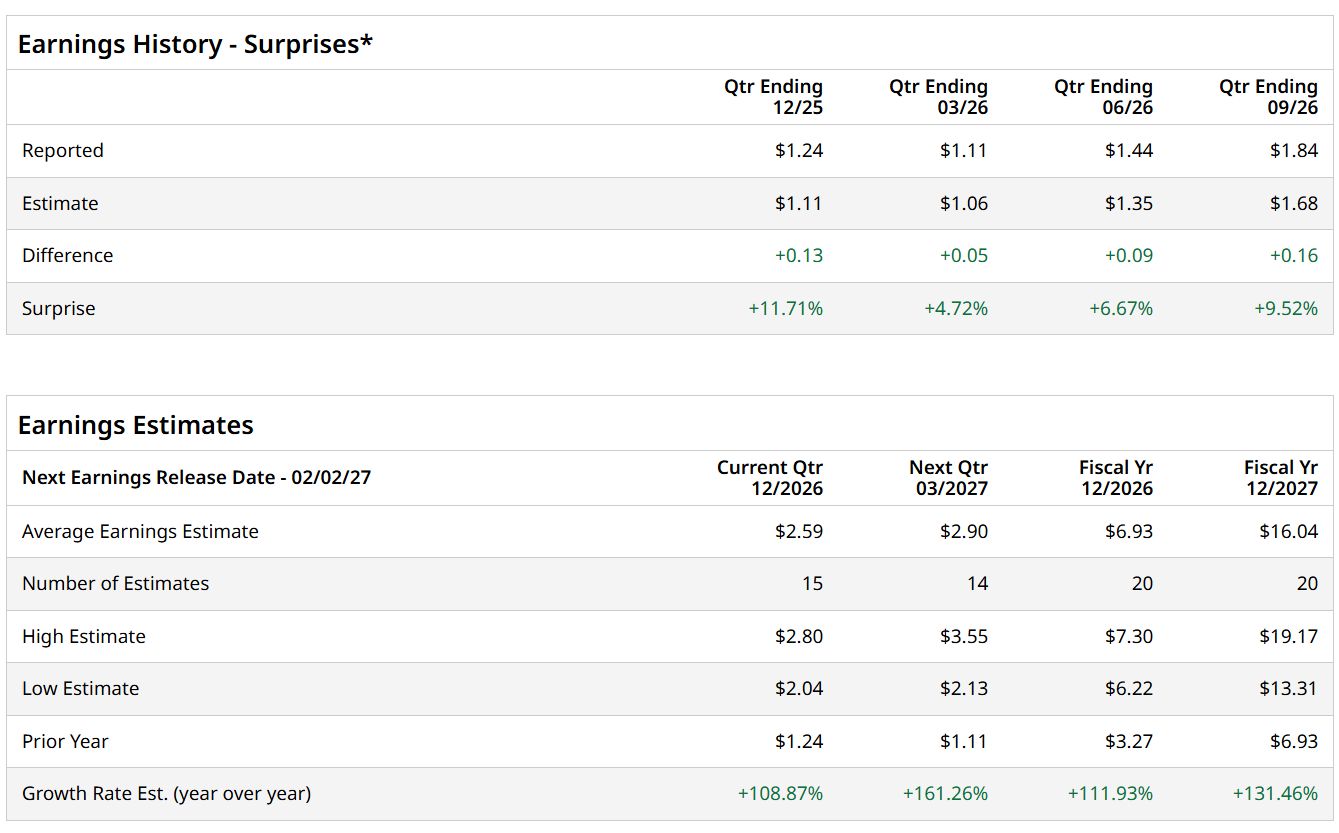
Well, it’s on AMD, for one; the business has been executing really well, having just reported third-quarter results that beat Wall Street’s expectations, marking the fifth quarter in a row it has beaten estimates, with both earnings and revenue growing strongly year over year.
 Screenshot courtesy of www.barchart.com
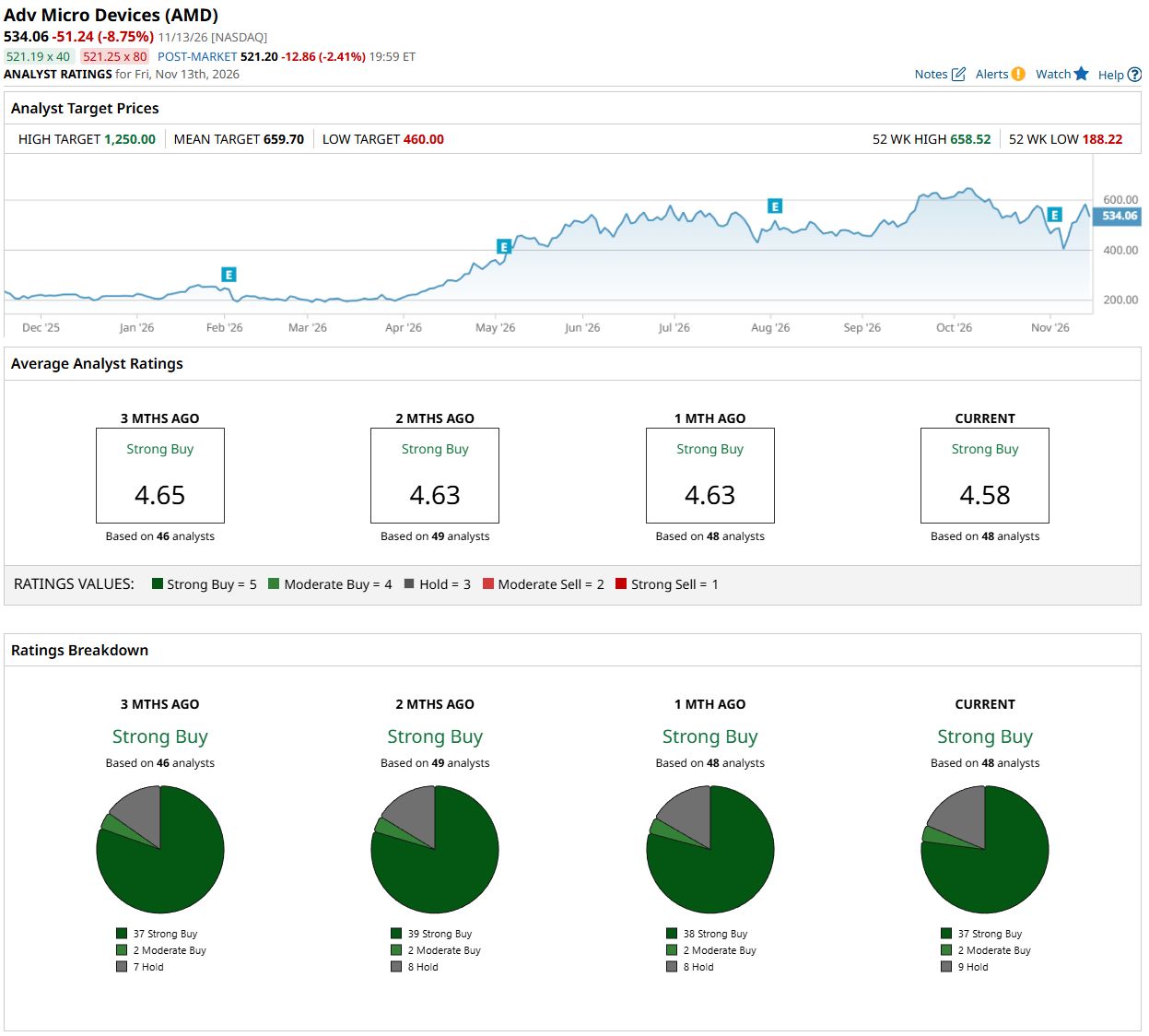
So, it’s no surprise that analysts have been raising their forecasts for next year, since almost all of the recent revisions have pointed higher, and, well, the large majority of analysts covering the stock rate it a Buy or Strong Buy, with none recommending a Sell, and the average price target sits comfortably above where the stock trades today.
 Screenshot courtesy of www.barchart.com
So let’s explore the naked put strategy, why it works in this context, and what this trade represents for those willing to sell.
What Is A Short Put?
So, basics first.
A short put is an options trade where you sell a put option and collect a premium up front, and in exchange, you agree that if the stock closes below the strike price at expiration, you may be required to buy 100 shares at that strike. Think of it as getting paid to place a limit order: you pick a price you’d be happy to own the stock at, and the market pays you to wait for it.
Now, there are really two ways this plays out. If the stock stays above the strike, the option expires worthless, and you keep the full premium, which is your maximum profit. But if the stock falls below the strike, you’ll likely be assigned the shares, and your effective cost is the strike minus the premium you collected, so the real risk is owning a stock that has dropped.
So, what’s the difference between naked and cash-secured? Well, a cash-secured put means you set aside enough cash to buy all 100 shares at the strike price, so you’re fully prepared if assigned. A naked put means you sell the put without setting that cash aside, relying on margin instead, which frees up capital but also means a sharp drop can trigger a margin call and force you to act at a bad time.
In that case, the trade itself is identical, and the only real difference is how much cash stands behind it. For this example, I’m using the cash-secured put version.
AMD 440-Strike Trade Details
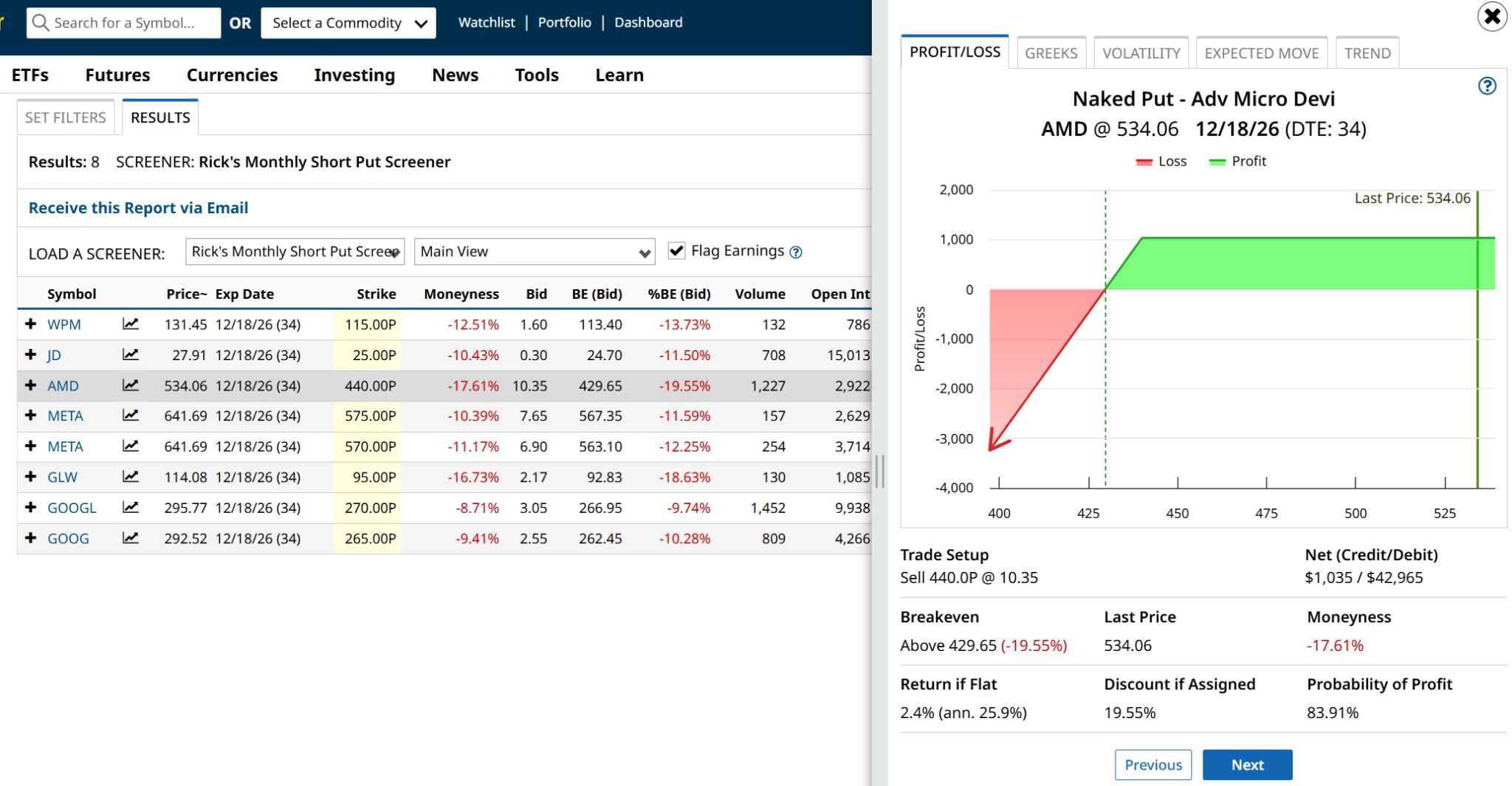 Screenshot courtesy of www.barchart.com
Now, let’s talk about the trade.
According to the screener, you can sell a 440-strike put on AMD and collect $10.35 per share in premium, or $1,035 per trade, since every put option represents 100 shares of AMD. The trade expires on December 18, 2026, roughly 34 days from the time of the scan.
 Screenshot courtesy of www.barchart.com
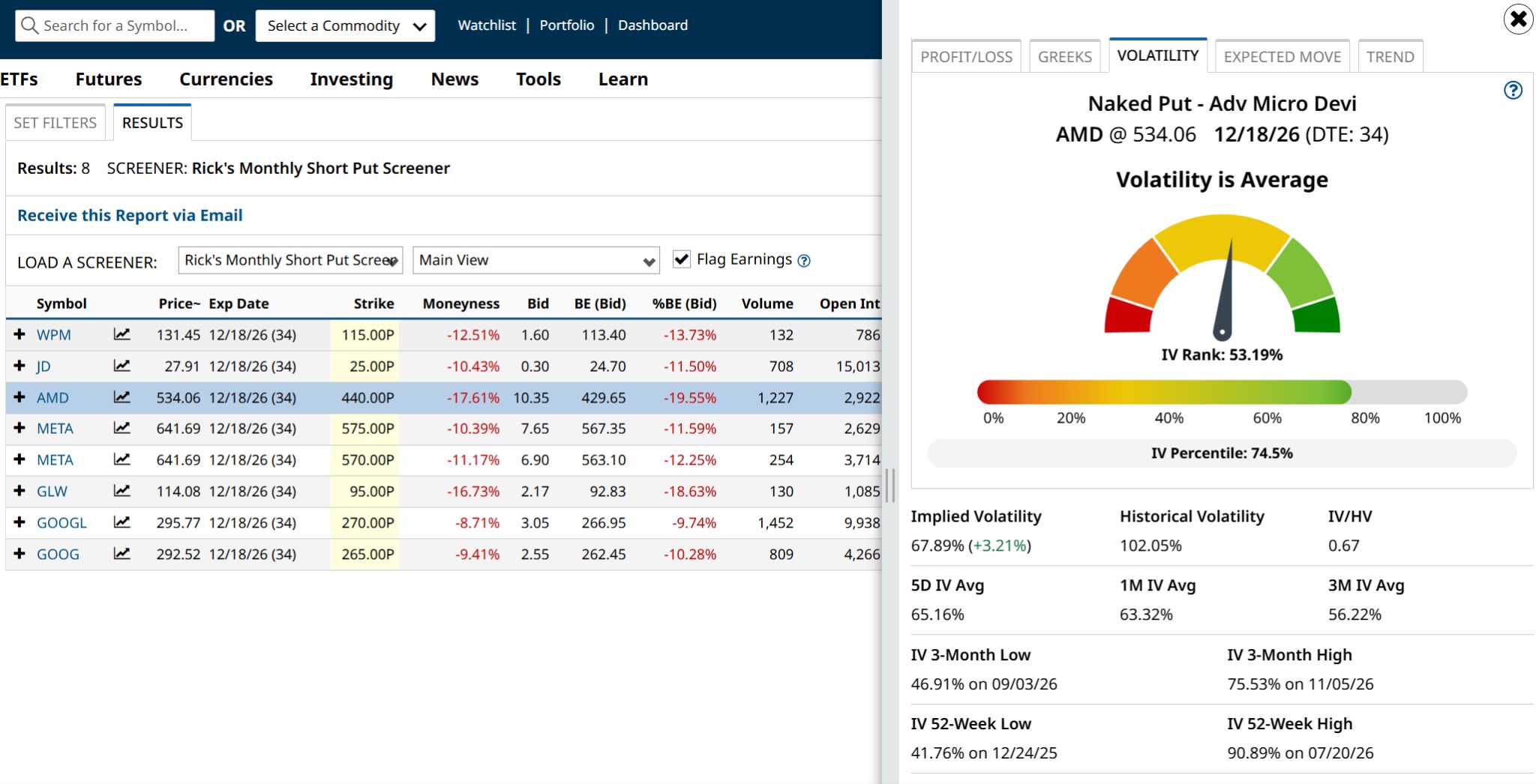
Now, implied volatility (IV) is at 68%, which might look high on paper. But remember, these are chip stocks, and we just got hit by a sell-off in early November. That’s why IV rank is a better metric: it compares current IV against its 52-week range. And since IV rank is at 53%, premiums are neither high nor low right now. So anyone selling this AMD put is fairly compensated for the risk.
As long as AMD trades above $440 by expiration, you keep the entire $1,035 premium and you're free of all other obligations. However, if AMD trades below $440, you must buy 100 shares of the stock at $440 each.
This is why it’s important to sell puts on stocks you are willing to own and believe will eventually grow past your purchase price.
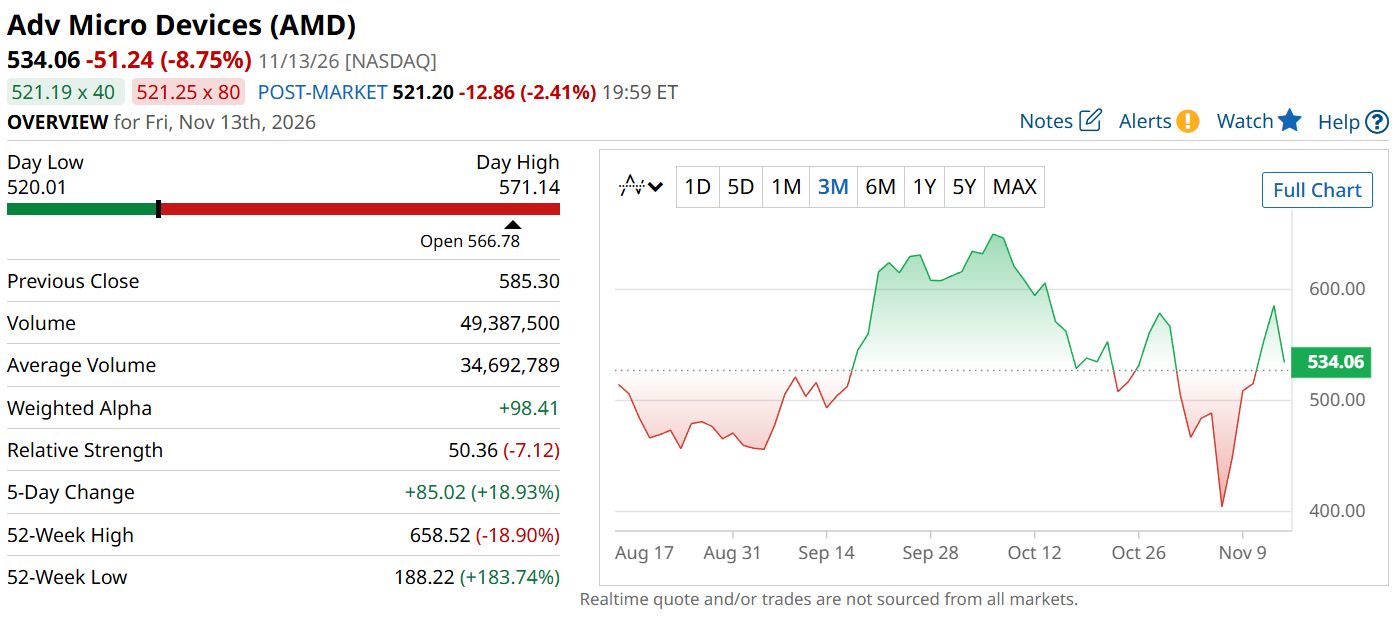
In this particular scenario, AMD fits the bill. Sure, it got hit by the AI chip sell-off on November 5, but it’s already back up to its previous level as of today.
 Screenshot courtesy of www.barchart.com
That’s a testament to how much investor confidence remains in AMD’s growth prospects. Of course, that doesn't mean the stock can't drop again, especially in a volatile sector like semiconductors. But it does show that buyers are still willing to step in when the stock pulls back.
 Screenshot courtesy of www.barchart.com
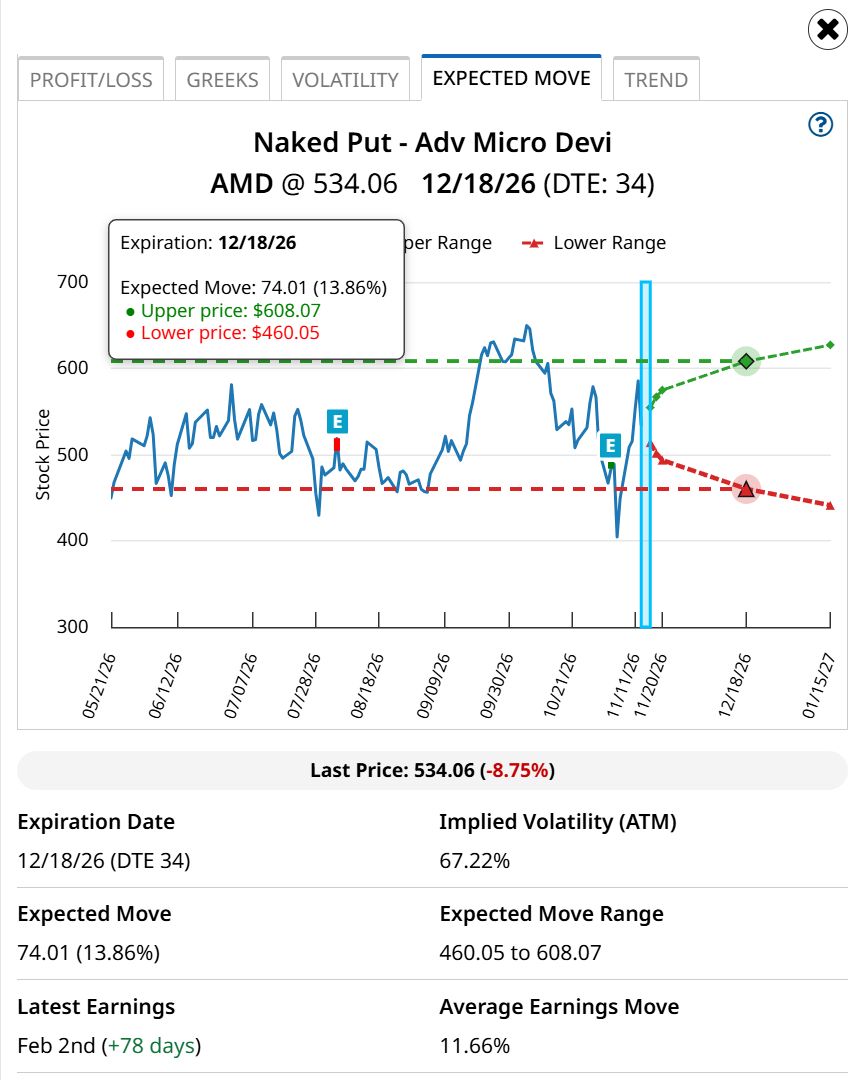
Even better, the Expected Move tab shows that AMD is expected to trade as low as $460 by the expiration date, at least based on option pricing. Of course, that’s not 100% certain, but the fact that option traders are pricing in a potential downside to around $20 above the strike price is good news.
Risks of Selling Put Options
Now, the biggest risk is that your downside is large while your upside is capped at the premium, so if AMD falls well below $440, you’re still buy it at that price despite what it might be trading at, at the time- even if it goes to zero. Now, that’s highly unlikely, but it's still worth knowing.
Also, your cash stays tied up until expiration, and if you’re running the naked version, a sharp drop could trigger a margin call, which is why position size matters more than anything.
Conclusion
Selling short puts backed by cash is a great way to generate income from stocks you’d be happy to own anyway, since you get paid up front whether the stock rises, stays flat, or dips modestly.
If the stock stays above your strike, you get paid in premium. If the stock dips below your strike, you’ve just bought shares at a relative discount from when you started the trade. Either way, there’s a path to winning, so smart traders hedge their bets by choosing a strike price that aligns with their risk tolerance, keeping enough capital to handle assignment, and never selling puts on stocks they wouldn't want to own in the first place. Always remember, collecting premium is great, but protecting your capital is what keeps you in the game.
On the date of publication, Rick Orford did not directly have a position in any of the securities mentioned in this article. All information and data in this article is solely for informational purposes. For more information please view the Barchart Disclosure Policy here.
More news from Barchart
Option Volatility and Earnings Report For Nov 16-20 Leverage AMD's 5th Straight Earnings Beat With A Trade Pays $1,035 Nvidia is Extraordinarily Undervalued Ahead of its Earnings on Tuesday - Has NVDA Bottomed? Starbucks’ Unusual Options Activity Points to Bullish Institutional Sentiment: Should You Follow the Crowd?