

The weight-loss drug market is becoming a much bigger contest than a battle between two pharmaceutical companies. Novo Nordisk (NVO) and Eli Lilly (LLY) have been locked in fierce competition, and now Amgen (AMGN) is entering the field as a serious new challenger. Novo has already carved out a multibillion-dollar empire with its obesity treatments, but fierce competition and pricing pressures are forcing the company to rethink its game plan. Meanwhile, Amgen is working on a potential breakthrough that might revolutionize how often patients need treatment. The stakes are sky-high, but which company will turn out to be the best choice for investors?
The Case for Novo Nordisk: Fighting to Retake Its Position
Novo Nordisk built its reputation on Ozempic and Wegovy, two semaglutide-based medicines that helped bring GLP-1 treatments into the mainstream. However, Eli Lilly's Mounjaro and Zepbound have intensified competition, pressuring Novo's market footing.
More Top Stocks Daily: Go behind Wall Street’s hottest headlines with Barchart’s Active Investor newsletter.
Determined to stay ahead, Novo is expanding its portfolio beyond tried-and-true injectables by rolling out oral formulations, testing higher doses, and advancing next-generation therapies. In the Q3 earnings call, management implied that this approach is starting to pay off.
 www.barchart.com
In the third quarter, Novo said its obesity-treatment patient base had doubled over the past year to 5.6 million. The company was treating 48 million people for diabetes and obesity, up two million from a year ago. Novo’s international GLP-1 volume market share was 54%, showing it still has significant reach even as competition grows. Obesity sales alone rose 22% year over year. Adjusted revenue was up 4% to DKK 79.2 billion, and adjusted operating profit increased 27% to DKK 31.7 billion.
Novo's oral Wegovy is gaining traction, accounting for around 80% of new-to-brand prescriptions in the U.S. oral obesity market. The broader Wegovy franchise accounts for over half of these prescriptions. Novo has already introduced the pill in seven international markets and plans to expand to more than 20 countries by mid-2027. Novo's next-generation candidate, CagriSema, combines semaglutide with cagrilintide, an amylin analogue. The idea is that targeting two appetite-regulating pathways could produce greater weight loss than using semaglutide alone.
In the REIMAGINE 5 trial involving patients with type 2 diabetes, it delivered 12.42% weight loss versus 9.12% for tirzepatide at the 5-milligram dose. Although promising, these results do not prove superiority over Lilly's therapies across all doses and patient groups. The true commercial promise will unfold as clinical trials and regulatory reviews progress.
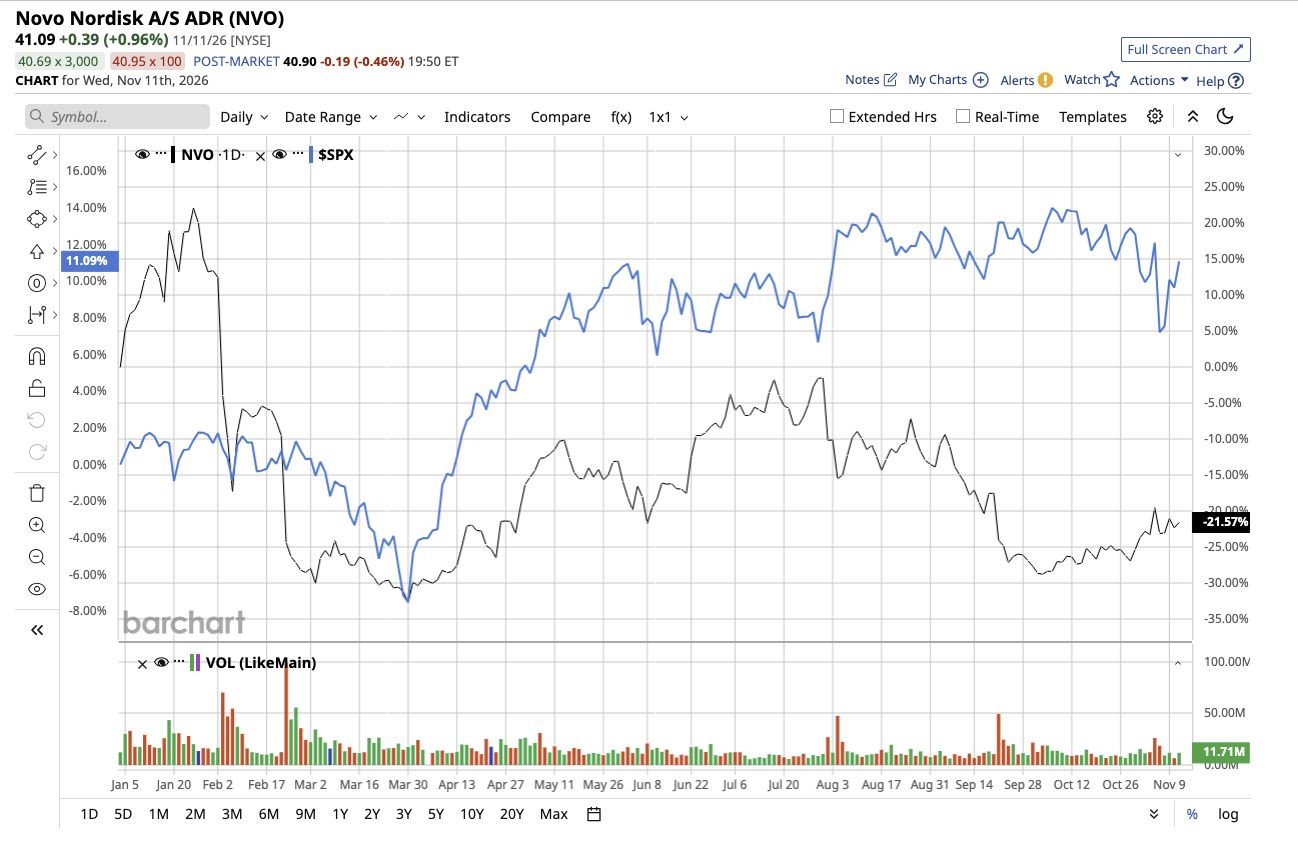
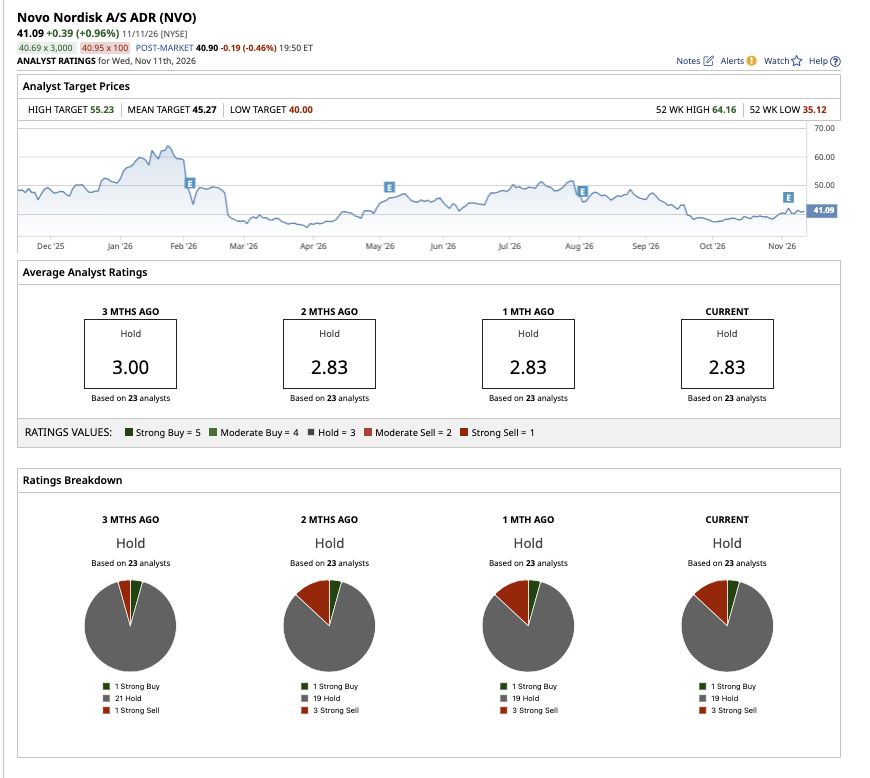
Novo Nordisk stock is currently rated as an overall “Hold” on Wall Street. Of 23 analysts, one recommends a “Strong Buy,” 19 rate it a “Hold,” and three suggest a “Strong Sell.” The stock has dropped 21% this year, but the average analyst price target is $45.27, suggesting a possible 10.1% gain from where it is now. The highest estimate, at $55.23, means the stock could rise as much as 34% over the next year.
 www.barchart.com
The Case for Amgen: MariTide Could Change the Treatment Equation
Amgen is breaking into the obesity market with a bold new approach. Its experimental medicine, MariTide, not only activates the GLP-1 receptor but also blocks the GIP receptor. Setting itself apart from current weekly treatments, MariTide’s long-acting formula could one day let patients get by with just four to six doses a year.
 www.barchart.com
For patients tired of frequent injections, a longer dosing interval could be a welcome relief, and fewer visits might boost their commitment to treatment. However, convenience alone will not make MariTide a blockbuster drug. To truly rival established medicines, Amgen must prove that MariTide delivers impressive weight loss, tolerable side effects, and lasting results. Amgen has moved MariTide into an extensive Phase 3 program. The trials are looking at weight management in people with and without type 2 diabetes, as well as cardiovascular outcomes, heart failure, and obstructive sleep apnea. Amgen is also testing whether patients who take weekly semaglutide or tirzepatide can switch to less frequent MariTide dosing.
While MariTide’s early results inspire optimism, its commercial promise is still untested. The upcoming Phase 3 data will reveal if its dosing advantage comes with sufficient efficacy and tolerability. Amgen’s bold investment in this program signals high hopes, but investors should brace for development costs and clinical uncertainty before any potential launch.
Unlike many biotechnology companies that hinge their fortunes on a single experimental drug, Amgen stands apart with a thriving commercial business. In the third quarter, the company’s revenue surged 8% to $10.4 billion, and adjusted earnings per share soared 14% to $6.45. Impressively, 17 products posted double-digit sales growth, with six key growth engines powering about 70% of total product sales.
Management has raised its 2026 revenue outlook to $38.9 billion to $39.7 billion, with adjusted EPS guidance now between $22.90 and $23.70. Still, Amgen faces important financial challenges. Research and development spending jumped 11% to $2.1 billion, and the company ended September with $54 billion in debt versus $13.2 billion in cash. While its established portfolio offers strong financial backing, the sizable debt load and ongoing investment needs remain key issues to watch.
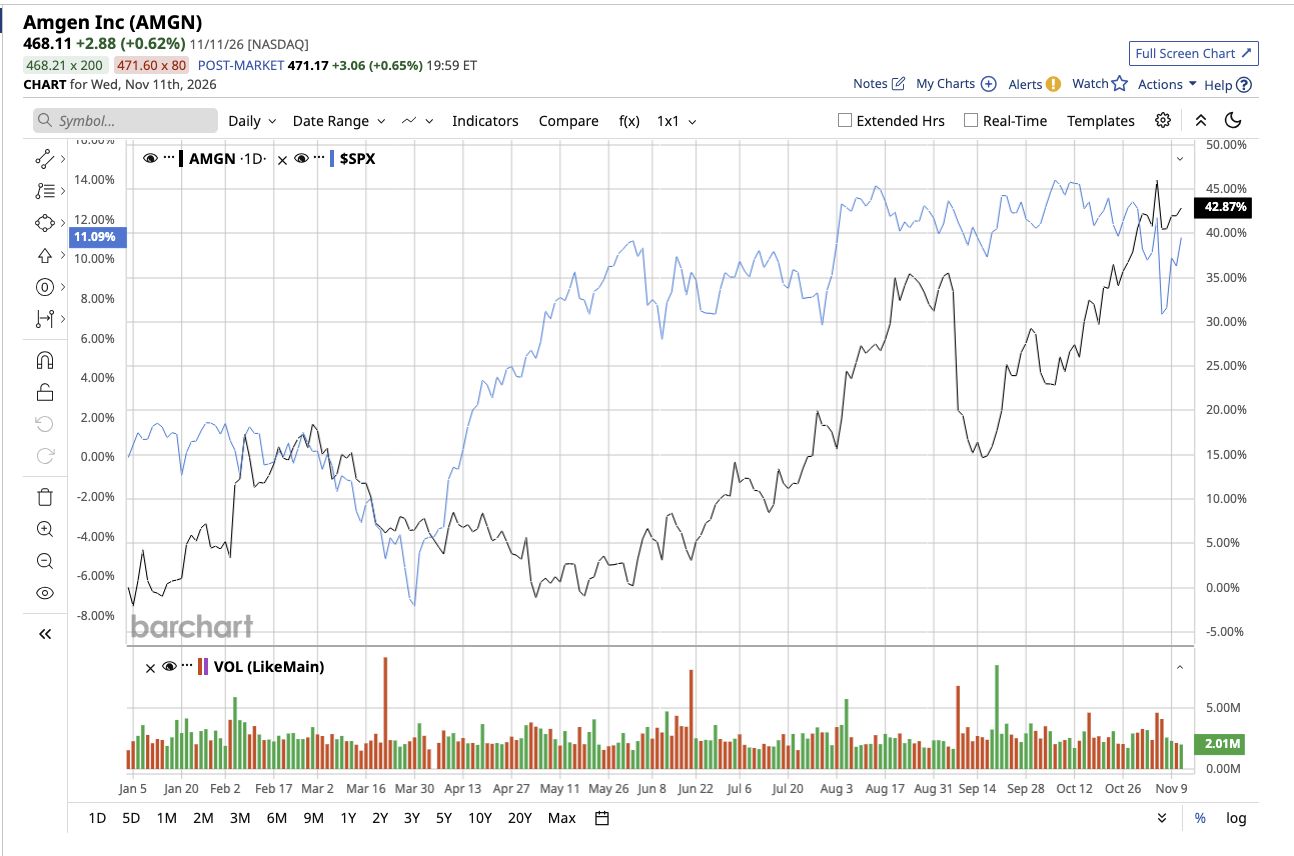
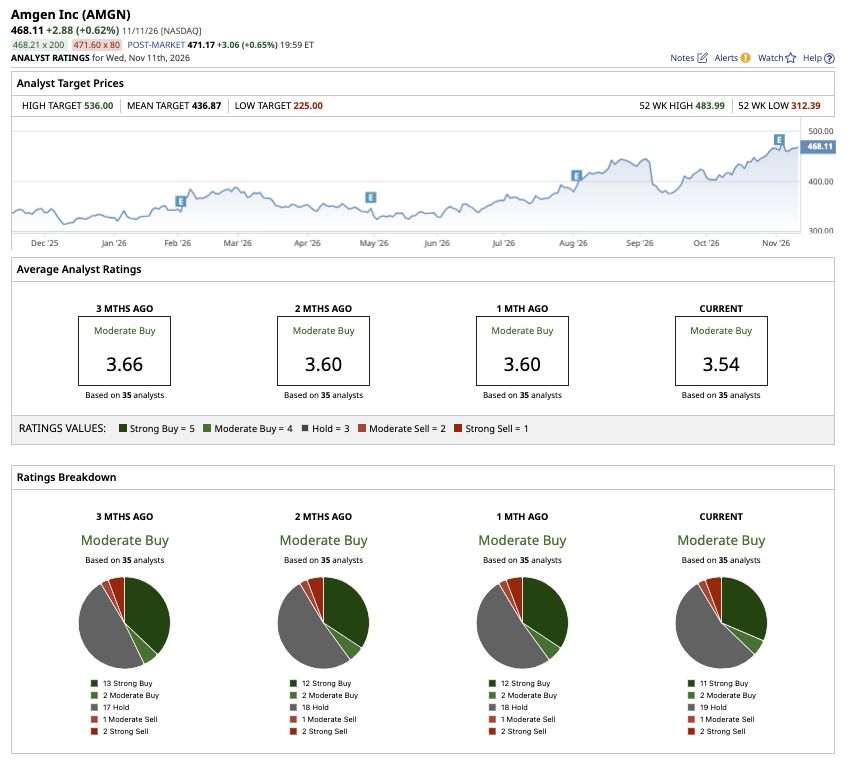
Amgen stock is up 42.8% so far this year, moving past the average target price of $438.81. The highest analyst estimate, $536, points to a possible 14% gain from here. Wall Street rates the stock as a “Moderate Buy.” Out of 35 analysts, 11 call it a “Strong Buy,” two rate it a “Moderate Buy,” 19 say “Hold,” one gives it a “Moderate Sell,” and two recommend a “Strong Sell.”
Which Is the Better Buy Now?
Novo gives investors exposure to a proven obesity business, backed by a growing oral franchise, and a promising pipeline that could help it compete more effectively against Lilly. Amgen, on the other hand, has MariTide, a possible game-changer thanks to its less frequent dosing. Its existing pharmaceutical business also makes it less dependent on that single candidate.
Still, MariTide remains in clinical trials, so investors must wait for Phase 3 results to see whether it can truly make waves in the market.
Amgen certainly earns a spot on investors’ watchlists, but for those looking for a solid foothold in the weight-loss market, Novo Nordisk stands out as the more compelling choice. Its commercial recovery and expanding Wegovy franchise offer a stronger combination of existing earnings and future growth potential.
 www.barchart.com
On the date of publication, Sushree Mohanty did not directly have a position in any of the securities mentioned in this article. All information and data in this article is solely for informational purposes. For more information please view the Barchart Disclosure Policy here.
More news from Barchart
Novo Nordisk vs. Amgen: 1 Has the Blockbuster Weight-Loss Drugs, the Other Has a Promising Rival Cathie Wood and Jim Cramer Disagree on Nvidia Stock Without Jensen Huang. Earnings Could Decide Who's Right A $1.3 Billion Reason to Buy Firefly Aerospace Stock Here Why at Least 1 Analyst Says Nvidia Stock Has Already Bottomed – Or Is Very Close