


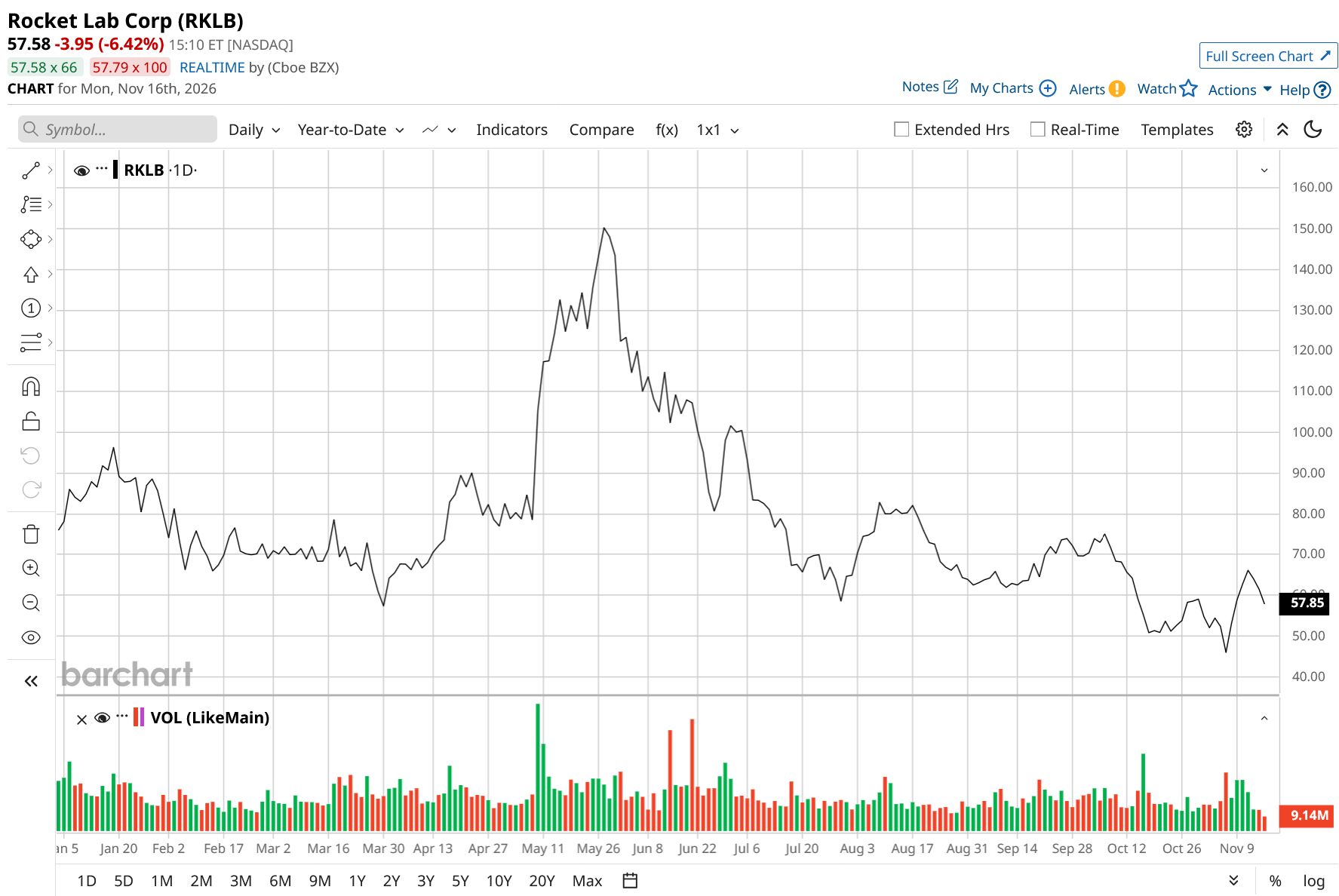
Cathie Wood has never been afraid to buy a beaten-down growth stock, and Rocket Lab (RKLB) is giving her plenty of opportunities. Shares of the space company have fallen nearly 62% from their May peak, battered by delays to its next-generation Neutron rocket and concerns about rising development costs.
Yet Wood's ARK Invest more than doubled its Rocket Lab holdings during the third quarter, accumulating approximately 3.56 million shares worth nearly $250 million at the end of September. The fund manager has continued buying into the weakness, even as investors question whether Rocket Lab can deliver on its ambitious expansion plans.
More Top Stocks Daily: Go behind Wall Street’s hottest headlines with Barchart’s Active Investor newsletter.
There's a compelling reason to remain optimistic about Rocket Lab's future, and it comes with a $70 million price tag.
 www.barchart.com
A Rocket That Hasn't Flown Is Already Becoming More Lucrative
Rocket Lab recently announced it had increased the base price of its Neutron rocket launches from $55 million to $70 million, a 27% increase. That's an impressive demonstration of pricing power for a rocket that hasn't completed its first flight.
More importantly, customers are signing contracts at those higher prices.
During the third quarter, Rocket Lab secured eight Neutron launch contracts worth more than $515 million, bringing its total Neutron backlog to 16 missions. Customers include satellite operators ICEYE, Muon Space, and Kepler Communications, as well as the U.S. Space Force. The company also signed a launch agreement with Starcloud, which is developing space-based data centers.
With the first 16 launches already booked, new customers are looking at availability extending into the 2030s.
That's an extraordinary position for a company still developing its first medium-lift rocket. It suggests Rocket Lab isn't merely hoping to find customers after Neutron becomes operational. Demand is already there.
Why $70 Million Could Change Rocket Lab's Business
Rocket Lab has built its reputation on Electron, a smaller rocket designed to launch satellites into orbit. Electron has become an important business, but its smaller payload capacity limits the revenue each launch can generate.
Neutron changes that equation. The reusable rocket is designed to carry approximately 13 metric tons into low Earth orbit, allowing Rocket Lab to compete for larger commercial and government missions. At $70 million per launch, 10 missions would represent $700 million in potential revenue. Twenty would generate $1.4 billion.
Those are illustrative figures, not forecasts, and revenue isn't profit. But they demonstrate why Neutron could dramatically expand Rocket Lab's financial opportunity.
For perspective, Rocket Lab generated $268 million in total revenue during the third quarter, up 73% year-over-year (YoY). Its backlog reached a record $3.57 billion, increasing 52% sequentially. The company also reported a positive GAAP operating cash flow of $7.2 million.
Rocket Lab's existing launch and space systems businesses are growing even before Neutron begins contributing revenue.
That gives Wood's investment thesis another dimension: The company isn't depending entirely on an unproven rocket to generate sales.
Rocket Lab's $8 Billion Iridium Deal Takes Its Ambitions Beyond Launches
And Neutron isn't Rocket Lab's only growth opportunity. The company is also pursuing an $8 billion acquisition of Iridium Communications (IRDM), whose global satellite network serves more than 2.55 million subscribers.
The deal, expected to close in 2027, would give Rocket Lab something its launch business lacks: a substantial stream of recurring satellite-service revenue. It could also allow Rocket Lab to build and launch satellites for its own network, capturing more of the value from each mission.
Iridium generated approximately $872 million in revenue last year, making the acquisition potentially transformative for Rocket Lab's financial profile.
There's Still One Big Problem
Neutron was originally expected to debut years ago, but its inaugural launch has now slipped into 2027. The latest setback involved a manufacturing problem with the rocket's first-stage composite propellant tank. Rocket Lab must complete additional manufacturing, inspection, and testing before establishing a firmer launch date. That delay helps explain why the stock has struggled despite its impressive contract wins.
Investors also shouldn't confuse a $70 million launch price with $70 million in earnings. Rocket development, manufacturing, and launch operations require substantial investment, and the economics of Neutron's reusable design remain unproven.
A successful first flight would be an important milestone, but consistent launches at attractive margins will ultimately determine whether the rocket delivers on its promise.
Is Cathie Wood Right About Rocket Lab?
Wood hasn't publicly identified Neutron's $70 million launch pricing as her specific reason for buying shares. Still, the company's growing backlog and ability to command higher prices help explain why a long-term growth investor might see opportunity in the selloff. Rocket Lab is demonstrating that customers are willing to commit substantial money before Neutron even reaches the launchpad.
For investors comfortable with the risks, RKLB stock's decline offers an opportunity to consider a business with growing revenue, a multibillion-dollar backlog, and a potentially transformative new product.
More cautious investors may prefer waiting until Neutron completes its critical first-stage testing and receives a firm launch date.
The Bottom Line
Cathie Wood is betting on Rocket Lab's future, and Neutron's $70 million launch price—and its Iridium acquisition—suggests that future could be considerably bigger than its current business. The challenge is now turning those lucrative contracts into successful launches and profitable growth.
On the date of publication, Rich Duprey did not directly have a position in any of the securities mentioned in this article. All information and data in this article is solely for informational purposes. For more information please view the Barchart Disclosure Policy here.
More news from Barchart
Shorting ConocoPhillips Puts and Put Credit Spreads Are Attractive Income Plays The $70 Million Reason Cathie Wood Can't Stop Buying Rocket Lab Stock What is the 2027 Outlook for the Grains Sector? Why You Should Buy the Pullback in Palantir Stock Now