


The S&P 500 took out its previous 4-month low (long-term bearish) and closed below its 200-day moving average (short-term bearish) Tuesday.
The commodity complex continues to see liquidation of long futures positions and covering of short futures positions as stock indexes extend their selloffs.
Join 200K+ Subscribers: Find out why the midday Barchart Brief newsletter is a must-read for thousands daily.
The US president's meeting with China's President Xi and Russia's Putin should raise some eyebrows, if not awareness of the global situation in general.
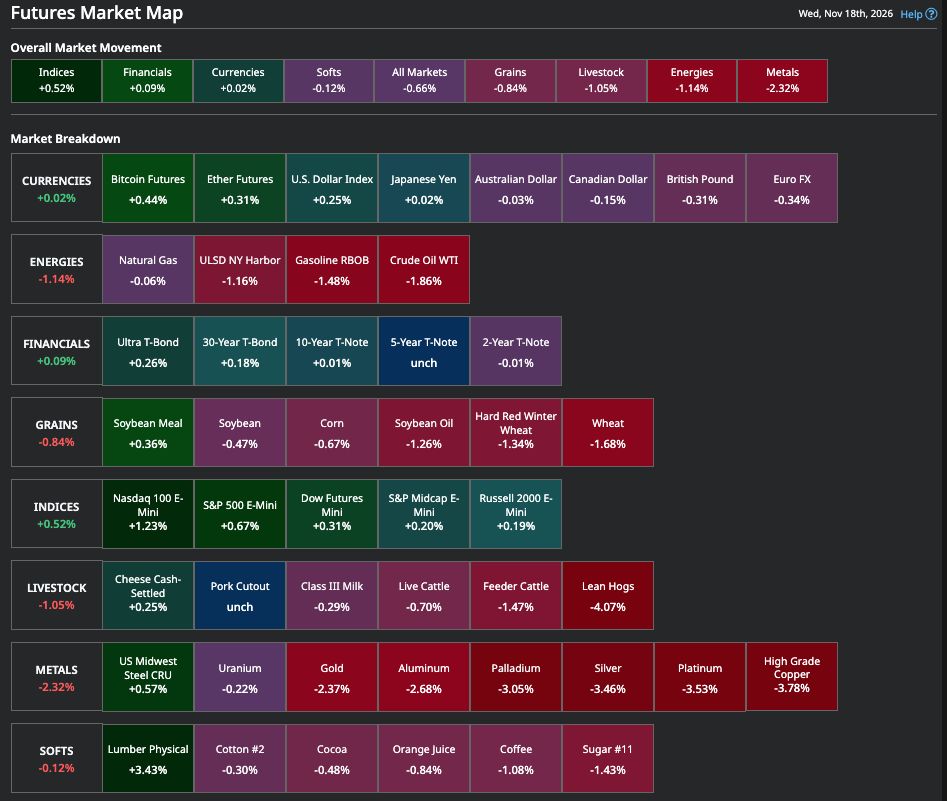
Morning Summary: A look at the Barchart Futures Market Heat Map to start the day shows the commodity complex is mixed. However, the three sectors in the green – Indices (US stock index futures), Financials (US Treasury futures), and Currencies (including Bitcoin and Ether futures, for whatever reason) – are not what we first think of when the subject of ‘commodities’ comes up. That’s everything else wearing colors other than green pre-dawn Wednesday. Hardest hit overnight was Metals with Dr. Copper (HGZ26) the economic indicator down 3.8% and silver (SIZ26) following close behind with a loss of 3.5%. The selloff in King Gold (GCZ26) seems mild by comparison with the December issue down 2.4%. Why are metals continuing to get hammered? Believe or not it has to do with increasing fears of inflation. These fears have lit a fire underneath the US dollar, the Index ($DXY) hitting a high of 103.86 overnight, its highest mark since March 3, 2025. Given the key fundamental of the dollar, or any country’s currency, is interest rates, the fact US Treasury yields are lower stands out. As for US stock indexes, Tuesday saw the S&P 500 ($INX) take out its previous 4-month low and close below its 200-day moving average. How did futures respond? By rallying overnight, of course.
Corn: Like most markets in the commodity complex, corn was in the red to start the day. With first notice day drawing nearer at the end of the month, the December issue (ZCZ26) was down 2.75 cents after dropping as much as 4.0 cents overnight. The March issue (ZCH27) is down 2.25 cents at this writing after losing as much as 3.5 cents. Trade volume for both was light at 17,000 and 16,000 contracts respectively. This being a Wednesday, it is the first day of the new noncommercial positioning week. At Tuesday’s close the March issue was down 2.25 cents, but we have to keep in mind the previous Tuesday was a USDA Keno game (WASDE report) day meaning our read on what funds were doing could be skewed again. Recall the previous positioning week saw March finish with a gain of 5.25 cents after March closed Keno Day 9.25 cents in the green. The latest Commitments of Traders report, for the week ending Tuesday, November 10 (Keno Day), still showed a decrease of 28,520 contracts in the noncommercial net-long futures position. As mentioned in Weekly Analysis, the net-long futures position of 109,075 contracts was the smallest since 100,980 contracts on Tuesday, July 7. Fundamentally, corn remains neutral.
Soybeans: The soybean market was also in the red pre-dawn Wednesday, also on light overnight trade volume. The January issue (ZSF27) was sitting 4.0 cents lower at this writing after posting a 13.5-cent trading range, from up 4.25 cents to down 9.25 cents on trade volume approaching 20,000 contracts. The front page of this morning’s financial news highlights the US president’s trip to China to meet with the Chinese President Xi and Russia’s Putin[i] (aka Vlad the Invader)[ii]. The secondary teaser grabbed my attention, “China’s Xi calls for removing trade and investment barriers ahead of meeting with (the US president) and Putin”. Given both branches of the US Congress will soon be under the control of the opposing party, will the US president make a ‘deal’ with China in the decade-old trade war? Will such a ‘deal’ be just another empty boast, similar to Phase One and all the rest we’ve heard over the past 10 years? Will the recent downturn in US stock markets influence the US president given he views indexes as ‘the economy’? I don’t know the answer to any of these questions, but we will find out together over the coming days. It’s interesting to note fundamentally, the soybean market remains bullish.
Wheat: The wheat sub-sector was in the red across the board to start the day. Why? Well, because it is a Watson Wednesday and all three markets finished Turnaround Tuesday with strong gains. As for the concluded Tuesday-to-Tuesday positioning week, March SRW (ZWH27) finished with a gain of 5.0 cents after closing 9.25 cents higher yesterday. This indicates Watson may have covered some of its net-short futures position, last reported at 60,040 contracts. The March HRW issue (KEH27) closed yesterday’s session 15.0 cents in the green, pushing its positioning week gain to only 2.75 cents. That isn’t much but still hints at a round of noncommercial short-covering. Over in HRS the March issue (MWH27) closed Tuesday 7.75 cents in the green with a positioning week gain of 4.0 cents, also indicating Watson covered some of its net-short futures position last reported at 9,120 contracts. Why would funds be covering shorts at a time when fundamentals are not bullish? As discussed in Tuesday’s Afternoon Commentary, some of the activity could be tied to the breakdown in US stock indexes creating margin calls, leading to liquidation of positions in other investment sectors like commodities. In other news, rains are in the extended forecast for the US Southern Plains.
[i] I have been questioned over my calling this trio The Three Amigos, but I think evidence, and history remains on my side.
[ii] A side teaser reads, “Ukraine allies reject ‘stupid’ U.S. criticism of deep strikes inside Russia”. Again, the U.S. administration doesn’t even try to hide its alliance with and admiration for Russia at this point.
On the date of publication, Darin Newsom did not directly have a position in any of the securities mentioned in this article. All information and data in this article is solely for informational purposes. For more information please view the Barchart Disclosure Policy here.
More news from Barchart
What Might the Break in the S&P Mean for the Commodity Complex? Will Soybeans Continue to Follow Oil and Oil Product Prices? What is the 2027 Outlook for the Grains Sector? Will Jensen Huang’s Chinese Spy Scandal Hurt Corn, Soybean and Wheat Prices?