

Cisco Systems (CSCO) has long worn the label of a mature networking giant, rarely linked to rapid growth. Yet now, the company is shaking up Wall Street’s expectations. Fueled by a wave of artificial intelligence (AI) infrastructure investment, strong enterprise demand, and an exceptional quarter, Cisco has prompted HSBC to abandon its cautious stance, upgrade the stock to “Buy,” and raise its price target to $133.
With the bank forecasting nearly 40% upside, Cisco’s growth revival is quickly becoming impossible to ignore. Let's take a closer look.
More Top Stocks Daily: Go behind Wall Street’s hottest headlines with Barchart’s Active Investor newsletter.
HSBC’s Change of Heart Has a Clear Catalyst
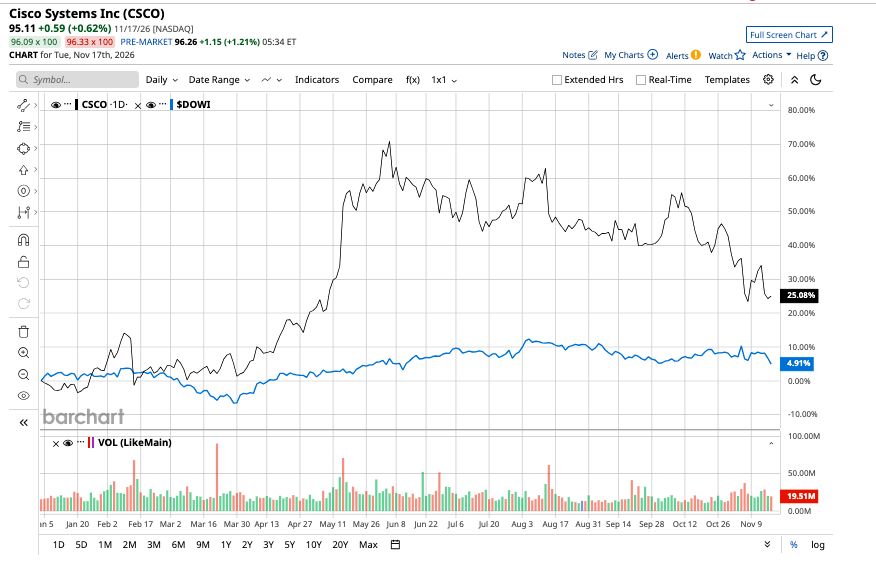
On Nov. 17, HSBC raised CSCO stock to “Buy” from “Hold” and increased its price target to $133 from $120. The new target implies approximately 40% potential upside from current levels. The move is notable because HSBC had downgraded Cisco stock from “Buy” to “Hold” in August, cutting its target from $137 to $120. Its latest upgrade reverses that decision, driven by a stronger networking outlook, firmer AI-related demand, and a valuation it considers attractive relative to growth.
HSBC expects Cisco’s networking revenue to compound at 19.2% annually from fiscal 2026 through fiscal 2029. The firm also forecasts adjusted EPS to grow 14.9% annually from fiscal 2026 through fiscal 2031. The $133 price target applies a 23 times multiple to the estimated next-12-month adjusted EPS of $5.78. In other words, the valuation depends on earnings growth continuing and investors maintaining that earnings multiple.
 www.barchart.com
The Quarter Was Strong Because Demand Reached Beyond AI
Cisco’s first quarter of fiscal 2027 performance encouraged HSBC to shift from caution to a more optimistic stance. The company reported $18.5 billion in revenue, up 24% year-over-year (YOY). Adjusted EPS rose 40% YOY to $1.40, while adjusted operating margin reached 37.8%. CFO Mark Patterson said the company exceeded the high end of its guidance for revenue, operating margin, and EPS. Cisco focused not just on shipping more equipment but on turning the stronger quarter into higher profitability.
Product revenue rose 32% YOY to $14.7 billion, while services revenue grew just 1% to $3.9 billion. Networking stole the spotlight with a remarkable 43% increase, while security, collaboration, and software each posted steady gains of 7%, 8%, and 8%, respectively, with software reaching $6.1 billion. Clearly, hardware drove this acceleration, not services.
Orders provide an important check on revenue momentum. Product orders climbed 21%, backed by double-digit growth across every region. Service provider and cloud orders soared 47%, while enterprise and public-sector orders advanced 15% and 13%. Networking orders surged 28%, marking its ninth-straight quarter of double-digit gains. This broad-based recovery reduces reliance on hyperscalers.
The order picture also extends into traditional networking. Campus networking orders increased 14%, and telecom orders rose 20%. Cisco is benefiting not only from new AI data centers but also from customers upgrading enterprise networks and connectivity. These projects can broaden the addressable demand pool and make the growth profile less dependent on the timing of a few large AI deployments.
Nonetheless, hyperscalers still remain the biggest growth catalyst. Cisco projects $9 billion in AI infrastructure sales to these customers in fiscal 2027, up from about $4 billion in fiscal 2026 and higher than its earlier $7.5 billion forecast. Management pointed to stronger orders, better visibility, and three AI design wins with Silicon One systems and 1.6-terabit optics.
Cisco ended the quarter with $46.2 billion in remaining performance obligations (RPO), up 8% YOY, and annual recurring revenue (ARR) of $32.7 billion, up 4%. Subscription revenue accounted for 44% of sales. No doubt, there is a sharp gap between hardware and services growth, but these numbers also reflect a steadier revenue foundation as networking equipment demand moves through its cycle.
Upbeat Outlook Adds to the Bullish Case
Cisco raised its fiscal 2027 revenue guidance to $74.8 billion to $75.8 billion and adjusted EPS to $5.47 to $5.53. The revenue midpoint implies roughly 19% YOY growth. For Q2, management expects revenue of $18 billion to $18.2 billion and EPS of $1.34 to $1.36.
Yet the quarter revealed a price to pay. Adjusted gross margin edged down to 65.6%, and product gross margin slipped to 63.7%. Management pointed to a heavier hardware mix and rising memory costs, with some relief from productivity gains and pricing. The very products fueling growth are, for now, less profitable than those they are replacing. Management remains confident it will reach a 36% adjusted operating margin for fiscal 2027, up from 34.8% in fiscal 2026, suggesting productivity and scale gains could help offset mounting pressures.
Operating cash flow surged 36% to $4.4 billion, highlighting strong financial momentum. Now, all eyes are on whether rising memory and component costs will persist as hardware claims a bigger slice of sales. Cisco returned $3.7 billion to shareholders during the quarter through dividends and share buybacks, showing its capacity to generate strong cash flow while fueling growth and rewarding investors.
The $9 Billion AI Opportunity Is Not Free of Its Costs
Cisco’s AI forecast depends on customers deploying systems on schedule. Management flagged optics supply as a potential constraint, while the second half of the year will test the company with tougher benchmarks. Delayed hyperscaler projects could shift revenue between quarters, and lower gross margins may limit how much sales growth reaches earnings. These risks lurk behind that bullish forecast.
Basically, HSBC is betting networking growth isn't a one-quarter spike. Its 19.2% compound annual growth rate (CAGR) forecast and $133 price target rest on the belief that AI infrastructure and broader networking demand will keep powering ahead. While some analysts have cut their price targets, they have also acknowledged the strong results and retained bullish ratings.
Cisco Must Prove It Can Keep Growth on Track
Cisco’s story extends far beyond the $9 billion AI forecast. Surging networking revenue, strong orders from diverse customers, and rising guidance fuel its growth engine. The challenge is turning this demand into profitable sales while managing component costs and supply constraints. The next quarters will reveal whether Cisco can turn orders into deliveries, stabilize margins, and meet its ambitious EPS targets. If the company delivers, CSCO stock can hit HSBC’s bullish target of $133 or even the Street's high price estimate of $150.
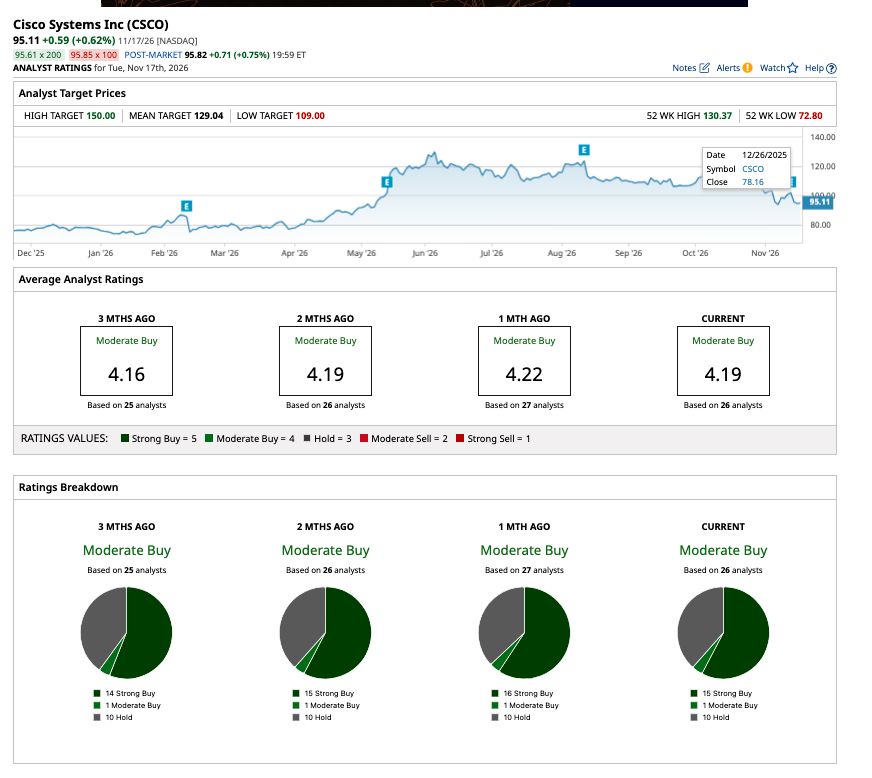
Overall, Cisco stock holds a consensus "Moderate Buy” rating on Wall Street. Of the 26 analysts covering the stock, 16 have a “Strong Buy,” one has a “Moderate Buy,” and nine have a “Hold” rating. The average price target sits at $129.65, suggesting a possible 37% climb, while the most bullish estimate of $150 implies potential upside of 58% from current levels.
 www.barchart.com
On the date of publication, Sushree Mohanty did not directly have a position in any of the securities mentioned in this article. All information and data in this article is solely for informational purposes. For more information please view the Barchart Disclosure Policy here.
More news from Barchart
HSBC Just Turned Bullish on Cisco Stock Again. Here’s Why It Expects 40% Upside. Paul Tudor Jones’ Initiates a New Position in This Profitable Midcap Tech Stock Dan Loeb’s Third Point Exits Its Entire Stake in Amazon Stock. Where It Invested Instead. Nvidia Without Jensen Huang: Strong Growth and Attractive Valuation Sustain the Bull Case