


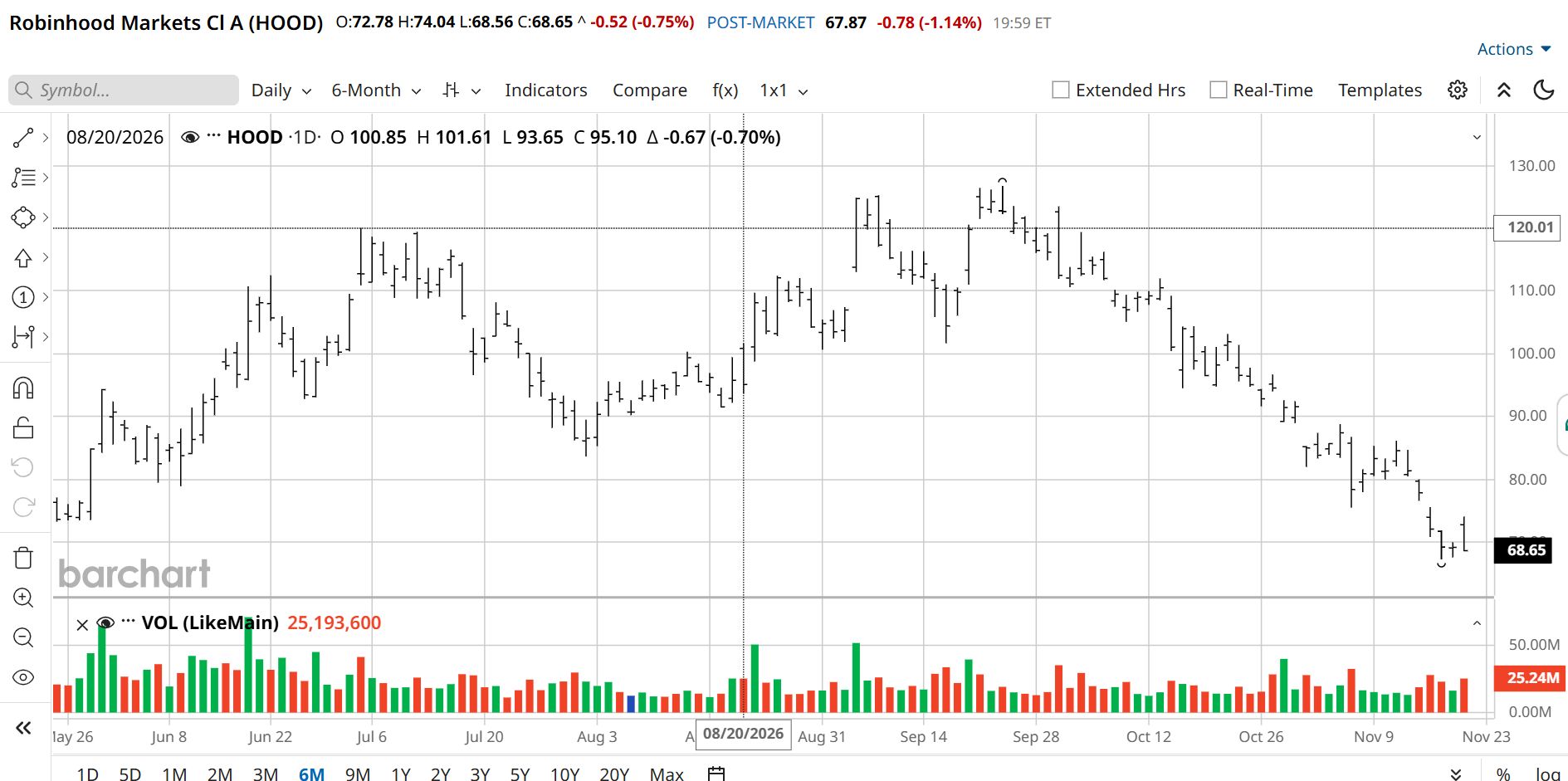
Prediction market platform Kalshi intends to start allowing users to trade stocks on its platform in the coming months, according to a report from the Wall Street Journal on Nov. 16. In combination with slumps in both the equity and cryptocurrency markets, the Kalshi stock-trading news has helped contribute to a 36% decline in Robinhood (HOOD) stock over the past month.
Still, both the characteristics of Kalshi's user base and history suggest that competition from the platform may not be much of a problem for Robinhood. Equities are also likely to recover over the longer term. Meanwhile, although the outlook for crypto is not promising, the valuation of HOOD stock already bakes in the impact of a sharp downturn in cryptocurrency revenue for the company.
More Top Stocks Daily: Go behind Wall Street’s hottest headlines with Barchart’s Active Investor newsletter.
As a result, buying HOOD stock on weakness could be a good idea for growth-at-a-reasonable-price (GARP) investors. Let's take a closer look.
 www.barchart.com
Why Kalshi May Not Be a Major Problem for Robinhood
According to reports from earlier this year, roughly 75% of Kalshi's user base has never deposited funds with the platform, instead using Kalshi to track markets. What's more, the customers who do deposit funds on Kalshi are likely much more interested in sports than finance; about 80% of bets on the platform have historically related to sports. So, it remains to be seen just how many customers will uptake stock trading on Kalshi.
Meanwhile, Robinhood has managed to become quite profitable and grow rapidly despite facing many tough competitors in its market. That includes Interactive Brokers (IBKR), Coinbase (COIN), and Charles Schwab (SCHW). While a new challenger in the form of Kalshi could potentially take away market share, Robinhood is certainly not a stranger to competition.
A Rebound in Equities and Robinhood Stock's Attractive Valuation
Over the longer term, equities should emerge from the deep slump that has been triggered by the artificial intelligence (AI) selloff and the recent resignation of Nvidia (NVDA) CEO Jensen Huang. Powerful demand for Anthropic (ANT) stock amid its initial public offering (IPO) indicates that investor interest in highly successful AI firms remains elevated, while the blistering growth of Anthropic's revenue suggests that businesses are continuing to rapidly increase how much they spend on AI.
With these points in mind, I believe the fundamentals of the AI sector remain sound and that many AI stocks will advance over the longer term. In turn, that should drive the stock market as a whole much higher. If the market rises meaningfully, HOOD stock should also perform very well.
Lastly, in the third quarter of fiscal 2026, crypto accounted for just 8.4% of Robinhood's total revenue, while analysts on average expect total revenue to surge 19% this year and 29% in fiscal 2027. HOOD stock currently changes hands at a relatively low forward price-to-earnings (P/E) ratio of 21 times compared to its historical average. Consequently, shares of Robinhood remain attractive even if we assume that the firm will lose most of its crypto business.
Overall, HOOD stock has a consensus “Strong Buy” rating on Wall Street based on 30 analysts with coverage.
On the date of publication, Larry Ramer did not directly have a position in any of the securities mentioned in this article. All information and data in this article is solely for informational purposes. For more information please view the Barchart Disclosure Policy here.
More news from Barchart
Why Robinhood’s Outlook Appears to Be Positive Despite the Kalshi Threat Intel Just Landed Its First 18A-P Chip Customer. What That Means for INTC Stock. AMD Gained From Nvidia’s China Scandal. Now a Short Seller Says AMD Has a China Problem Too. Leadership Risk vs. Record Numbers: Nvidia Posted $115 Billion in Revenue in Its First Report Without Jensen Huang. What It Means for NVDA Stock.