

Oil prices hovered near three-month lows on Tuesday as the war premium faded and supply concerns eased. Brent crude slipped below $90 per barrel, while WTI approached $80.
Now, traders are turning to a key OPEC+ meeting. Its decision could shape prices well into 2027.
What's Behind the Oil Slide
A war premium is the extra price traders pay to hedge against supply disruptions from military conflict. That premium is now fading fast.
On Monday, Brent fell 3.5% to $89.37, while WTI dropped 4.5% to $80.17. Early Tuesday, Brent traded near $88.67. Both benchmarks had topped $100 in October. In fact, Brent has dropped more than 23% over the past month.
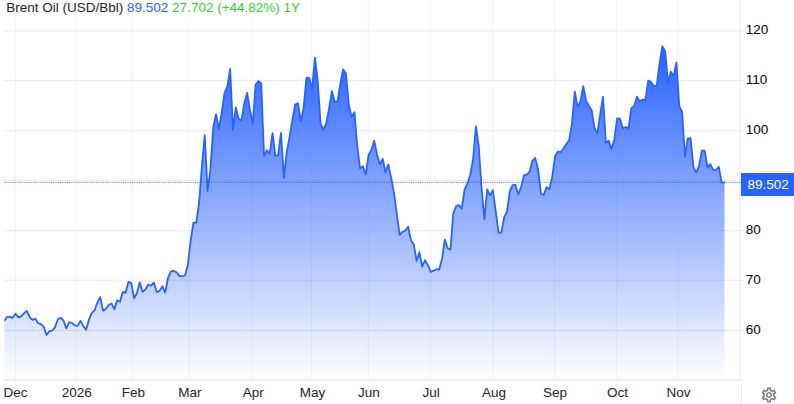 Brent Crude Price Performance. Source: TRADING ECONOMICS
Signs of possible diplomacy with Iran triggered the sell-off. President Donald Trump said he would give diplomacy more time but did not rule out renewed hostilities. As a result, traders unwound hedges over the weekend. Meanwhile, Libya resumed flows from its Sharara field after a pipeline reopened.
Even fresh risks failed to lift prices. Iran's Revolutionary Guard claimed that three tankers hit mines in the Strait of Hormuz.
However, traders largely dismissed the reports.
"Brent has largely lost any upward impetus in recent days as supply conditions remain benign," said DBS Bank's Suvro Sarkar.
The Hormuz crisis has caused the largest energy shock in history – by the end of May, oil supply losses already exceeded those of every previous major disruption.
— International Energy Agency (@IEA) November 20, 2026
And the longer the crisis lasts, the deeper the effects will be 👉 https://t.co/bjcDrCOOtb pic.twitter.com/2gtpMe1WQM
What Could OPEC+ Decide, and What Comes Next?
OPEC+ ministers will meet on November 29 to set production policy for 2027. Earlier this month, a core group kept December targets unchanged and paused quota hikes through year-end.
The backdrop looks challenging for producers. The IEA expects a global surplus of about 2 million barrels per day this quarter. Similarly, Goldman Sachs and Bernstein both anticipate oversupply ahead.
Supply flows remain uneven, though. Kpler data shows about 9.5 million barrels per day crossed Hormuz in the ten days to November 19. By comparison, October flows reached 12.2 million.
🛢️ OPEC's 11 members pumped about 20.4 million b/d of crude in the 3rd quarter, against 24.6 million a year earlier.
— Jack Prandelli (@jackprandelli) November 23, 2026
About 4 million b/d is gone.
The Gulf took the hit:
🇮🇷 Iran −33%
🇰🇼 Kuwait −26%
🇸🇦 Saudi Arabia −22% (9.7m to 7.5m)
🇮🇶 Iraq −15%
Members outside the Gulf… pic.twitter.com/pdDEdDa5V6
Other risks persist. Houthis claimed an attack on Saudi Arabia's Rabigh refinery, while Ukraine targeted Russian energy sites. Still, Sarkar warned that prices could climb again. At the same time, Saxo Bank's Ole Hansen noted that cheaper diesel eases inflation pressure.
That shift could reduce concerns about further rate hikes, which matters for stocks and crypto. For now, OPEC+ holds the next key move.
Read the Original story Why Are Oil Prices Falling to 3-Month Lows? by Luis Blanco at beincrypto.com