

TL;DR
PowerCompute mined 23.9 BTC in Q3, but lower average Bitcoin prices reduced revenue. A roughly $1 million purchase of 600 replacement miners targets about 10% more active hashrate by mid-December. The operating loss and going-concern disclosure remain relevant alongside improved mining margins.Producing more Bitcoin does not necessarily mean bringing in more dollars. PowerCompute’s latest quarterly results demonstrate that tension, while a new equipment order shows how the small US miner intends to improve output without building another power-hungry site.
The company reported higher Bitcoin production but lower revenue for the quarter ended September 30. It also disclosed a cash purchase of replacement machines that it expects to lift active hashrate by about 10%. The practical question is whether that additional computing work can earn enough to cover the equipment and the rest of the business.
Bitcoin production and revenue moved in opposite directions
In its November 13 results release , PowerCompute reported mining 23.9 BTC, up 35.8% from a year earlier. Revenue fell to approximately $1.9 million from $2.2 million as the average value of coins produced declined. Its stated mining margin improved to 50.7%, compared with 29% in the preceding quarter.
These measures answer different questions. Coin production describes the output of the mining operation. Revenue converts that production into dollars at the applicable values. Mining margin then considers a narrower set of operating costs; it does not automatically cover every salary, professional fee or equipment charge across the company.
A miner can improve at running machines and still struggle to generate a sustainable company-wide profit. Looking at all three measures makes that distinction visible.
The new machines replace equipment already on site
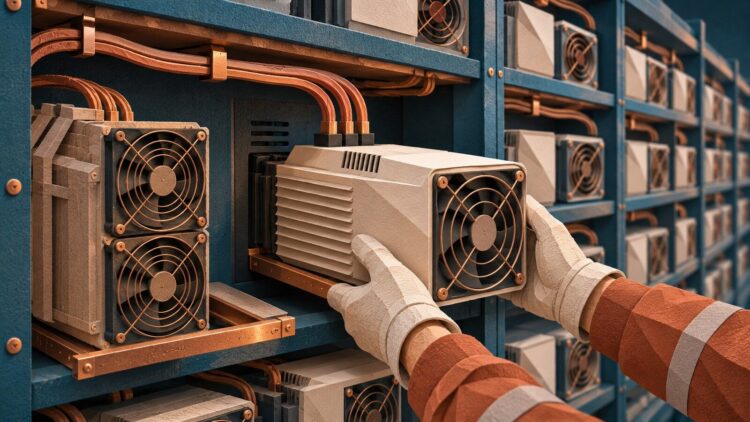
The new order comprises 600 Antminer S21++ units costing about $1 million, with deployment expected by mid-December. PowerCompute says replacing older machines at its Mississippi facility should add roughly 80–85 petahashes per second without additional power capacity. That is a management estimate, dependent on delivery and installation.
The attraction of a replacement programme is straightforward: it tries to squeeze more useful computation from an existing electrical connection. It can avoid some of the construction and interconnection work involved in adding an entirely new site. Installation still means downtime, and the advertised performance has to survive ordinary operating conditions.
Paying cash also puts the economic test close to home. The investment needs to justify money that could otherwise support operating expenses or remain available for unexpected repairs.
Efficiency matters as much as the machine count
PowerCompute’s September fleet-refresh announcement described an earlier generation of replacements that used about 21.5 joules per terahash, compared with roughly 34 for retired equipment. Those figures concern that earlier programme, rather than the newly ordered S21++ units.
The comparison explains why raw machine counts can mislead. Two fleets containing the same number of devices can consume different amounts of power and perform very different amounts of hashing. The relevant calculation combines electricity prices, actual efficiency, uptime and the share of the network’s work each miner contributes.
NewsBTC’s coverage of PowerCompute’s earlier debt repayment and production update also showed the role of curtailment. Sometimes selling or conserving electricity can be more attractive than running every machine continuously.
Improved mining results leave a wider financial test
The latest release still reported an operating loss of about $0.9 million despite net income near $0.4 million, and it referenced substantial doubt about the company’s ability to continue as a going concern. Those disclosures deserve attention alongside the better mining margin.
NewsBTC has covered other miners directing capital toward AI infrastructure . PowerCompute’s immediate equipment decision takes a different practical route: improve the Bitcoin output of power and sites it already operates.
The next useful checkpoints are delivered machines, sustained hashrate and cash generated after the upgrade. A larger production figure will be encouraging only if it comes with acceptable costs and enough liquidity to keep the operation running.
Written by the News Desk and edited by Samuel Rae.