


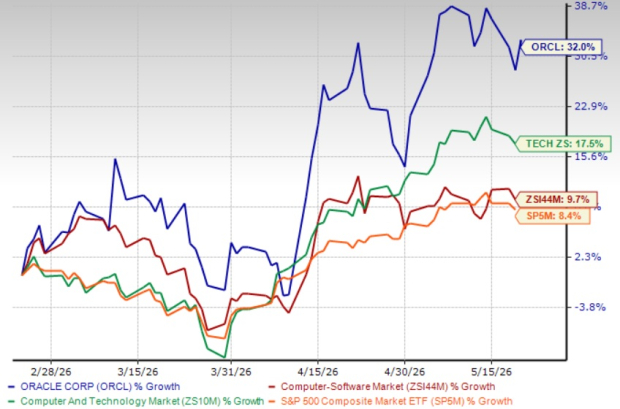
Oracle ORCL has generated significant investor enthusiasm in 2026, fueled by management's ambitious forward-looking targets and an AI infrastructure demand environment that continues to support accelerating cloud revenue growth. ORCL shares have returned 32% over the past three months, outperforming the Zacks Computer and Technology sector and the Zacks Computer - Software industry.
The company raised its fiscal 2027 revenue guidance to $90 billion, as AI compute and inferencing demand continues to outpace available supply — a structural tailwind it expects to sustain strong revenue growth across the medium and long term.
ORCL Outperforms Sector In 3-Months
Image Source: Zacks Investment Research
A Record-Breaking Quarter Validates the Strategy
Fiscal third-quarter 2026 results, reported March 10, 2026, offered strong evidence that Oracle's cloud and AI investments are converting to revenues at scale. Total revenues rose 22% in U.S. dollars to $17.2 billion — the first quarter in over 15 years where both organic total revenues and non-GAAP earnings per share each grew at 20% or more in USD. Cloud revenues climbed 44% in USD to $8.9 billion, with Cloud Infrastructure revenues surging 84% to $4.9 billion, while Cloud Application revenues reached $4.0 billion, up 13%. Non-GAAP earnings per share came in at $1.79, beating guidance, and GAAP net income reached $3.7 billion. Non-GAAP operating income grew 19% to $7.4 billion. Multicloud database revenues soared 531% year over year, and Remaining Performance Obligations ended at $553 billion, up 325% and $29 billion higher sequentially. Fusion Cloud ERP grew 17%, and NetSuite Cloud ERP expanded 14%. These third-quarter results broadly beat management's expectations across key metrics.
For fiscal fourth-quarter 2026, Oracle guided total revenues to grow between 19% and 21% in USD, with cloud revenues projected to expand 46% to 50% in USD and non-GAAP EPS of $1.96 to $2. Oracle also maintained its fiscal 2026 revenue target of $67 billion, holding its $50 billion capital expenditure plan unchanged. The board of directors declared a quarterly cash dividend of 50 cents per share, payable April 24, 2026, signaling commitment to shareholder returns.
The Zacks Consensus Estimate for fiscal 2027 earnings stands at $7.99 per share, indicating a 32.44% year-over-year growth.
Oracle Corporation Price and Consensus
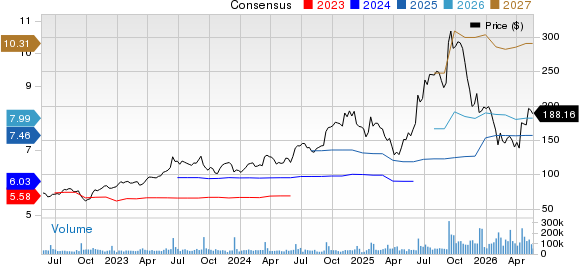
Oracle Corporation price-consensus-chart | Oracle Corporation Quote
Capital Commitments Cast a Long Shadow
The same momentum powering Oracle's top line is also fueling an extraordinary capital program that introduces considerable near-term financial risk. Oracle is committed to capital expenditures of $50 billion for fiscal 2026 alone. In February 2026, the company announced plans to raise up to $50 billion in debt and equity financing in calendar year 2026, quickly securing $30 billion through investment-grade bonds and mandatory convertible preferred stock. Management noted that large-scale AI contracts carry mechanisms — including customer prepayments and partner-supplied GPU and compute equipment — that partially decouple associated capital expenditures from Oracle's own cash. Nevertheless, the financing scale is striking. Software revenues, historically a reliable high-margin business, grew only 3% in USD to $6.1 billion, falling in constant currency. Cloud Applications revenues increased at a comparatively restrained 13%, highlighting that Oracle's explosive growth is concentrated primarily in infrastructure. Free cash flow is under pressure from the intensity of investment spending, and the growing debt load warrants careful ongoing monitoring from investors who expect profitability to keep pace with revenue ambitions.
Recent Announcements Underscore Strategic Range
Recent months have brought a steady stream of announcements from Oracle's newsroom, each reinforcing the company's deepening AI and cloud ambitions. Last month, Oracle expanded Oracle AI Database availability on Google Cloud to seven new regions, bringing the global total to 15 regions across 20 sites, and introduced Platinum and Diamond-tier availability tiers for Oracle AI Database to address the requirements of the most demanding mission-critical enterprise workloads.
Recently, Oracle reached an agreement with the U.S. Department of War to deploy advanced AI capabilities on classified networks, drawing on its 10 dedicated government cloud regions that span workloads from DISA IL2 through Top Secret and Special Access Program security levels — a development that signals growing traction in the highly lucrative federal AI market. On May 8, 2026, Oracle launched OCI Enterprise AI, offering access to frontier models including Grok 4.3 and NVIDIA Nemotron 3 Nano Omni, and confirmed SoftBank's deployment of OCI to support a sovereign cloud platform in Japan. These announcements collectively highlight Oracle's expanding addressable market, though operating successfully across classified, regulated and sovereignty-sensitive environments demands sustained execution discipline that the company must demonstrate over the coming quarters.
Valuation and Competitive Landscape
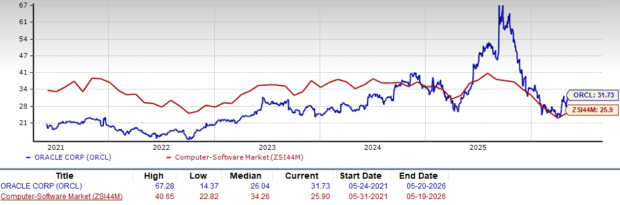
ORCL’s 32% rally over the past three months has stretched the stock's trailing 12-month P/E ratio to 31.73x, above the industry average of 25.9x, and Oracle carries a Value Score of D.
ORCL’s Premium Valuation Builds Concern
Image Source: Zacks Investment Research
In the highly contested cloud infrastructure market, Oracle competes against Amazon's AMZN AWS, Microsoft MSFT Azure, and Alphabet GOOGL-owed Google Cloud — three deeply capitalized rivals with vast AI capabilities. Amazon's global scale and customer base, Microsoft's embedded enterprise relationships, and Google's AI model leadership represent formidable competition. Amazon continues investing heavily in AI infrastructure, Microsoft is extending AI into every layer of its cloud suite, and Google is accelerating cloud expansion across verticals, significantly pressuring Oracle's pricing and market-share ambitions.
Conclusion
ORCL's near-term momentum is undeniable, driven by record Remaining Performance Obligations growth, accelerating cloud revenues and rapidly expanding government and enterprise partnerships. However, soaring capital commitments, declining earnings estimates, and intensifying competition from global cloud rivals make this Zacks Rank #3 (Hold) stock to hold — not aggressively accumulate — at current levels in 2026. You can see the complete list of today’s Zacks #1 Rank (Strong Buy) stocks here.
Zacks' Research Chief Names "Stock Most Likely to Double"
Our team of experts has just released the 5 stocks with the greatest probability of gaining +100% or more in the coming months. Of those 5, Director of Research Sheraz Mian highlights the one stock set to climb highest.
This top pick is a little-known satellite-based communications firm. Space is projected to become a trillion dollar industry, and this company's customer base is growing fast. Analysts have forecasted a major revenue breakout in 2025. Of course, all our elite picks aren't winners but this one could far surpass earlier Zacks' Stocks Set to Double like Hims & Hers Health, which shot up +209%.
Free: See Our Top Stock And 4 Runners UpWant the latest recommendations from Zacks Investment Research? Today, you can download 7 Best Stocks for the Next 30 Days. Click to get this free report
Amazon.com, Inc. (AMZN): Free Stock Analysis Report
Microsoft Corporation (MSFT): Free Stock Analysis Report
Oracle Corporation (ORCL): Free Stock Analysis Report
Alphabet Inc. (GOOGL): Free Stock Analysis Report
This article originally published on Zacks Investment Research (zacks.com).