

Eli Lilly LLY has emerged as a dominant force in the cardiometabolic market. Its revenues have become increasingly concentrated in its blockbuster GLP-1 franchise, with Mounjaro and Zepbound contributing nearly 65% of total revenues in the first quarter of 2026. The recent U.S. launch of Foundayo (orforglipron), LLY’s oral GLP-1 therapy for obesity, is set to further increase this dependence, with second-quarter sales expected to push GLP-1 therapies' contribution over the 65% mark.
To diversify its revenue base beyond GLP-1 therapies, Lilly secured approvals and launched several other new therapies over the past few years.Omvoh for inflammatory bowel diseases (ulcerative colitis and Crohn’s disease), Jaypirca for hematologic cancers [mantle cell lymphoma (MCL) and chronic lymphocytic leukemia (CLL)], Ebglyss for moderate-to-severe atopic dermatitis, Kisunla for early symptomatic Alzheimer's disease (AD) and Inluriyo for metastatic breast cancer. These are making meaningful contributions to sales growth. Management expects these products, alongside Mounjaro and Zepbound, to remain key growth drivers in 2026. A broader portfolio reduces Lilly's dependence on its flagship GLP-1 medicines and partially offsets the pressure to sustain exceptional growth from Mounjaro and Zepbound alone.
Lilly is also working to extend the commercial potential of its marketed portfolio through multiple label-expansion programs. Ebglyss is in phase III development for perennial allergens and chronic rhinosinusitis with nasal polyps, while Kisunla is being studied in late-stage studies for cognitively unimpaired AD. Jaypirca is also being evaluated in earlier lines of therapy to broaden its use in CLL and MCL. Meanwhile, Jardiance has steadily expanded beyond diabetes, securing approvals for heart failure with reduced and preserved ejection fraction in 2021 and 2022, respectively, followed by chronic kidney disease in 2023.
Jaypirca was initially approved for later-line CLL/SLL and has since expanded its commercial opportunity through successive regulatory approvals and label expansions. In late 2025, the FDA approved the drug for patients with relapsed or refractory CLL/SLL, previously treated with a covalent BTK inhibitor. This significantly expanded its eligible patient population. More recently, the European Medicines Agency's Committee for Medicinal Products for Human Use (CHMP) recommended approving Lilly's application to expand Jaypirca's use to adults with CLL across all lines of therapy, regardless of prior BTK inhibitor treatment. The application is now awaiting a final decision from the European Commission, which typically follows CHMP recommendations. Lilly is also awaiting an FDA decision on a similar label-expansion filing later this year. If approved, these regulatory milestones would further strengthen Jaypirca's growth prospects and support Lilly's long-term revenue expansion.
While obesity therapies are expected to remain Lilly's primary growth engine, the company is steadily diversifying its revenue base beyond GLP-1 through newly launched medicines and label expansions, creating a more balanced and sustainable long-term growth profile. Lilly is also complementing this strategy with an aggressive M&A push, announcing more than $20 billion in acquisitions and partnerships across oncology, neuroscience, cardiovascular disease, gene editing and vaccines in 2026. These investments should further diversify its future growth drivers and reduce its long-term dependence on its blockbuster GLP-1 franchise.
Lilly's GLP-1 Franchise Faces Rising Competitive Pressure
Eli Lilly and Novo Nordisk NVO presently dominate the obesity market. Mounjaro and Zepbound directly compete with NVO’s semaglutide medicines, Ozempic for T2D and Wegovy for obesity. Like Eli Lilly, Novo Nordisk also generates a substantial portion of revenues from both drugs, underscoring the importance of building additional revenue streams beyond GLP-1 therapies to support sustainable long-term growth.
Novo Nordisk gained approval for an oral version of its obesity drug, Wegovy, in December 2025 and launched the pill in January 2026, giving it a first-mover advantage over Foundayo. However, Lilly may be able to close the gap quickly now that it has launched Foundayo. The GLP-1 space is also attracting new contenders to challenge the incumbents. Smaller biotech firms, like Viking Therapeutics VKTX and Structure Therapeutics GPCR, are also advancing GLP-1–based therapies to challenge the incumbents.
Viking Therapeutics’ dual GIPR/GLP-1 receptor agonist, VK2735, is being developed both as oral and subcutaneous formulations for the treatment of obesity. Viking Therapeutics plans to advance oral VK2735 into phase III development for obesity in the fourth quarter of 2026.
Structure Therapeutics’ phase II ACCESS study on its orally administered GLP-1 RA, aleniglipron, demonstrated significant weight loss across all doses. Structure Therapeutics expects to initiate the late-stage program of aleniglipron in obesity in the second half of 2026.
LLY’s Stock Price, Valuation and Estimates
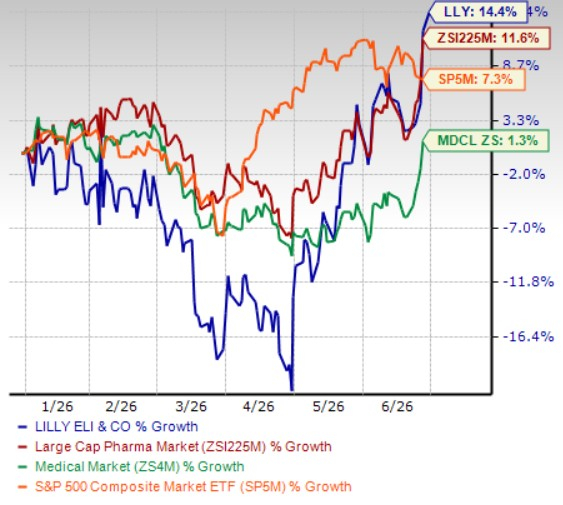
Shares of Eli Lilly have gained 14.4% year to date compared with the industry’s 11.6% growth. During the same time frame, the company has also outperformed the sector and the S&P 500, as seen in the chart below.
LLY Stock Price Movement
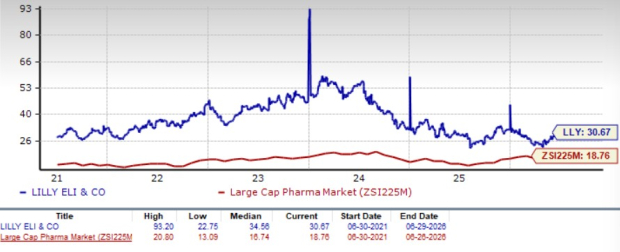
From a valuation standpoint, LLY stock is expensive. Going by the price/earnings ratio, the company’s shares currently trade at 30.67 forward earnings, higher than 18.76 for the industry. However, the stock is trading below its five-year mean of 34.56.
LLY Stock Valuation
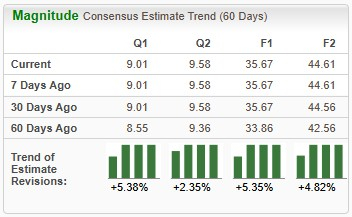
Estimates for Eli Lilly’s 2026 earnings have improved from $33.86 to $35.67 per share in the past 60 days, and estimates for 2027 earnings have improved from $42.56 to $44.61 per share over the same time frame.
LLY Estimate Movement
Eli Lilly currently carries a Zacks Rank #3 (Hold). You can see the complete list of today’s Zacks #1 Rank (Strong Buy) stocks here.
Radical New Technology Could Hand Investors Huge Gains
Quantum Computing is the next technological revolution, and it could be even more advanced than AI.
While some believed the technology was years away, it is already present and moving fast. Large hyperscalers, such as Microsoft, Google, Amazon, Oracle, and even Meta and Tesla, are scrambling to integrate quantum computing into their infrastructure.
Senior Stock Strategist Kevin Cook reveals 7 carefully selected stocks poised to dominate the quantum computing landscape in his report, Beyond AI: The Quantum Leap in Computing Power .
Kevin was among the early experts who recognized NVIDIA's enormous potential back in 2016. Now, he has keyed in on what could be "the next big thing" in quantum computing supremacy. Today, you have a rare chance to position your portfolio at the forefront of this opportunity.
See Top Quantum Stocks Now >>Want the latest recommendations from Zacks Investment Research? Today, you can download 7 Best Stocks for the Next 30 Days. Click to get this free report
Eli Lilly and Company (LLY): Free Stock Analysis Report
Novo Nordisk A/S (NVO): Free Stock Analysis Report
Viking Therapeutics, Inc. (VKTX): Free Stock Analysis Report
Structure Therapeutics Inc. Sponsored ADR (GPCR): Free Stock Analysis Report
This article originally published on Zacks Investment Research (zacks.com).