


Physical stores remain vital as shopping venues, pickup and return locations, and fulfillment centers, increasing the appeal of well-located retail space. Phillips Edison & Company, Inc. PECO, Tanger Inc. SKT and American Assets Trust, Inc. AAT could benefit from these trends. However, economic and geopolitical uncertainty may weigh on discretionary spending and leasing demand.
Industry Description
The Zacks REIT and Equity Trust - Retail industry comprises REITs that own, develop, manage and lease various retail properties, including regional malls, outlet centers, grocery-anchored shopping venues and power centers with big-box retailers. Net lease REITs focus on freestanding properties, where tenants bear rent and most operating expenses. Retail REIT performance is significantly impacted by economic conditions, employment levels and consumer spending trends. Key drivers of demand include the geographic location of properties and the demographics of surrounding trade areas. While the industry faced significant challenges from declining foot traffic, store closures and retailer bankruptcies in the past, it is now experiencing a rebound, driven by renewed consumer interest in in-store shopping, signaling a positive shift in the retail landscape.
What's Shaping the Future of the REIT and Equity Trust - Retail Industry?
Need-Based and Value Retail Will Lead Growth: Retail REITs are likely to benefit most from tenants that serve household needs. Grocery stores, discount chains, health and wellness businesses and other value-focused retailers attract customers because they offer useful products at practical prices. These businesses generate repeat visits, which helps shopping centers maintain traffic and supports nearby tenants. As retailers become careful about where they open new stores, landlords with the right tenant mix should remain in a stronger position. Properties anchored by essential and value-oriented businesses can offer stable leasing demand and are better protected when consumer confidence weakens. This trend gives landlords a chance to fill available space with tenants that match changing shopping habits. Retail REITs that focus on convenience, affordability, and everyday services should therefore be better placed to grow and maintain occupancy.
Limited New Supply Will Support Existing Properties: The limited amount of new retail construction is another positive force shaping the industry. With fewer projects entering the market, existing shopping centers face less competition for tenants. Retailers looking to expand have a limited choice of locations, which is helping landlords protect occupancy and maintain rental growth. This supply advantage is useful because the market is less likely to become oversupplied. Owners are also focused on improving properties, updating layouts and bringing in stronger tenants rather than competing with newly built centers. Well-located properties with flexible space and local traffic are expected to continue to hold their value. For retail REITs, limited construction creates a supportive operating environment and gives established landlords more control over how they improve and position their portfolios.
Consumer Pressure May Create Uneven Results: The main concern is that consumer spending may become less reliable as households face higher living costs and economic uncertainty. Shoppers may continue to spend, but they are likely to become more selective and place importance on essentials, discounts and clear value. This could create a wider gap between different types of retailers. Businesses that depend on optional purchases may delay expansion, close weaker stores, or ask for more flexible lease terms. As a result, retail REIT performance may become less even across the sector. Landlords with strong finances, adaptable properties and tenants that meet everyday needs should manage the pressure effectively. However, owners with greater exposure to discretionary retail may face slower leasing, weaker demand and a risk of vacancies if consumer caution continues.
Zacks Industry Rank Indicates Bright Prospects
The Zacks REIT and Equity Trust - Retail industry is housed within the broader Zacks Finance sector. It carries a Zacks Industry Rank #95, which places it in the top 38% of 247 Zacks industries.
The group’s Zacks Industry Rank, which is the average of the Zacks Rank of all the member stocks, indicates robust near-term prospects. Our research shows that the top 50% of the Zacks-ranked industries outperform the bottom 50% by a factor of more than 2 to 1.
The industry’s positioning in the top 50% of the Zacks-ranked industries is a result of the upward funds from operations (FFO) per share outlook for the constituent companies in aggregate. Looking at the aggregate FFO per share estimate revisions, it appears that analysts are gaining confidence in this group’s growth potential. Over the past year, the industry’s FFO per share estimates for 2026 and 2027 have moved 2.20% and 3.40% north, respectively.
Before we present a few stocks that you may want to consider for your portfolio, let’s take a look at the industry’s recent stock market performance and valuation picture.
Industry Outperforms Sector and S&P 500
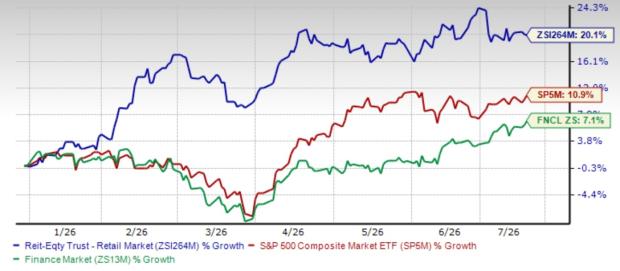
The REIT and Equity Trust - Retail Industry has outperformed the broader Zacks Finance sector as well as the S&P 500 composite so far in the year.
The industry has risen 20.1% during this period compared with the S&P 500’s increase of 10.9% and the broader Finance sector’s growth of 7.1%.
Year-To-Date Price Performance
Industry's Current Valuation
On the basis of the forward 12-month price-to-FFO, which is a commonly used multiple for valuing retail REITs, we see that the industry is currently trading at 16.84X compared with the S&P 500’s forward 12-month price-to-earnings (P/E) of 21.21X. The industry is trading marginally below the Finance sector’s forward 12-month P/E of 16.85X. These are shown in the chart below.
Forward 12 Month Price-to-FFO (P/FFO) Ratio
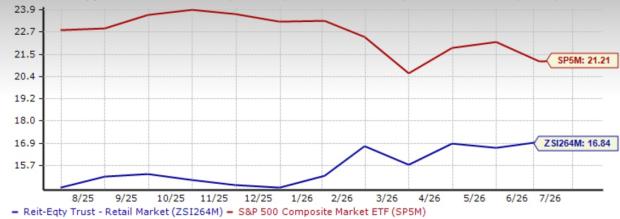
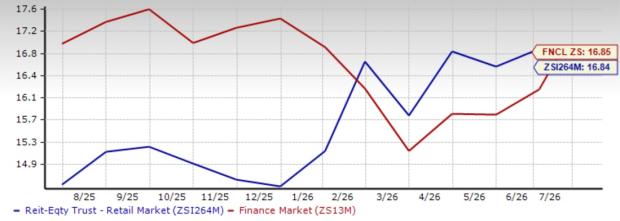
Over the last five years, the industry has traded as high as 18.72X and as low as 12.21X, with a median of 15.15X.
3 Retail REIT Stocks to Buy
Phillips Edison & Company: This REIT, based in Cincinnati, OH, is focused on grocery-anchored neighborhood centers and complementary everyday retail. It owns 326 properties totaling 36.9 million square feet across 31 states. The portfolio is 97% leased, with 94% of annualized base rent from grocery-anchored centers and 74% from necessity-based retailers.
PECO presents a resilient growth story built on essential spending, retailer demand and disciplined capital allocation. For this retail REIT, 82% of rent comes from centers anchored by the number-one or number-two grocer by sales, while portfolio markets average $101,000 in three-mile household income. Strong occupancy supports pricing power, with comparable renewal and new-lease spreads of 21.2% and 36.2% in the first quarter of 2026. A mostly fixed-rate debt profile, liquidity and development yields near 9-12% support durable cash-flow growth.
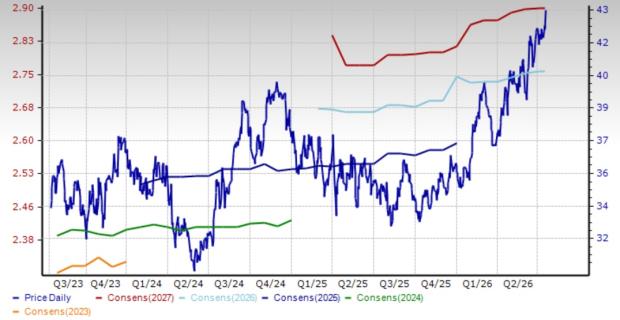
PECO currently carries a Zacks Rank #2 (Buy). Over the past three months, the Zacks Consensus Estimate for its 2026 and 2027 FFO per share has been revised upward to $2.76 and $2.90, suggesting increases of 6.15% and 5.14% year over year, respectively. The stock has risen 8.8% over the past three months. You can see the complete list of today’s Zacks #1 Rank (Strong Buy) stocks here.
Price and Consensus: PECO
Tanger: This Greensboro, N.C.-based REIT specializes in outlet and open-air retail destinations. With 45 years of experience, it operates 38 outlet centers and four lifestyle centers spanning nearly 17 million square feet across 22 U.S. states and Canada. Its properties host more than 3,000 stores, representing more than 800 brands and retail concepts, creating diversified shopping environments.
Tanger combines resilient operations, leasing momentum and balance-sheet flexibility. Portfolio occupancy stands near 97%, while average tenant sales reached $482 per square foot and blended rent spreads were 10.5% in the first quarter of 2026. Tenant affordability remains supported by a 9.7% occupancy-cost ratio. With net debt to adjusted EBITDAre of 4.8 times, entirely fixed-rate debt and more than $1 billion of liquidity, Tanger has the capacity to reinvest, pursue acquisitions and support shareholder returns.
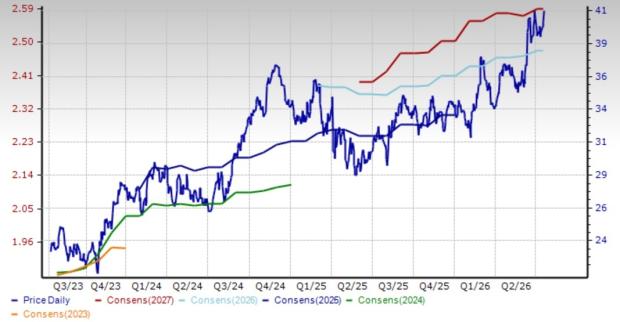
Tanger currently has a Zacks Rank #2. The Zacks Consensus Estimate for its 2026 FFO per share has been raised marginally over the past month to $2.48, indicating a 6.44% year-over-year increase. The stock has rallied 11% over the past three months.
Price and Consensus: SKT
American Assets Trust: This REIT, headquartered in San Diego, CA, has a diversified portfolio concentrated in high-barrier coastal markets. Its 31 properties span office, retail, multifamily and mixed-use assets across California, Washington, Oregon, Hawaii and Texas, totaling about 6.8 million square feet, 2,302 multifamily units and 369 hotel rooms. Its platform combines long-standing experience with in-house leasing, development and operations expertise.
AAT offers a compelling mix of asset quality, diversification and embedded upside. The portfolio benefits from locations with strong demographics, limited new supply and barriers to entry. An investment-grade balance sheet, 96% unsecured debt and roughly $618 million of liquidity provide flexibility, while no significant maturities until 2027 reduce refinancing pressure. Lease-up potential across the portfolio could add meaningful incremental FFO at stabilization.
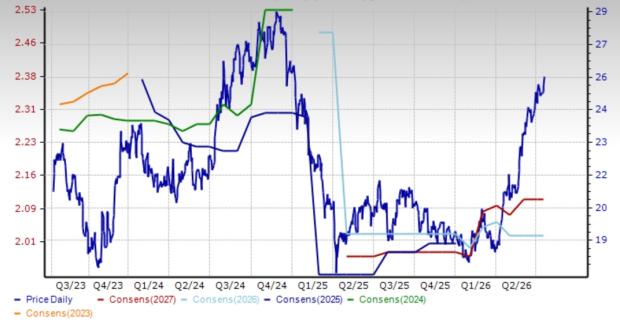
American Assets Trust currently carries a Zacks Rank #2. The Zacks Consensus Estimate for 2026 and 2027 FFO per share has witnessed upward revisions to $2.03 and $2.11, indicating a 1.50% and 3.94% increase year over year, respectively. The stock has appreciated 24.1% over the past three months.
Price and Consensus: AAT
Note: Funds from operations (FFO) is a widely used metric to gauge the performance of REITs rather than net income as it indicates cash flow from their operations. FFO is obtained after adding depreciation and amortization to earnings and subtracting the gains on sales.
Zacks' Research Chief Names "Stock Most Likely to Double"
Our team of experts has just released the 5 stocks with the greatest probability of gaining +100% or more in the coming months. Of those 5, Director of Research Sheraz Mian highlights the one stock set to climb highest.
This top pick is a little-known satellite-based communications firm. Space is projected to become a trillion dollar industry, and this company's customer base is growing fast. Analysts have forecasted a major revenue breakout in 2025. Of course, all our elite picks aren't winners but this one could far surpass earlier Zacks' Stocks Set to Double like Hims & Hers Health, which shot up +209%.
Free: See Our Top Stock And 4 Runners UpWant the latest recommendations from Zacks Investment Research? Today, you can download 7 Best Stocks for the Next 30 Days. Click to get this free report
Tanger Inc. (SKT): Free Stock Analysis Report
American Assets Trust, Inc. (AAT): Free Stock Analysis Report
Phillips Edison & Company, Inc. (PECO): Free Stock Analysis Report
This article originally published on Zacks Investment Research (zacks.com).