


Merck’s MRK blockbuster PD-1 inhibitor, Keytruda, approved for several types of cancer, is its key top-line driver, accounting for around 55% of the company’s pharmaceutical sales. Keytruda now holds more than 40 FDA-approved indications spanning 19 tumor types.
The drug has played an instrumental role in driving Merck’s steady revenue growth over the past few years. Keytruda is expected to remain Merck's primary growth driver in the second quarter of 2026. Investors will look out for Keytruda’s sales number when Merck announces second-quarter results on Aug. 4.
The Zacks Consensus Estimate for Keytruda’s sales is $8.06 billion. Keytruda is expected to continue delivering double-digit year-over-year growth in the second quarter. Its sales are likely to have been driven by strong demand across earlier-stage indications globally and continued strong momentum in metastatic indications. A favorable timing of wholesaler purchases benefited Keytruda’s sales in the first quarter, which is likely to be absent in the second.
Keytruda Qlex, the recently launched subcutaneous formulation of Keytruda, is also gradually contributing incremental sales. It added $128 million to Keytruda’s sales in the first quarter and the contribution is expected to be higher in the second.
Last quarter, Merck said that it was seeing an increase in usage of Keytruda in tumors that primarily affect women, including cervical, breast and endometrial cancers, as well as Keytruda in combination with Pfizer’s antibody drug conjugate, Padcev, in first-line, locally advanced or metastatic urothelial cancer. An update is expected on the upcoming conference call.
The company expects Keytruda’s growth to continue till it loses patent exclusivity in 2028. Keytruda’s core U.S. patent is expected to expire around 2028, with additional patents expiring slightly after that. Keytruda is expected to face significant biosimilar competition around 2028-2029. Once biosimilars enter, Keytruda’s sales are likely to decline sharply. Investors will also look for management commentary on long-term growth and Merck's strategy to offset Keytruda's LOE impact.
Key Competitors of Merck’s Keytruda
The closest and most direct competitor to Keytruda is Bristol Myers’ BMY Opdivo, another PD-1 inhibitor. Like Keytruda, Opdivo is approved across multiple tumor types, including non-small cell lung cancer (NSCLC), melanoma, renal cell carcinoma (RCC), head and neck cancer, bladder cancer and gastrointestinal cancers. Bristol Myers has strengthened Opdivo's competitive position through combination regimens such as Opdivo + Yervoy (ipilimumab) and newer fixed-dose combinations. Opdivo generated sales of $2.15 billion in the first quarter of 2026, down 5% year over year.
Another major competitor is AstraZeneca's AZN PD-L1 inhibitor, Imfinzi, particularly in lung cancer. AstraZeneca’s Imfinzi generated sales of $1.69 billion in the first quarter of 2026, up 30% year over year.
Roche RHHBY markets Tecentriq, another PD-L1 inhibitor competing with Keytruda in NSCLC, bladder cancer, liver cancer and certain breast cancers.
The longer-term competitive threat to Keytruda comes from dual PD-1/VEGF inhibitors that inhibit both the PD-1 pathway and the VEGF pathway at once. They are designed to overcome the limitations of single-target therapies like Keytruda. One of the most closely watched dual PD-1/VEGF inhibitor is Summit Therapeutics' ivonescimab, which it has licensed from Akeso.
MRK’s Price Performance, Valuation and Estimates
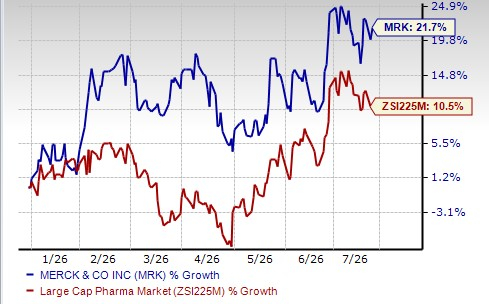
Merck’s stock has risen 21.7% so far this year compared with an increase of 10.5% for the industry.
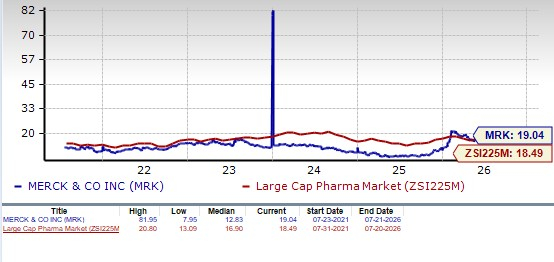
From a valuation standpoint, Merck is slightly expensive. Going by the price/earnings ratio, Merck’s shares currently trade at 19.04 forward earnings, higher than 18.49 for the industry as well as the stock’s five-year mean of 12.83.
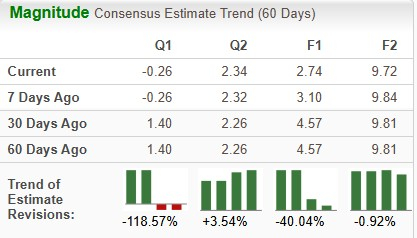
The Zacks Consensus Estimate for 2026 earnings has declined from $4.57 per share to $2.74 per share, while that for 2027 has declined from $9.81 per share to $9.72 per share over the past 30 days.
Merck has a Zacks Rank #4 (Sell) at present.
You can see the complete list of today’s Zacks #1 Rank (Strong Buy) stocks here.
Beyond Nvidia: AI's Second Wave Is Here
The AI revolution has already minted millionaires. But the stocks everyone knows about aren't likely to keep delivering the biggest profits. AI’s second wave is moving from infrastructure to implementation and these companies are at the forefront of this transition, positioned to become what Amazon and Google were to the internet era.
See Stocks Now >>Want the latest recommendations from Zacks Investment Research? Today, you can download 7 Best Stocks for the Next 30 Days. Click to get this free report
Merck & Co., Inc. (MRK): Free Stock Analysis Report
AstraZeneca PLC (AZN): Free Stock Analysis Report
Roche Holding AG (RHHBY): Free Stock Analysis Report
Bristol Myers Squibb Company (BMY): Free Stock Analysis Report
This article originally published on Zacks Investment Research (zacks.com).