


Capital One Financial Corporation COF used its second-quarter 2026 earnings call to keep investors focused on integration execution rather than headline earnings. Management’s central message was that Discover and Brex are already contributing, while the bigger payoff still sits on the other side of platform conversions.
That framing mattered because the quarter mixed strong credit, revenue growth and an earnings beat against a still-temporary Discover loan “brownout,” elevated investment spending and a lower capital ratio.
Second-quarter net income was $3 billion, or $4.73 per share. Adjusted earnings per share (EPS) were $5.81 after acquisition-related items. Adjusted EPS topped the Zacks Consensus Estimate of $4.85. Revenues rose 4% from the first quarter to $15.85 billion, beating the consensus estimate of $15.7 billion.
Capital One Financial Corporation Price, Consensus and EPS Surprise
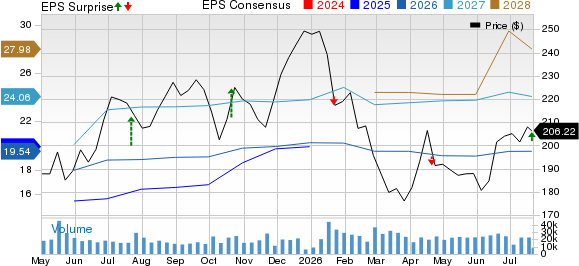
Capital One Financial Corporation price-consensus-eps-surprise-chart | Capital One Financial Corporation Quote
COF Keeps Discover on a 24-Month Clock
Richard Fairbank, founder, chairman, chief executive officer and president, kept the emphasis on Discover integration. He said Capital One is now 14 months into its planned 24-month integration, has completed the conversion of Capital One debit customers to the Discover network and has already captured the full quarterly run-rate of debit revenue synergies.
He added that second-quarter results included about one-third of the announced operating expense synergies and that the company remains on track for the full $2.5 billion target. That kept the call centered on timing and execution rather than on revisiting the strategic logic of the deal.
Capital One Balances Brownout and Growth
A Barclays analyst pressed management on when Discover card growth should reaccelerate. Fairbank said the current slowdown reflects Discover’s prior cutbacks in originations and line management, plus Capital One’s own tighter approach in parts of the portfolio, especially around high-balance revolvers.
He described that pressure as temporary and laid out the conversion schedule in more concrete terms than in prepared remarks. Fairbank said 50% of Discover originations are already on Capital One’s tech stack, with full front-book migration expected by the end of the third quarter.
The back book will move in waves during July, October and January, with full migration expected in the first quarter of next year. Fairbank said the bottom of the brownout should come around the fourth quarter of this year, after which Capital One expects its underwriting and spender-focused capabilities to support a return to growth.
COF Sees Early Brex Benefits
Brex was the other major strategic topic. Responding to Barclays, Fairbank said the company is more than 100 days into ownership and remains highly encouraged by Brex’s position in corporate cards, its infrastructure and its talent base.
He said Brex is already benefiting from Capital One’s brand, lower funding costs on the balance sheet and a new lead-sharing program across businesses. Management characterized the early results from that pipeline as promising, though the broader marketing and product push will take more integration work.
Fairbank also said Brex capabilities should eventually strengthen Capital One’s small-business card offering. For now, he framed most of the work as foundational, with more visible commercial impact still ahead.
Capital One Points to NIM Catch-Up
Chief financial officer Andrew Young gave one of the clearest pieces of near-term operating commentary in the Q&A. He said second-quarter net interest margin rose to 8.01%, helped by lower retail deposit costs and lower average cash, but ending cash fell much faster than average cash during the quarter.
That led him to point to a third-quarter “catch-up” in margin as average balances reflect the lower ending cash position. He also reminded investors that each quarter in the back half of the year carries one additional day, worth a 9-basis-point tailwind to NIM.
Young kept the outlook measured by noting that balance-sheet changes and rate moves can still affect margin in the short run. Even so, his comments gave investors a more specific bridge into the next quarter than most other parts of the call.
COF Defends Investment-Led Efficiency
Questions from KBW and Goldman Sachs focused on whether heavier spending could erode the economics of the Discover deal. Fairbank’s answer was consistent. Efficiency will remain pressured by technology, AI, Brex and travel investments, but management still expects earnings power after integration to align with what it outlined when the Discover deal was announced.
That stance was backed by operating context from the quarter. Total non-interest expense rose 7% sequentially to $9.0 billion, including an 11% increase in marketing, while Domestic Card expense rose 38% from a year earlier and companywide marketing climbed to about $1.7 billion.
Management did not offer a tighter efficiency target. Instead, Fairbank argued that the better way to judge the combined company is by the earnings power and growth capacity that should emerge once the integrations and tech investments mature.
Capital One Sticks to Long-Term Priorities
Capital management added another layer of restraint. A Goldman Sachs analyst asked whether buybacks could step up now that the major deal work is done, but Young said the company still views 11% as a long-term capital need, not a target to rush toward.
He said that view reflects internal modeling, growth plans, earnings accretion, regulatory uncertainty, stock price and macro conditions. The quarter ended with a common equity Tier 1 ratio of 13.7%, down 70 basis points from the first quarter, after buybacks, Brex and higher risk-weighted assets.
Taken together, the call left a clear impression of a company willing to accept near-term noise in exchange for integration, distribution and technology gains it believes will define the next leg of returns.
Zacks Signals for COF
COF carries a Zacks Rank #3 (Hold), along with a Value Score of A, Growth Score of C, Momentum Score of B and VGM Score of B, based on the provided Zacks data. That combination points to favorable value characteristics and decent all-around style traits, but a more neutral near-term earnings revision profile than a Zacks Rank #1 (Strong Buy) or Zacks Rank #2 (Buy). You can see the complete list of today’s Zacks #1 Rank stocks here.
The Style Score framework indicates that stronger letter grades are generally associated with better expected performance, and that VGM scores of A or B can be useful complements to the Zacks Rank over the next one to three months. Still, the Zacks Rank can change as analysts revise earnings estimates after the quarter, so the current setup should be viewed as a snapshot rather than a fixed signal.
Research Chief Names "Single Best Pick to Double"
From thousands of stocks, 5 Zacks experts each have chosen their favorite to skyrocket +100% or more in months to come. From those 5, Director of Research Sheraz Mian hand-picks one to have the most explosive upside of all.
This company targets millennial and Gen Z audiences, generating nearly $1 billion in revenue last quarter alone. A recent pullback makes now an ideal time to jump aboard. Of course, all our elite picks aren’t winners but this one could far surpass earlier Zacks’ Stocks Set to Double like Nano-X Imaging which shot up +129.6% in little more than 9 months.
Free: See Our Top Stock And 4 Runners UpWant the latest recommendations from Zacks Investment Research? Today, you can download 7 Best Stocks for the Next 30 Days. Click to get this free report
Capital One Financial Corporation (COF): Free Stock Analysis Report
This article originally published on Zacks Investment Research (zacks.com).