


SoFi Technologies SOFI is trying to become more than a digital lender, and its latest stablecoin moves give that strategy a clearer infrastructure angle. The September launch of the SoFiUSD settlement across Mastercard’s network takes the company from testing blockchain-based payments to using them in a live card program expected to handle more than $25 billion in annualized volume. The development makes the stablecoin story more relevant, even if its direct financial contribution is still early.
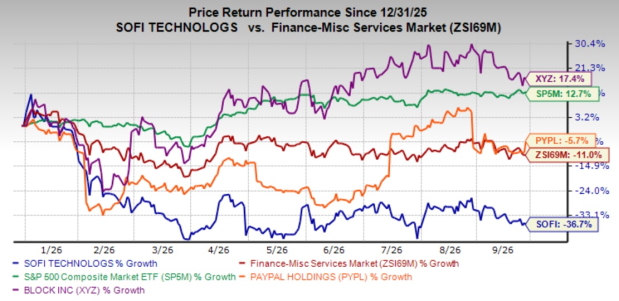
SOFI stock, however, has struggled despite the company’s operating momentum. As of Sept. 25, 2026, shares have fallen 36.7% year to date compared with a 5.7% decline for PayPal PYPL and a 17.4% gain for Block XYZ. The sharp underperformance suggests investors remain cautious about SoFi’s valuation and whether rapid business expansion can translate into sustainable earnings growth.
Meanwhile, the operating backdrop is strengthening. Record member growth, higher product adoption and rising fee-based revenues give SoFi’s newer digital-asset initiatives a larger platform from which to scale.
Year-to-date Stock Price Performance
Image Source: Zacks Investment Research
SoFiUSD Moves Into Live Commercial Settlement
The Mastercard rollout gives SoFiUSD a more meaningful real-world payments use case. SoFi Bank has begun migrating its full debit and credit card program to stablecoin settlement using SoFiUSD, with the program expected to process more than $25 billion in annualized volume.
Transactions are already live on blockchain rails, showing that the initiative has moved into commercial implementation. Merchants do not need to hold stablecoins or build new infrastructure to participate. SoFi is also discussing stablecoin-based settlement with large U.S. merchants, which could broaden adoption beyond its own card program.
Momentum is building on the institutional side as well. Payward will join the SoFi Exchange Network, list SoFiUSD on Kraken and use SoFi’s Big Business Banking capabilities, while SoFi will use Kraken Prime for digital-asset liquidity. In the second quarter, management said roughly $300 million of SoFiUSD was in circulation and that its first commercial clients were moving money in real time through the network. Wider adoption could support both net interest income and additional fee-based revenue opportunities.
SOFI’s Core Results Give New Businesses Room to Develop
The attraction is that SoFi does not need stablecoins to carry the near-term financial story. Second-quarter adjusted net revenues rose 40% year over year to $1.2 billion, adjusted EBITDA reached $358 million at a 30% margin, and fee-based revenues were $472 million, or 39% of adjusted net revenues. Members reached 15.8 million, and products climbed to 24.4 million, with cross-buy improving to 51%. Management also lifted 2026 adjusted net revenue guidance to $4.75 billion-$4.85 billion while maintaining about $1.6 billion of adjusted EBITDA.
This diversification matters. Private-market funds from CAZ Investments and AngelList, SoFi Plus, investing tools, lending and enterprise banking give SoFi more ways to monetize members beyond credit. PYPL remains more concentrated in payments, while XYZ combines Cash App and merchant services. However, SoFi is increasingly blending banking, lending, investing, payments and infrastructure in one model.
SOFI’s Estimate Revisions Depict an Improving Outlook
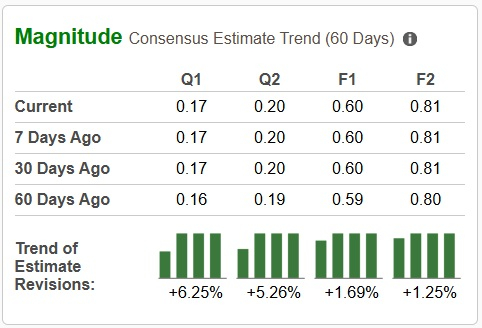
Over the past 60 days, estimates for SOFI’s 2026 and 2027 EPS have been revised marginally upward. The consensus mark for 2026 and 2027 EPS suggests a year-over-year increase of 53.85% and 35.91%, respectively.
Image Source: Zacks Investment Research
SOFI’s Valuation Still Points to a Premium
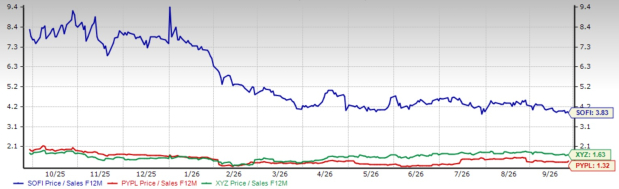
On a forward 12-month price-to-sales basis, SOFI continues to trade at a sizable premium to its close fintech peers. SoFi’s P/S F12M is at 3.83X compared with 1.32X for PayPal and 1.63X for Block.
The gap reflects SoFi’s much faster expected revenue growth. Estimates suggest SoFi’s 2026 revenues will increase about 35.52%, with another 20.16% rise expected in 2027, while PayPal’s growth profile is considerably slower.
Still, even after SOFI’s sharp share-price decline this year, investors are paying more than XYZ’s forward sales multiple and PYPL’s. This keeps valuation from looking outright cheap and supports a measured stance, while investors watch whether stablecoin adoption, fee-based revenues and broader platform growth can justify the premium.
Valuation
Image Source: Zacks Investment Research
What Should Investors Do With SOFI?
SOFI’s steep share-price decline has created a more balanced setup than earlier in the year. The core business continues to post strong revenue growth and improving profitability, while SoFiUSD is gaining real commercial use through Mastercard settlement, Big Business Banking and the Payward partnership.
At the same time, SOFI continues to command a clear valuation premium over PYPL and XYZ, and stablecoin-related revenues remain too early to quantify confidently. For existing investors, keeping current exposure while watching SoFiUSD adoption, fee-based revenue growth and earnings delivery appears reasonable. A stronger case for adding exposure would require further proof that these newer initiatives can materially contribute to profits.
At present, SOFI carries a Zacks Rank #3 (Hold). You can see the complete list of today’s Zacks #1 Rank (Strong Buy) stocks here.
Beyond Nvidia: AI's Second Wave Is Here
The AI revolution has already minted millionaires. But the stocks everyone knows about aren't likely to keep delivering the biggest profits. AI’s second wave is moving from infrastructure to implementation and these companies are at the forefront of this transition, positioned to become what Amazon and Google were to the internet era.
See Stocks Now >>Want the latest recommendations from Zacks Investment Research? Today, you can download 7 Best Stocks for the Next 30 Days. Click to get this free report
SoFi Technologies, Inc. (SOFI): Free Stock Analysis Report
PayPal Holdings, Inc. (PYPL): Free Stock Analysis Report
Block, Inc. (XYZ): Free Stock Analysis Report
This article originally published on Zacks Investment Research (zacks.com).