

Lyft (LYFT and Grab Holdings GRAB are well-known names in the Zacks Computer and Technology sector. Both companies provide ride-hailing services and have revolutionized the transportation industry with their innovative business models centered on ride-sharing.
Grab is a leading provider of deliveries, mobility and digital financial services in multiple cities across eight countries in Southeast Asia: Cambodia, Indonesia, Malaysia, Myanmar, the Philippines, Singapore, Thailand and Vietnam. Lyft, headquartered in San Francisco, has a more focused strategy, operating primarily in the United States and concentrating mainly on ride-sharing.
Given this difference in approaches and geographical focus of the two companies, let's examine closely to find out which one currently holds the edge, and more importantly, which might be the smarter investment now.
The Case for Grab
Recently, Grab signed a deal to purchase a controlling 60% equity interest in Atome Financial, the digital financial services platform of Advance Intelligence Group Limited ("AIGL"), for $1.49 billion in cash, out of which $0.26 billion is primary growth capital (Phase 1). The Phase 1 deal is being funded entirely from GRAB’s existing cash.
Subject to regulatory approvals and other customary closing conditions, the deal is anticipated to be completed by the third quarter of 2027. The buyout is anticipated to be accretive to the combined business adjusted Earnings Before Interest, Tax, Depreciation and Amortization (EBITDA) post-completion, and will not affect GRAB’s ongoing share repurchase program. Grab plans to complete about $900 million of remaining share repurchases over the next 12 months. The company will fund repurchases from cash reserves, backed by $7.4 billion in gross cash liquidity.
The expanded Financial Services segment is expected to generate $500 million in adjusted EBITDA by 2028. The combined business is expected to have a gross loan portfolio of more than $6 billion by 2028. Grab also raised its broader 2028 targets following the transaction. The company now expects $1.7 billion in Group Adjusted EBITDA by 2028, up from its previous target, while forecasting revenue growth of more than 30% annually from 2025 through 2028.
Apart from the aforesaid deal, Grab has also agreed with AIGL and the other sellers to purchase the remaining 40% equity interest in Atome Financial, almost two years after the completion of this aforesaid deal (Phase 2).
Grab is seeing healthy momentum in On-Demand Gross Merchandise Value , continued fintech expansion and higher user activity across its ecosystem.
The Case for Lyft
Lyft is benefiting from the increase in gross bookings. Gross bookings are improving mainly due to the growing active rider base, expansion into new markets and the success of the company’s customer-friendly "Price Lock" feature.
In August, Lyft released its second-quarter 2026 earnings report. While second-quarter earnings of 29 cents per share missed the Zacks Consensus Estimate of 39 cents by 25.6%, revenues of $1.84 billion beat the consensus estimate of $1.81 billion and rose 16.1% year over year. Growth was fueled by record rides and gross bookings, while Active Riders reached a record 30.5 million. Gross bookings were $5.5 billion in the second quarter, increasing 22.6% from the year-ago period. Rides climbed 11.8% year over year, reaching a record level as growth accelerated sequentially.
For the September quarter, gross bookings are expected in the band of $5.50 billion and $5.67 billion, up approximately 15% to 19% year over year. Adjusted EBITDA is anticipated in the band of $183 million to $203 million. Adjusted EBITDA margin (calculated as a percentage of Gross Bookings) is expected to be approximately 3.3% to 3.6%.
LYFT’s move to focus on less densely populated markets, such as Indianapolis, is paying off. Its Price Lock feature is also doing well. With the return-to-office mode gaining steam, there is a surge in weekday demand for ride-hailing services. To compete more effectively with rivals in the ride-hailing arena, Lyft has introduced a Price Lock feature. This feature allows users to bypass surge pricing during peak commuting hours. By locking in a commute price, users can save money.
LYFT aims to gain a stronghold in the highly promising robotaxi market through strategic partnerships. By adopting this approach, Lyft has avoided the massive R&D costs associated with developing autonomous systems independently. Another area of confidence is LYFT’s buyback strategy.
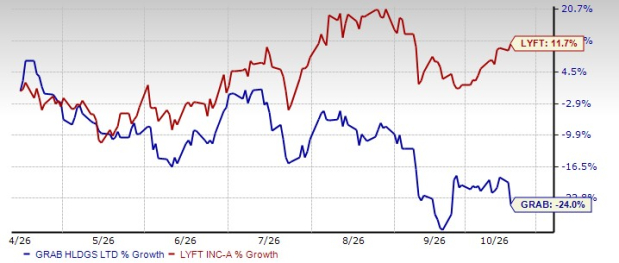
LYFT Outscores GRAB Concerning Price Performance
Over the past six months, LYFT's shares have gained in double digits (%-wise), outperforming GRAB. GRAB's shares have declined in double digits in the same timeframe.
Six-Month Price Comparison
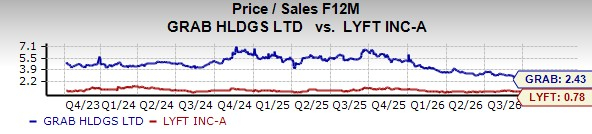
LYFT Excels on the Valuation Front as Well
LYFT is trading at a forward sales multiple of 0.78, much below GRAB’s reading of 2.43. LYFT has a Value Score of B, while GRAB has a Value Score of C.
How Do Estimates Compare for LYFT & GRAB?
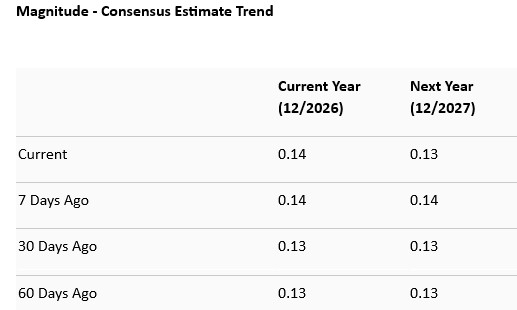
The Zacks Consensus Estimate for LYFT's 2026 sales implies a year-over-year increase of 15.8%, and the same for earnings indicates massive 240% growth. The consensus estimate for LYFT's 2027 sales implies year-over-year growth of 11.4%, and the same for earnings indicates 30% growth. The EPS estimates for 2026 and 2027 have been trending northward over the past 60 days.
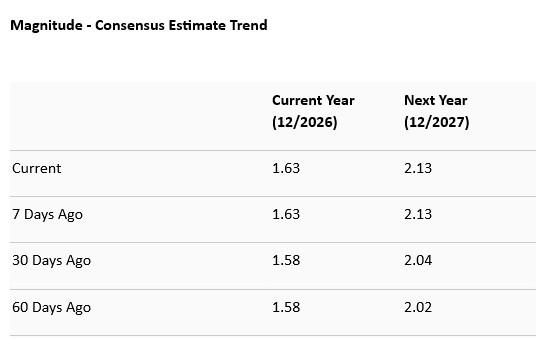
The Zacks Consensus Estimate for GRAB's 2026 sales has risen 25.3% year over year, while the same for earnings indicates massive 133% growth. The consensus estimate for GRAB's 2027 sales reflects an increase of 24%, while earnings are likely to contract 7% from 2026 expectations. The EPS estimate for 2026 has been trending northward over the past 60 days, like LYFT. For 2027, the same has remained stable over the past 60 days, unlike LYFT.
Conclusion
LYFT appears to have weathered the stock market volatility stemming from Middle East tensions effectively, as evidenced by its strong share price performance. The company is well-positioned to benefit from robust gross bookings. Its efforts to establish a significant presence in the promising and rapidly evolving autonomous vehicle market further strengthen its growth prospects. Additionally, the company's attractive valuation and upward revisions to earnings and revenue estimates enhance its investment appeal.
Grab, meanwhile, faces headwinds from economic uncertainty across key Southeast Asian markets, fueled by inflation, shifting consumer preferences and supply-chain disruptions. Fierce competition in the deliveries business adds to its challenges. The region's complex and fragmented regulatory environment also creates obstacles. For example, Indonesia's growing emphasis on domestic digital platforms could adversely affect Grab's market share. Furthermore, GRAB's elevated valuation indicates that much of its potential upside may already be reflected in the stock price.
Based on our assessment, LYFT stands out as the clear winner and appears to be a more attractive investment option than Grab at present, even though both stocks currently carry a Zacks Rank #3 (Hold).
You can see the complete list of today’s Zacks #1 Rank (Strong Buy) stocks here.
Radical New Technology Could Hand Investors Huge Gains
Quantum Computing is the next technological revolution, and it could be even more advanced than AI.
While some believed the technology was years away, it is already present and moving fast. Large hyperscalers, such as Microsoft, Google, Amazon, Oracle, and even Meta and Tesla, are scrambling to integrate quantum computing into their infrastructure.
Senior Stock Strategist Kevin Cook reveals 7 carefully selected stocks poised to dominate the quantum computing landscape in his report, Beyond AI: The Quantum Leap in Computing Power .
Kevin was among the early experts who recognized NVIDIA's enormous potential back in 2016. Now, he has keyed in on what could be "the next big thing" in quantum computing supremacy. Today, you have a rare chance to position your portfolio at the forefront of this opportunity.
See Top Quantum Stocks Now >>Want the latest recommendations from Zacks Investment Research? Today, you can download 7 Best Stocks for the Next 30 Days. Click to get this free report
Lyft, Inc. (LYFT): Free Stock Analysis Report
Grab Holdings Limited (GRAB): Free Stock Analysis Report
This article originally published on Zacks Investment Research (zacks.com).