

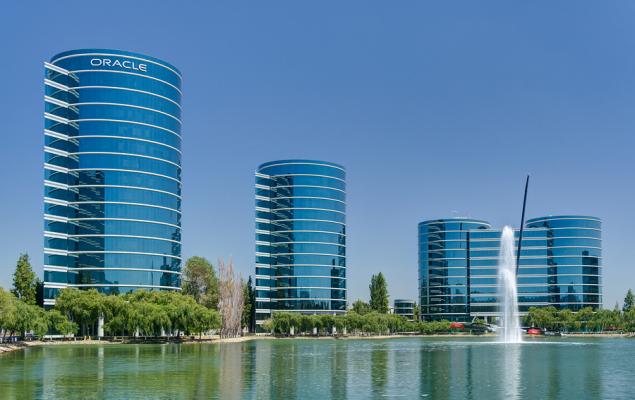
Oracle ORCL and Alibaba Group BABA have each repositioned as artificial intelligence (AI) infrastructure providers, pairing massive data center buildouts with proprietary software. Oracle leverages Oracle Cloud Infrastructure (“OCI”), its database franchise and Fusion applications, while Alibaba combines Alibaba Cloud, its Qwen model family and in-house T-Head chips under one full-stack strategy.
Both companies are spending aggressively on capital expenditure (capex) to meet AI compute demand that outstrips supply, making funding discipline and monetization pace critical differentiators now.
Let's delve deep and closely compare the fundamentals of the two stocks to determine which one is a better investment now.
The Case for ORCL Stock
Oracle's biggest strength is contracted visibility. Remaining performance obligations (RPO) reached $664 billion at the end of first-quarter fiscal 2027, and management expects roughly half to convert into revenue over the next 36 months. Oracle booked more than $30 billion of new AI cloud contracts, mostly structured through customer prepayments or bring-your-own-hardware arrangements that require no incremental cash from Oracle, easing funding concerns and supporting a self-funding growth model.
Fleet economics remain highly encouraging for long-term profitability. GPU utilization stood at 97.9%, and capacity up for renewal was re-contracted at a 20% premium. Multicloud database revenues grew 353% as Oracle completed its planned Azure and AWS regional expansion, reaching 70 multicloud database regions. The applications portfolio adds diversification, with Fusion growing 14% and AI agents increasingly embedded across customer workflows, deepening customer stickiness.
Recent announcements strengthen the AI software layer. In October 2026, Oracle added xAI's Grok 4.6 and 4.7 models and a Smart Model Router to OCI Enterprise AI. On Oct. 21, it unveiled AI Agent Studio for Industry Applications, a no-code and low-code environment for building industry-specific AI agents.
For fiscal 2027, Oracle raised its revenue outlook to at least $90 billion, implying 34% growth, and expects non-GAAP EPS of $8.10. For the second quarter, it guides total revenue growth of 30-34% and cloud revenue growth of 65-71%. Challenges include a fiscal 2027 capex projection of $90-$95 billion, negative free cash flow, a completed $20 billion equity issuance and air-permitting and power-delivery hurdles at certain data center sites.
The Zacks Consensus Estimate for ORCL’s fiscal 2027 earnings is currently pegged at $8.13 per share. The estimate implies 6.55% year-over-year earnings growth.
Oracle Corporation Price and Consensus
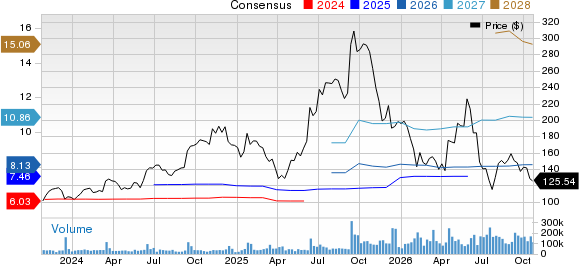
Oracle Corporation price-consensus-chart | Oracle Corporation Quote
The Case for BABA Stock
Alibaba's cloud momentum is clearly notable. External revenue growth at Alibaba Cloud accelerated to 45% in the June quarter, a 22-quarter high, while AI-related product revenues posted triple-digit growth for the 12th straight quarter and now accounts for 35% of external cloud revenues. Management expects AI and cloud growth to accelerate further as new capacity comes online, with annualized AI-related revenues approaching $10 billion.
The full-stack strategy remains a key competitive differentiator for the company. At the Apsara Conference on Sept. 22, 2026, Alibaba disclosed that Qwen 4 is in training, with the Qwen 4.5 and Qwen 5 series projected to scale to 5-10 trillion parameters. T-Head unveiled the Zhenwu V900 accelerator, offering three times its predecessor's performance and slated for mass production in the first quarter of 2027. Alibaba also targets more than 20GW of global data center capacity by 2032 and plans new cloud regions in Türkiye, Finland and the Netherlands.
However, the investment burden is substantial. Alibaba has spent RMB190 billion of its RMB380 billion three-year capital investment plan, and June-quarter capex jumped 75% year over year to RMB67.7 billion, driving a sizable free cash outflow in the quarter. Management expects AI-related capex to break even within three years, potentially sooner through proprietary chips and higher-margin products, but those returns are yet to materialize at scale. Meanwhile, customer management revenues declined 7%, and heavier technology investment compressed operating income by 57%, keeping near-term profitability under pressure, while its sizable commerce operations must continue funding the AI buildout.
The Zacks Consensus Estimate for fiscal 2027 EPS is pegged at $6.37, reflecting a 2.7% downward revision over the past 30 days.
Alibaba Group Holding Limited Price and Consensus
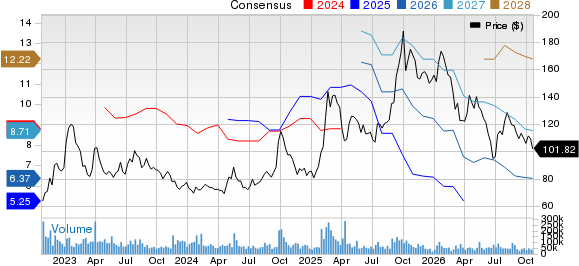
Alibaba Group Holding Limited price-consensus-chart | Alibaba Group Holding Limited Quote
Valuation and Price Performance Comparison
Oracle trades at a trailing 12-month price-to-earnings (P/E) ratio of 18.46X, well below Alibaba's 44.66X. Oracle's discount appears justified given heavy capex and negative free cash flow, but investors should track the stock as the $664 billion backlog offers earnings visibility that the lower multiple does not reflect. Alibaba's premium already prices in a cloud acceleration, so investors should hold or wait patiently.
ORCL vs. BABA: P/E TTM Ratio
Image Source: Zacks Investment Research
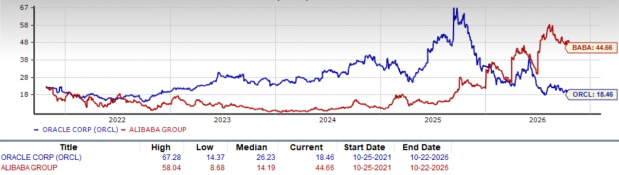
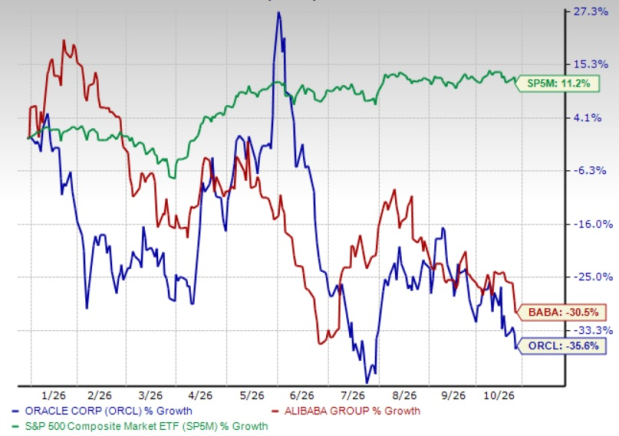
Oracle shares have plunged 35.6% year to date, while Alibaba shares have lost 30.5%. Oracle's steeper drop still merits tracking since raised fiscal 2027 guidance signals that underlying fundamentals remain firmly intact despite share weakness.
ORCL underperforms BABA Year-to-date
Image Source: Zacks Investment Research
Conclusion
Oracle holds the edge over Alibaba on multiple fronts. Its $664 billion RPO provides multi-year revenue visibility, prepayment and bring-your-own-hardware structures ease funding pressure, and raised fiscal 2027 guidance reinforces execution strength. Multicloud database expansion, embedded AI agents and new agent-building tools diversify growth beyond infrastructure. Alibaba offers strong cloud acceleration and an ambitious full-stack roadmap, but heavy capex, compressed profitability, uncertain payback timing and a premium valuation temper its appeal. With a discounted valuation backed by contracted demand, Oracle offers better upside potential. Investors should track and hold ORCL stock and wait for a better entry point for BABA. Oracle and Alibaba carry a Zacks Rank #3 (Hold) each at present. You can see the complete list of today’s Zacks #1 Rank (Strong Buy) stocks here.
Zacks' Research Chief Names "Stock Most Likely to Double"
Our team of experts has just released the 5 stocks with the greatest probability of gaining +100% or more in the coming months. Of those 5, Director of Research Sheraz Mian highlights the one stock set to climb highest.
This innovative software-as-a-service firm upped its user base +22% year over year. That rate is increasing and margins are expanding as AI efficiencies take effect. Of course, all our elite picks aren't winners, but this one could far surpass earlier Zacks' Stocks Set to Double like D-Wave Quantum, which shot up +680.1%.
Free: See Our Top Stock And 4 Runners UpWant the latest recommendations from Zacks Investment Research? Today, you can download 7 Best Stocks for the Next 30 Days. Click to get this free report
Oracle Corporation (ORCL): Free Stock Analysis Report
Alibaba Group Holding Limited (BABA): Free Stock Analysis Report
This article originally published on Zacks Investment Research (zacks.com).