


The growing investments in data centers and mission-critical infrastructure are creating a diversified market exposure for firms like EMCOR Group, Inc. EME and MasTec, Inc. MTZ. Customers are increasing investments in data centers, AI infrastructure, communications networks and other mission-critical facilities, creating demand for contractors with the skilled workforce and operational capabilities to deliver complex projects efficiently. However, project funding volatility, elevated inflation and ongoing geopolitical uncertainties are concerning for the near-term prospects to some extent.
EMCOR offers mechanical and electrical construction, industrial and energy infrastructure services for a diverse range of businesses, serving commercial, industrial, utility and institutional clients in the United States. MasTec engages in the engineering, building, installation, maintenance and upgrade of energy, communication and utility infrastructure and is working to expand its margins and improve execution.
Let’s compare the fundamentals of the two infrastructure stocks to determine which one has better upside potential.
The Case for EMCOR Stock
EMCOR’s U.S. construction business is benefiting from robust demand for data centers, AI infrastructure, network and communications, healthcare, and water and wastewater projects. In the first half of 2026, company-wide revenues rose 19.7% year over year to $9.78 billion, reflecting strong activity across its businesses. As of June 30, 2026, RPOs reached $17.14 billion, up 43.9% year over year and 29% from December 2025, with approximately 95% of the growth attributed to organic demand. Investments in prefabrication, construction technologies, workforce training, virtual design and construction, and advanced project planning further support productivity and delivery capabilities on increasingly complex projects.
Besides, EME’s first-half 2026 performance highlights improving operating leverage and disciplined cost management. Strong construction activity, improved Electrical Construction profitability and better Building Services margins supported performance. Beyond market tailwinds, EMCOR’s acquisition strategy is strengthening its electrical construction footprint and expanding its ability to serve complex infrastructure customers. Its 2026 electrical contractor acquisitions—including B&B Electric, Sidney Electric, Giles Electric, Schmidt Electric and Connelly Electric—bring complementary capabilities, geographic reach and access to skilled union labor. Collectively, the acquired businesses generated approximately $625 million in trailing 12-month revenues and $105 million in EBITDA, while management expects $250-$275 million in incremental revenues in the second half of 2026 from the acquisitions.
However, the company faces several macroeconomic and operational risks that could affect project execution, profitability and future growth. Economic and geopolitical uncertainty, changing interest rates and volatility in customer spending may influence construction activity and funding decisions, particularly for large-scale infrastructure and industrial projects.
Inflation in labor, materials, equipment and energy costs may pressure project margins, especially when contractual pricing mechanisms do not fully offset cost increases. Changes in project mix, competitive bidding, tariffs, regulatory requirements and reduced refinery turnaround activity could further affect profitability. Consequently, sustaining margins and converting its record backlog into revenues and cash flow remain key execution priorities.
The Case for MasTec Stock
MasTec is benefiting from strong infrastructure spending trends, especially in AI-related projects such as power delivery, grid modernization, data-center construction, fiber connectivity and related infrastructure. Its record 18-month backlog reached $21.4 billion in the second quarter of 2026, up 30% year over year and 5% sequentially, with Clean Energy & Infrastructure backlog rising 58% year over year to $7.8 billion. Power Delivery backlog also reached a record $6.3 billion, reflecting continued award activity.
Also, MTZ’s acquisition strategy is enhancing its capabilities in attractive, high-growth infrastructure markets while expanding its ability to execute increasingly complex projects. The July 2026 acquisition of The Superior Group is particularly compelling. Superior is expected to contribute $800-$900 million in revenues and $100-$115 million in adjusted EBITDA during the remainder of 2026, making the deal immediately accretive to earnings and cash flow based on management’s preliminary estimates.
However, the ongoing weakness in its Communications segment, macroeconomic and industry-specific uncertainties, and issues in cash flow generation are concerning for near-term prospects. In the second quarter of 2026, MasTec’s Communications segment remains a notable weak spot, with EBITDA declining 11.6% to $73.1 million, while the EBITDA margin contracted 170 basis points to 8.2% from 9.9% a year ago. The deterioration suggests that revenue growth is not translating efficiently into profitability in this business. While management continues to expect Communications revenues of roughly $3.25 billion in 2026, the high-single-digit margin outlook leaves limited room for execution setbacks.
Additionally, MTZ is subject to risks from inflation, interest rates, tariffs, regulatory and policy changes, permitting, supply-chain constraints, labor availability and changes in customer capital-expenditure plans. These risks are particularly relevant because MasTec operates across capital-intensive markets, including clean energy, power infrastructure, communications and pipelines. Weak free cash flow is also another concern for the company.
Stock Performance & Valuation Trend
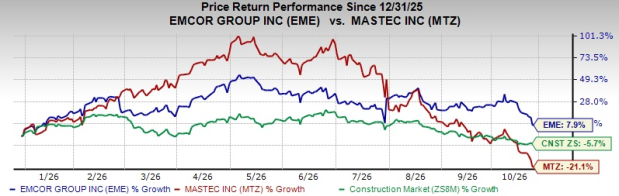
As witnessed from the chart below, in the year-to-date period, EMCOR’s share price performance has outperformed MasTec and the broader Construction sector.
Image Source: Zacks Investment Research
Considering valuation, over the last five years, EMCOR has been trading above MasTec on a forward 12-month price-to-earnings (P/E) ratio basis.
Image Source: Zacks Investment Research
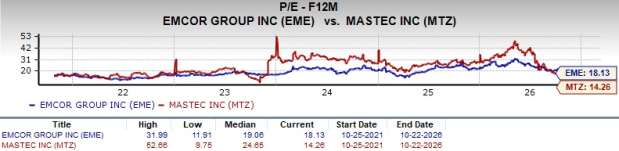
Overall, from these technical indicators, it can be deduced that EME stock offers a diminishing growth trend but with a premium valuation, while MTZ stock offers a declining trend with a discounted valuation.
Comparing EPS Estimate Trends: EME vs. MTZ
The Zacks Consensus Estimate for EME’s 2026 and 2027 earnings has remained unchanged over the past 60 days at $32.98 and $37.23 per share, respectively. However, the estimates for 2026 and 2027 indicate year-over-year improvements of 27.5% and 12.9%, respectively.
EME’s EPS Trend
Image Source: Zacks Investment Research

The Zacks Consensus Estimate for MTZ’s 2026 and 2027 earnings has trended downward over the past 30 days to $9.27 and $12.67 per share, respectively. However, the revised estimates for 2026 and 2027 imply year-over-year growth of 41.5% and 36.7%, respectively.
MTZ’s EPS Trend
Image Source: Zacks Investment Research

Return on Equity (ROE) of EME & MTZ Stocks
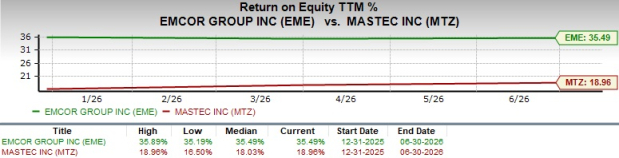
EMCOR’s trailing 12-month ROE of 35.49% significantly exceeds MasTec’s average, underscoring its efficiency in generating shareholder returns.
Image Source: Zacks Investment Research
Which Stock Has More Upside Potential: EME Stock or MTZ Stock?
EMCOR is supported by strong organic demand, a record remaining performance obligation (RPO) balance and improving operating efficiency. Its investments in construction technology, workforce capabilities and electrical contractor acquisitions are strengthening its ability to execute complex projects. Stable earnings estimates and superior return on equity also highlight its financial execution and profitability advantages. However, its premium valuation and exposure to labor inflation, project costs and changing customer spending could limit near-term gains
MasTec offers exposure to expanding power infrastructure and clean energy markets, with a growing backlog and the Superior Group acquisition broadening its capabilities. Its earnings growth outlook is encouraging, but downward earnings estimate revisions, weakening Communications segment profitability and cash flow concerns raise execution risks. Integration challenges and macroeconomic uncertainties could further pressure results.
Even though both stocks currently carry a Zacks Rank #4 (Sell), EME stock appears to be the more attractive option for investors choosing between the two, given its stronger execution, profitability and earnings estimate stability. MasTec’s discounted valuation and infrastructure exposure may appeal to risk-tolerant investors, but its deteriorating earnings revisions warrant caution.
Investors may be better off waiting for improved market signals and clearer evidence of sustained operating performance before buying either stock. You can see the complete list of today’s Zacks #1 Rank (Strong Buy) stocks here.
Zacks' Research Chief Names "Stock Most Likely to Double"
Our team of experts has just released the 5 stocks with the greatest probability of gaining +100% or more in the coming months. Of those 5, Director of Research Sheraz Mian highlights the one stock set to climb highest.
This innovative software-as-a-service firm upped its user base +22% year over year. That rate is increasing and margins are expanding as AI efficiencies take effect. Of course, all our elite picks aren't winners, but this one could far surpass earlier Zacks' Stocks Set to Double like D-Wave Quantum, which shot up +680.1%.
Free: See Our Top Stock And 4 Runners UpWant the latest recommendations from Zacks Investment Research? Today, you can download 7 Best Stocks for the Next 30 Days. Click to get this free report
EMCOR Group, Inc. (EME): Free Stock Analysis Report
MasTec, Inc. (MTZ): Free Stock Analysis Report
This article originally published on Zacks Investment Research (zacks.com).