


Two years ago, the question about Advanced Micro Devices was whether it could compete at all in artificial intelligence accelerators.
Nvidia had the hardware, the software moat, and effectively the entire customer list. AMD had a roadmap and a lot of goodwill from its CPU comeback.
That question has been answered, and not in the way the skeptics expected. AMD now holds multi-gigawatt commitments from three of the most demanding buyers of compute on earth. The question heading into Tuesday afternoon's third-quarter report is entirely different, and in some ways harder: can the company actually deliver what it has already sold?
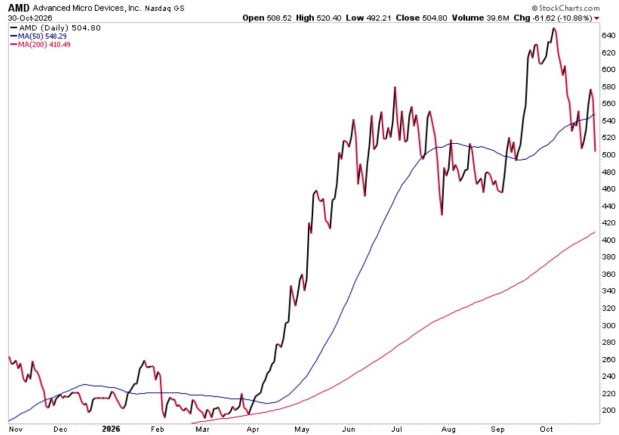
Image Source: StockCharts
The Contracts Are Signed
Start with the scale of what has been committed. In October of last year, OpenAI agreed to deploy up to six gigawatts of AMD Instinct accelerators, beginning with one gigawatt of MI450 silicon in the second half of 2026. This past February, Meta signed a definitive multi-year agreement for up to six gigawatts of its own, built around a custom Instinct GPU based on the MI450 architecture, paired with sixth-generation EPYC processors and AMD's Helios rack-scale design. Anthropic rounds out the anchor group.
These are not evaluation orders. They are capacity reservations measured in power rather than units, which tells you how the buyers now think about the problem.
Both deals carry an unusual feature. AMD issued Meta a performance-based warrant for up to 160 million shares of its own stock, vesting in tranches as shipments scale toward six gigawatts and as AMD's share price clears defined thresholds. OpenAI received a similar structure. Against roughly 1.85 billion shares outstanding, the Meta warrant alone represents potential dilution near 9%.
The structure aligns incentives beautifully — Meta profits if AMD succeeds, which gives Meta reason to make AMD succeed. It also means AMD is paying for a meaningful share of its own demand in equity rather than in price concessions. Shareholders should understand they are funding part of this ramp. The vesting hurdles mean it only triggers if things go very well, which is the right way to structure it, but the dilution is real.
What the Numbers Say Heading In
The Zacks Consensus Estimate for the September quarter stands at $1.94 per share, representing growth of 61.7% over the year-ago period. Revenue is pegged at $13.12 billion, up 41.9%. Company guidance called for roughly $13 billion give or take $300 million, with non-GAAP gross margin near 56%, so the Street and management are closely aligned.
The full-year picture is more striking. The 2026 consensus sits at $7.55 per share on $50.71 billion in revenue — earnings growth of 81% on revenue growth of 46%. And the forward estimate has been moving fast. The 2027 consensus now stands near $15.24 per share, up from $14.78 just sixty days ago. That is a 3.11% upward revision to next year's earnings in just two months, which is the kind of move that tends to precede sustained outperformance.
Image Source: Zacks Investment Research
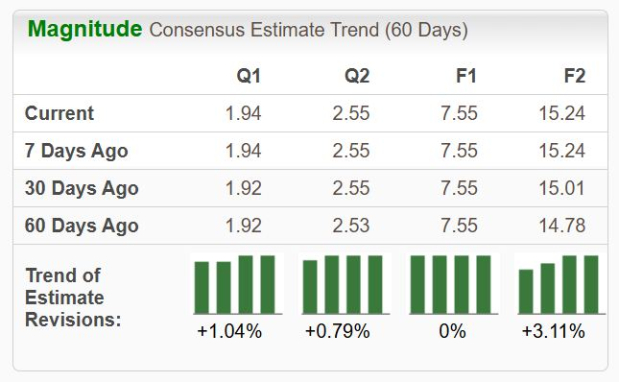
AMD has also exceeded the consensus in each of the past four quarters, with an average beat of 6.5%, and currently carries a positive Earnings ESP (Expected Surprise Prediction) of +3.49% heading into Tuesday’s print. This proprietary indicator has proven to be very useful for finding positive surprises. In fact, when combining a Zacks Rank #3 or better and a positive Earnings ESP, stocks produced a positive surprise 70% of the time according to our 10-year backtest.
The One Line That Matters
Within that report, a single number carries disproportionate weight: Data Center revenue. Analysts are modeling $8.27 billion, which would represent growth of 90.6% and place the segment at roughly two-thirds of total company revenue.
Here is why investors who do not own AMD should still read this report carefully.
The market spent October questioning whether AI capital spending converts into revenue and cash flow. The debate shifted from capability to financing, and it took real casualties among the companies carrying debt to fund the buildout. AMD AMD reports Tuesday, well ahead of Nvidia, which makes it the first substantial read on accelerator demand since those doubts surfaced.
A Data Center number at or above $8.27 billion, paired with constructive commentary on the Helios ramp, would suggest the spending is landing on real silicon and real revenue. A miss on that line, or any sign that supply constraints in wafers, packaging or high-bandwidth memory are pushing deliveries to the right, would validate the more skeptical view and likely travel well beyond AMD's own shares.
Bottom Line
One caution before Tuesday. After the fourth-quarter 2025 report, AMD beat on earnings by roughly 16% and the stock fell more than 17%. Expectations are high, the shares have advanced better than 135% this year, and the company carries a market capitalization over $800 billion. A good quarter may not be enough; the market will want the Helios ramp confirmed and the 2027 trajectory defended.
AMD no longer needs to prove the technology is competitive — the contracts settled that argument. It needs to prove it can ship at scale, hold margin through a ramp where AI accelerators run below the corporate average, and navigate a supply chain that is tight in every direction at once.
That is a far better problem to have than the one the company faced two years ago. It is also a problem that gets settled quarter by quarter, in public, starting Tuesday afternoon.
Radical New Technology Could Hand Investors Huge Gains
Quantum Computing is the next technological revolution, and it could be even more advanced than AI.
While some believed the technology was years away, it is already present and moving fast. Large hyperscalers, such as Microsoft, Google, Amazon, Oracle, and even Meta and Tesla, are scrambling to integrate quantum computing into their infrastructure.
Senior Stock Strategist Kevin Cook reveals 7 carefully selected stocks poised to dominate the quantum computing landscape in his report, Beyond AI: The Quantum Leap in Computing Power .
Kevin was among the early experts who recognized NVIDIA's enormous potential back in 2016. Now, he has keyed in on what could be "the next big thing" in quantum computing supremacy. Today, you have a rare chance to position your portfolio at the forefront of this opportunity.
See Top Quantum Stocks Now >>Want the latest recommendations from Zacks Investment Research? Today, you can download 7 Best Stocks for the Next 30 Days. Click to get this free report
Advanced Micro Devices, Inc. (AMD): Free Stock Analysis Report
This article originally published on Zacks Investment Research (zacks.com).