


Bank of America BAC faces mounting pressure on its securities portfolio as elevated interest rates weigh on bond valuations. According to the Federal Deposit Insurance Corporation’s Nov. 24 report, unrealized securities losses across U.S. banks surged 48.8% sequentially to $486 billion in the third quarter of 2026, highlighting persistent balance-sheet challenges.
BAC remains particularly exposed, given its substantial held-to-maturity (“HTM”) securities portfolio, accumulated largely during the low-interest-rate environment. Its gross unrealized HTM securities losses increased 29.4% to $103.9 billion as of Sept. 30, 2026, from $80.3 billion at 2025-end. Although these losses do not directly affect earnings, they reflect significant deterioration in the market value of its investments.
Bank of America’s exposure to longer-duration, lower-yielding securities limits its ability to capitalize on elevated interest rates. Selling these securities to reinvest proceeds at higher yields could crystallize losses, potentially hurting earnings and capital. Moreover, higher deposit costs alongside relatively low returns on legacy securities could restrict net interest margin expansion and weigh on profitability.
The substantial unrealized losses also reduce BAC’s balance-sheet flexibility, particularly if unexpected liquidity needs arise. BAC’s average global liquidity sources declined to $914 billion in the third quarter of 2026 from $975 billion in the fourth quarter of 2025. Nonetheless, its diversified deposit franchise, strong earnings generation and recurring securities cash flows mitigate the risk of forced asset sales.
Going forward, the gradual maturity of legacy securities should allow Bank of America to redeploy funds into potentially higher-yielding assets, supporting net interest income growth. While declining long-term yields could ease valuation pressures, persistently elevated rates may prolong balance-sheet constraints. Hence, disciplined portfolio repositioning, effective funding cost management and adequate liquidity will remain critical to BAC’s profitability and financial flexibility.
How Do Bank of America’s Peers Fare?
JPMorgan Chase JPM also faces securities valuation pressures stemming from elevated interest rates. As of Sept. 30, 2026, JPMorgan’s HTM securities portfolio stood at $274.6 billion, up from $270.1 billion at 2025-end. Its available-for-sale (“AFS”) securities portfolio increased to $547.2 billion.
However, JPMorgan’s strong liquidity position provides considerable flexibility in managing interest rate risks. At the third-quarter end, JPM had approximately $1.5 trillion in liquidity sources, while its average deposits increased 8% year over year. Its diversified revenue streams and robust funding base should help mitigate the impact of securities valuation pressures.
Wells Fargo & Company WFC has been gradually reshaping its investment portfolio. At third-quarter end, Wells Fargo’s HTM securities declined 10% year over year to $189.3 billion, while AFS securities increased 25% to $247.7 billion. Nonetheless, combined net unrealized losses on these portfolios increased from the figure at 2025-end, primarily reflecting interest rate movements.
Wells Fargo’s declining HTM securities exposure and growing AFS portfolio could provide greater flexibility in balance-sheet management. However, persistent securities valuation pressures and potential increases in funding costs could temper the benefits of portfolio repositioning on NII growth.
BAC’s Price Performance, Valuation & Estimates
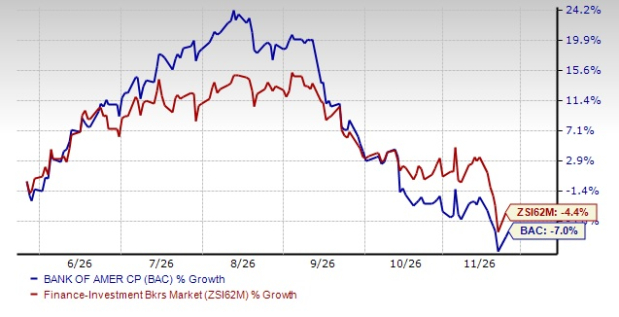
In the past six months, shares of Bank of America have lost 7% compared with the industry’s 4.4% decline.
Image Source: Zacks Investment Research
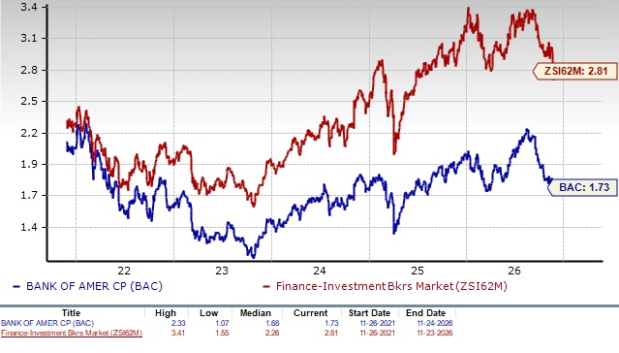
From a valuation standpoint, BAC trades at a trailing 12-month price-to-tangible book ratio of 1.73, below the industry average of 2.81.
Image Source: Zacks Investment Research
The Zacks Consensus Estimate for BAC’s 2026 and 2027 earnings indicates year-over-year growth rates of 18.4% and 14.9%, respectively. Earnings estimates for both years have been revised lower over the past 30 days.
Image Source: Zacks Investment Research

Currently, Bank of America carries a Zacks Rank #3 (Hold). You can see the complete list of today’s Zacks #1 Rank (Strong Buy) stocks here.
7 Best Stocks for the Next 30 Days
Just released: Experts distill 7 elite stocks from the current list of 220 Zacks Rank #1 Strong Buys. They deem these tickers "Most Likely for Early Price Pops."
Since 1988, the full list has beaten the market more than 2X over with an average gain of +23.9% per year. So be sure to give these hand picked 7 your immediate attention.
See them now >>Want the latest recommendations from Zacks Investment Research? Today, you can download 7 Best Stocks for the Next 30 Days. Click to get this free report
Bank of America Corporation (BAC): Free Stock Analysis Report
Wells Fargo & Company (WFC): Free Stock Analysis Report
JPMorgan Chase & Co. (JPM): Free Stock Analysis Report
This article originally published on Zacks Investment Research (zacks.com).