
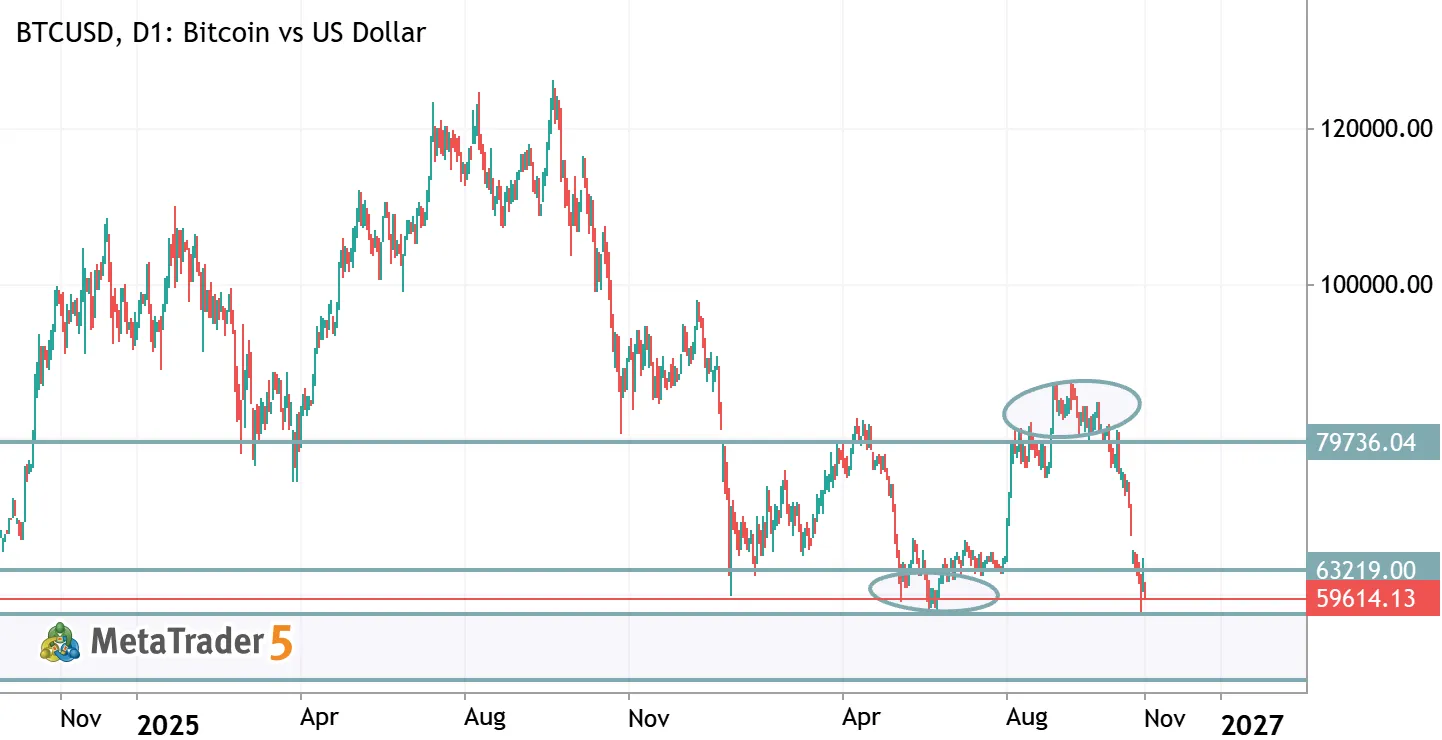
BTCUSD Near $60,000: ETF Outflows, Liquidations and the Risk of a Drop Toward $50,000
Bitcoin remains under pressure despite yesterday’s recovery in the U.S. stock market.
BTCUSD briefly rebounded toward $64,500, but has already returned to the $60,000 area today. This suggests that a sustainable recovery in risk appetite has not yet emerged.
Why Is Bitcoin Falling?
Several factors are putting pressure on the market at the same time.
First, expectations for high U.S. interest rates remain in place. Rising Treasury yields and a strong U.S. dollar reduce investor appetite for risk assets.
Second, capital continues to flow out of U.S. spot Bitcoin ETFs. On November 23 alone, net outflows were around $570 million, while total outflows since the beginning of November reached approximately $4.7 billion.
The third factor is leveraged position liquidations. High leverage continues to amplify BTCUSD moves and creates additional selling pressure during sharp declines.
Another sign of weakness is the position of short-term holders. Their average Bitcoin acquisition price is currently around $72,500, while the broader market realized price is near $53,200.
BTCUSD Technical Analysis
After losing the key $78,000–80,000 area, Bitcoin moved quickly through a zone of relatively low trading activity and returned toward $60,000.
So far, buyers have failed to establish a sustainable recovery.
Key levels:
$63,000–65,000 — the first area that buyers need to reclaim to improve the short-term technical picture.
$60,000 — current key support.
$55,000 — area of recent lows.
$50,000–53,000 — the next major zone to watch if the decline continues.
What’s Next for Bitcoin?
If BTCUSD can recover above $63,000–65,000, it would be the first sign that demand is beginning to return.
If the market loses $60,000 and breaks below the recent lows around $55,000, the risk of a move toward $50,000–53,000 would increase significantly.
In my view, the current move is not just a technical correction. It reflects a combination of leverage reduction, ETF outflows, and a broader reassessment of risk.
That is why a sharp decline in Bitcoin alone is not enough to justify buying.
What matters more is seeing the moment when buyers genuinely begin to regain control of the market, rather than producing only short-lived rebounds.
Trading CFDs and other financial instruments involves a high risk of capital loss. This communication provides information about market movements, does not constitute investment research, and should not be considered investment advice. Past performance does not guarantee future results.

 Profil MQL5

Nouveau commentaire