

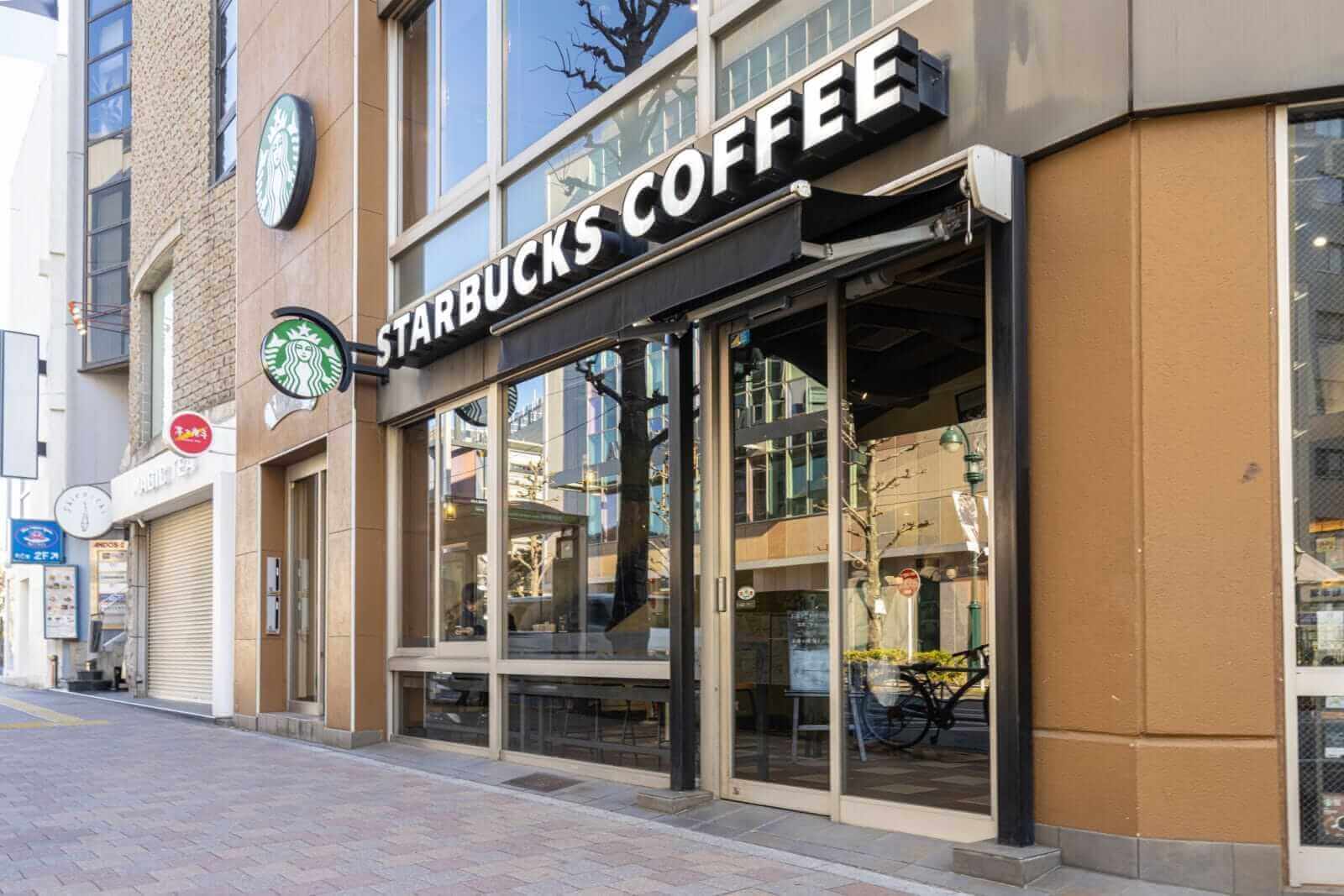
Starbucks (SBUX) made headlines last week when it fired its AI ‘employee’, a development that came as a surprise to many who were wondering if the technology would eventually replace baristas. The company had developed an AI system with a firm called NomadGo, essentially to track inventories for a better supply chain process. Since the company’s supply chain is extremely fragmented and relies on local suppliers, it has been a challenge for the management for some time. The AI was supposed to resolve this by not only automating the inventory management but also ordering new items whenever inventory levels went low. As it turned out, it did a horrible job.
Apart from incorrect product recognition, the system also failed at something as simple as counting. As a result, it multiplied the impact of existing supply chain issues, resulting in what the management dubbed ‘disaster faster'. Most of the employees would see this as a welcome development though, ensuring their jobs are safe, for now.
More Top Stocks Daily: Go behind Wall Street’s hottest headlines with Barchart’s Active Investor newsletter.
The issue could be deeper than just a bad AI system. To reiterate, Starbucks’ supply chain system is quite fragmented. While the new AI may have looked like that attractive solution that seems to make all old problems go away, it was essentially just a shiny layer on top of the existing infrastructure. Starbucks still relies on an old 90s system built by International Business Machines (IBM) to manage its core inventory. Without improving that core, it wasn’t a great idea to bring in the AI.
Also, this suggests that initial fears about AI replacing humans weren’t entirely accurate. Companies won’t just need to invest in AI but also revamp their existing infrastructure to make it compatible with AI. OpenAI CEO Sam Altman has echoed a similar sentiment this week, saying that the human element is still essential for most work. He had earlier predicted humans may not be needed for jobs as soon as 2035. Now, he admits that this isn’t possible. The AI may well progress at a fast pace, but the human element will likely still be needed. The Starbucks example is just an early signal pointing to that reality.
About Starbucks Stock
Based in Seattle, Washington, Starbucks is an international coffee company that markets, roasts, and sells coffee through its stores and retail channels. It operates in the Channel Development, North America, and International segments. The company’s stores offer coffee, tea, food items, packaged coffee products, ready-to-drink beverages, and other refreshments.
The stock gained 18.1% over the past year, underperforming the S&P 500 Index ($SPX), which delivered returns of 28.26% during the same period. However, year-to-date (YTD), the stock has outperformed the broader market, rising 20.1% returns compared to the S&P 500’s gains of 10.3%
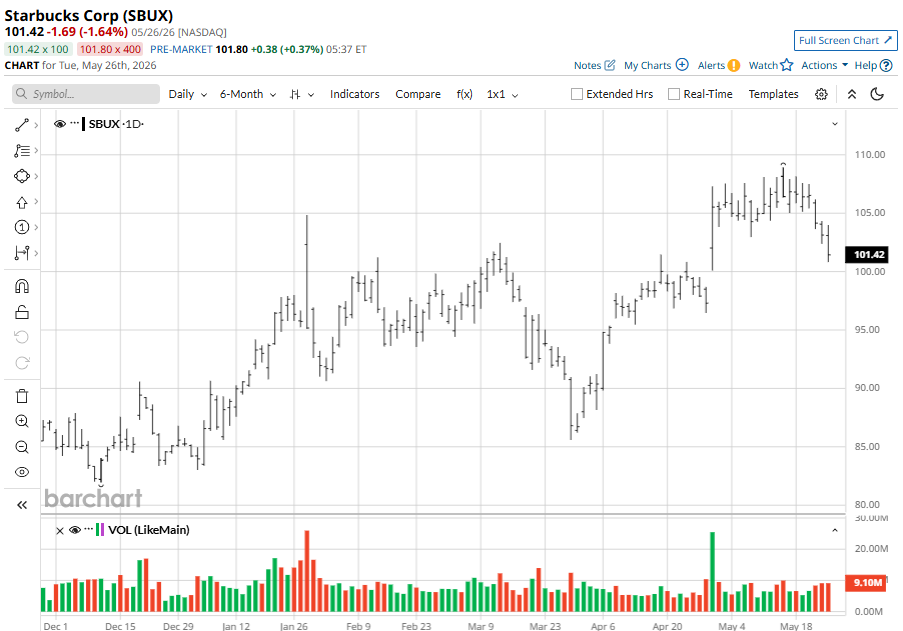 barchart.com
The company’s stock continues to trade at a premium, more than what investors have been used to in the past. For instance, the stock has an average forward price-to-earnings of 32 times over the past 5 years. Today, it trades at a multiple of 41.99 times. The earnings prospects look good all the way through 2028, with growth above 20%. However, that doesn’t provide enough margin of safety for conservative investors, despite a decent dividend yield of 2.4%.
Starbucks Reports First Quarterly Growth In Two Years
Starbucks reported its second-quarter fiscal 2026 earnings on April 28. The company posted consolidated revenue of $9.53 billion, with global comparable sales rising 6% year-over-year (YOY). Meanwhile, earnings per share increased 22% YOY to $0.50, marking the company’s first quarterly EPS growth in more than two years. During the quarter, consolidated operating margin improved to 9.4%.
The company raised its fiscal 2026 outlook, with global comparable sales now expected to grow by 5% or higher, led by the U.S. market. It now expects total net revenues to be broadly in line with last year’s level. Operating margins are still projected to see a slight YOY improvement. Moreover, the company continues to plan the opening of around 600 to 650 new coffeehouses during the year.
What Are Analysts Saying About Starbucks Stock
Andrew Charles of TD Cowen recently upgraded the stock to a “Buy” with a $104.94 price target, which offers 3.6% upside from here. Other analysts have echoed a similar sentiment, but the proximity of their price targets to the current share price suggests there may not be significant upside for investors. Bank of America Securities, with its $137 price target on the stock, continues to be the most bullish firm on SBUX, implying 35.23% upward growth in the coming months.
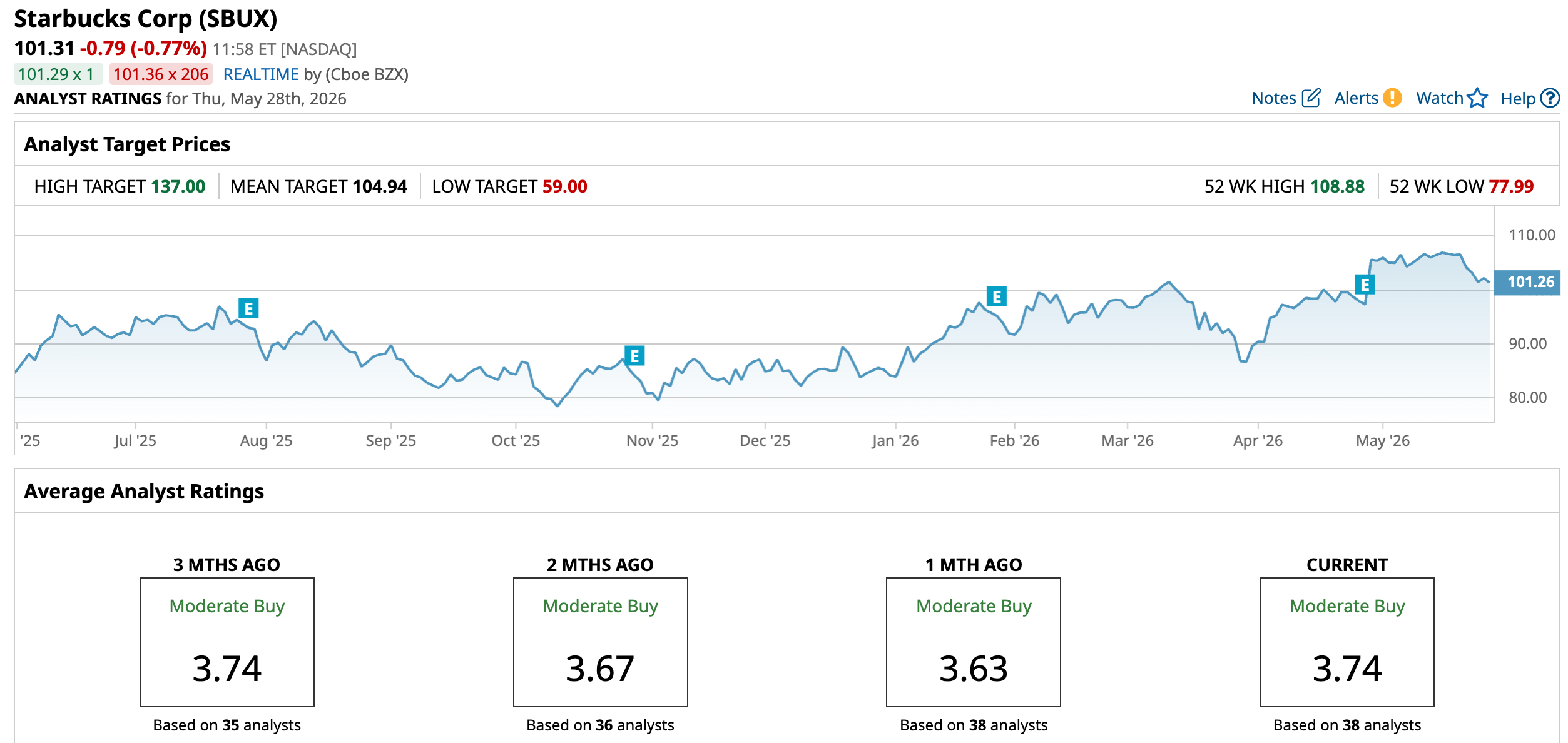 www.barchart.com
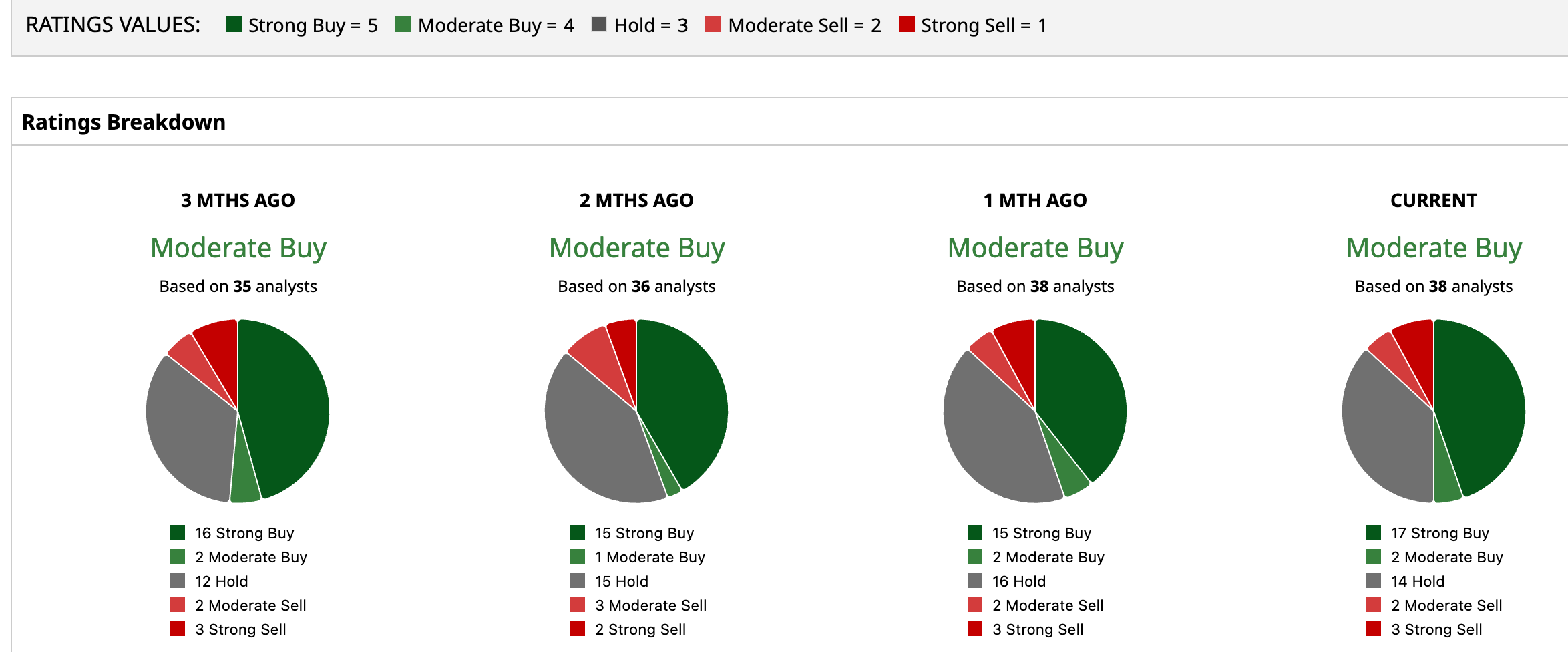 www.barchart.com
 On the date of publication, Jabran Kundi did not have (either directly or indirectly) positions in any of the securities mentioned in this article. All information and data in this article is solely for informational purposes. For more information please view the Barchart Disclosure Policy here.
More news from Barchart
A Giant Short Squeeze Could Be Brewing in Wolfspeed Stock The SpaceX IPO Is a Bet That Retail Investors Love Elon Musk So Much They’ll Fund His Money-Losing Empire You’ve Likely Never Heard of This Stock, But Data Center Demand Just Took Shares to New 52-Week Highs Starbucks’ AI Disaster and Sam Altman’s U-Turn Prove That AI Still Needs Humans