

Last week wasn’t exactly a smooth ride for the high-flying tech players. Investors rushed to cash in on some of the market’s biggest winners, and artificial intelligence (AI) darling Nvidia Corporation (NVDA) found itself right in the middle of the sell-off. Shares of the world’s most valuable company plunged 6.2% on Friday after stronger-than-expected U.S. jobs data reignited fears that interest rates could remain higher for longer, sending a chill through Wall Street.
Still, Nvidia bulls have little reason to panic. Many analysts view the decline as a healthy breather for a semiconductor sector that had been running red-hot for months. Wells Fargo (WFC) Chief Equity Strategist Ohsung Kwon summed it up best, arguing that chip stocks had become “way overbought” but stressing that the broader semiconductor bull market remains very much alive.
More Yield, Less Trap: Sign up free to get Barchart’s daily Dividend Investor newsletter straight to your inbox.
In fact, the long-term investment case for Nvidia may be stronger than ever. CEO Jensen Huang recently brushed off concerns surrounding the broader tech sell-off, describing it as a potential buying opportunity and emphasizing that the global AI buildout is still in its early innings. As companies and governments continue pouring billions into artificial intelligence infrastructure, Nvidia remains one of the biggest beneficiaries of that spending wave.
However, one recent development has caught investors' attention. Nvidia director Mark Stevens sold 1 million shares in two separate transactions between June 1 and June 5, worth roughly $221.10 million. The sale represented about 2.5% of his indirect holdings, leaving him with approximately 39 million shares. That raises an important question for investors. Is this insider sale a red flag signaling caution ahead, or simply a routine profit-taking move from an executive who has enjoyed Nvidia's extraordinary rise?
About Nvidia Stock
Few companies have been as instrumental in shaping the AI revolution as Nvidia. While many technology firms have benefited from the industry's rapid growth, Nvidia has emerged as one of the primary architects of that transformation. Founded in 1993 and headquartered in Santa Clara, California, the company initially built its reputation by developing graphics processing units (GPUs) for gamers. What started as a niche focus, however, eventually evolved into a much broader opportunity as Nvidia's technology found applications far beyond the gaming world.
Today, Nvidia's chips serve as the backbone of some of the most important technological advancements taking place globally. Its hardware powers large-scale AI models, cloud and data center infrastructure, autonomous machines, and complex scientific computing projects. As AI adoption accelerates, Nvidia has positioned itself at the center of the trend, becoming the leading provider of the computing infrastructure required to train and run generative AI systems.
Its portfolio is anchored by industry-leading products, including the H100 platform, Blackwell GPUs, and the company's next-generation Rubin architecture. Investors have richly rewarded that success. Nvidia's meteoric ascent has propelled it to a market capitalization of approximately $5.04 trillion, making it the most valuable company in the world at the time of writing. The journey has not been without turbulence, however.
Throughout the year, Nvidia shares have experienced periods of heightened volatility as investors weighed earnings results, questioned the sustainability of AI-related spending, and navigated broader weakness across semiconductor stocks. Despite those concerns, Nvidia has continued to strengthen its leadership position within both the AI and data center markets. That leadership has translated into exceptional returns for shareholders.
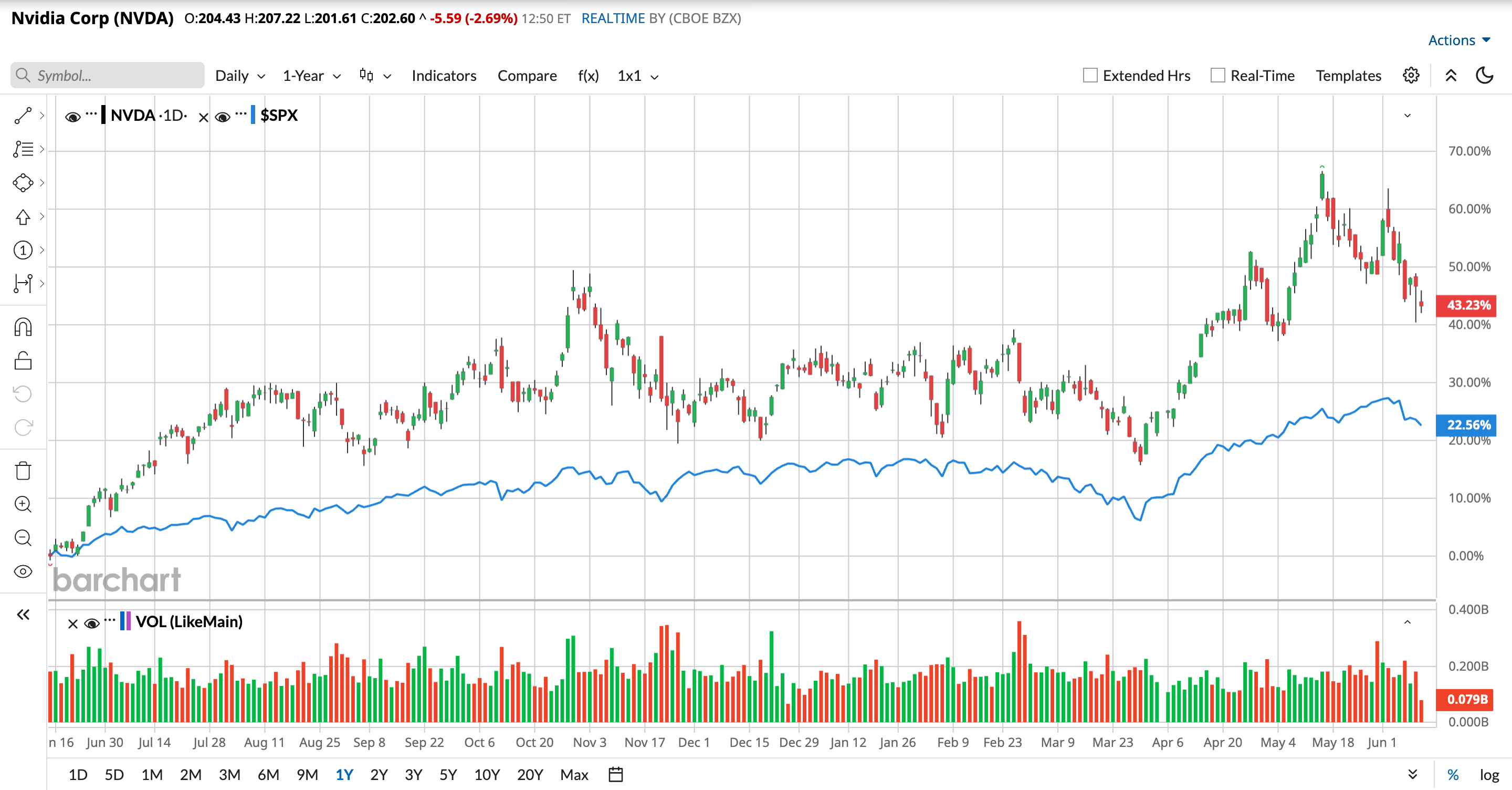
Although the stock currently sits 16.7% below its May 14 peak of $236.54 amid the broader tech sell-off, Nvidia has still generated a gain of 41.34% over the last 12 months. In comparison, the broader S&P 500 Index ($SPX) returned 21.2% over the same period. The outperformance has extended into 2026, with Nvidia shares rising 9.1% year-to-date (YTD), ahead of the broader market’s 6.9% gain.
 www.barchart.com
 A Look Inside Nvidia’s Q1 Financials
When Nvidia released its fiscal 2027 first-quarter results on May 20, the company once again reminded investors why it sits at the center of the AI revolution. The chipmaker delivered another standout quarter, surpassing Wall Street’s expectations on both revenue and earnings while continuing to benefit from the relentless global demand for AI infrastructure.
Revenue climbed to a record $81.6 billion during the quarter, an impressive 85% increase from $44.1 billion in the year-ago period and 20% higher than the previous quarter. The result comfortably exceeded analysts’ consensus estimate of $78.84 billion, highlighting the extraordinary pace at which Nvidia’s business continues to expand.
Profit growth was even more eye-catching. Adjusted earnings per share jumped 140% year-over-year (YOY) to $1.87, easily beating Wall Street’s forecast of $1.77 per share. The performance further reinforced Nvidia’s reputation as one of the fastest-growing and most profitable companies in the technology sector.
The quarter also marked an important shift in how Nvidia reports its business. To better reflect its evolving operations and future growth opportunities, the company has reorganized its reporting structure around two major platforms: Data Center and Edge Computing. The move underscores Nvidia’s growing influence across multiple areas of the AI ecosystem.
As expected, the Data Center segment remained the company's primary growth engine. Revenue from the division surged to an all-time high of $75.2 billion, accounting for more than 92% of Nvidia’s total sales during the quarter. The business posted a remarkable 92% YOY growth as hyperscalers, enterprises, and governments continued investing heavily in generative AI infrastructure and large-scale cloud deployments.
Meanwhile, Nvidia’s newly defined Edge Computing segment generated $6.4 billion in revenue, representing a healthy 29% increase from the prior-year period. The division encompasses a broad range of technologies, including data processing systems that support agentic and physical AI applications across PCs, gaming consoles, workstations, AI-RAN base stations, robotics platforms, and automotive solutions.
Beyond its top-line growth, Nvidia continued to showcase exceptional operational efficiency. The company reported a GAAP gross margin of 74.9%, essentially unchanged from the previous quarter, while improving by an impressive 14.4 percentage points compared to the same period last year. Nvidia also stepped up its commitment to returning capital to shareholders.
During the first quarter alone, the company returned a record $20 billion through a combination of share repurchases and cash dividends. Adding to that momentum, Nvidia's Board of Directors approved a massive new $80 billion share repurchase authorization on May 18, a move that signals management's confidence in the company's long-term growth trajectory. Dividend investors received good news as well. Nvidia announced a dramatic 25-fold increase in its quarterly cash dividend, raising the payout from $0.01 per share to $0.25 per share. The enhanced dividend is scheduled to be paid on June 26.
Looking ahead, Nvidia’s outlook suggests that the AI spending boom remains firmly intact. For the second quarter of fiscal 2027, management projected revenue of approximately $91 billion at the midpoint, well ahead of Wall Street’s consensus estimate of roughly $86.11 billion. The company also noted that its guidance excludes any contribution from Data Center compute revenue generated in China. On the profitability front, Nvidia expects GAAP and non-GAAP gross margins of 74.9% and 75%, respectively, plus or minus 50 basis points. Taken together, the guidance points to continued strength in AI-related demand and reflects management’s confidence that the company’s growth momentum remains far from over.
What Do Analysts Think About Nvidia Stock?
Despite the recent market jitters, Nvidia’s investment thesis remains firmly intact. The company continues to dominate the AI landscape, and its relentless innovation is helping shape the future of computing. While the broader tech selloff and a notable insider stock sale have sparked some short-term concerns, Wall Street remains overwhelmingly bullish on Nvidia’s prospects.
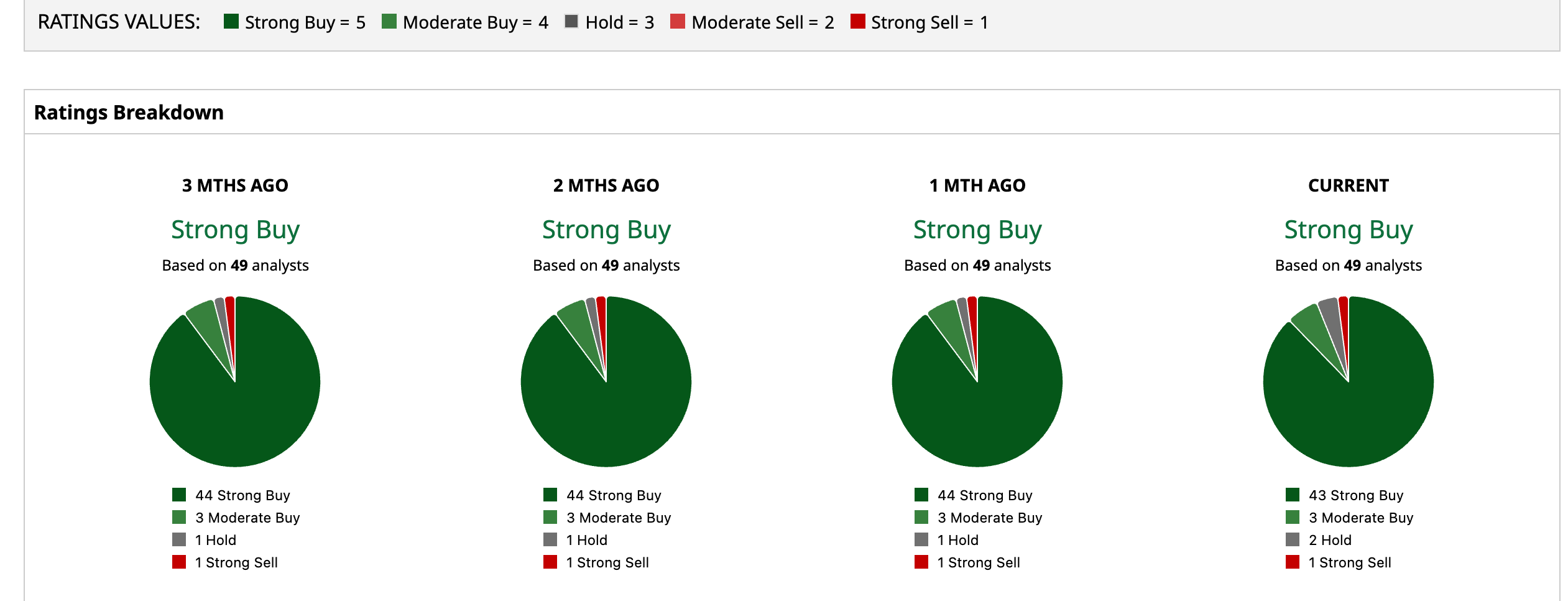
The stock currently enjoys a consensus “Strong Buy” rating overall. Of the 49 analysts covering the company, 43 recommend “Strong Buy,” three assign a “Moderate Buy,” two remain on the sidelines with “Hold” ratings, and only one carries a “Strong Sell” recommendation. Moreover, analysts also see considerable room for further gains.
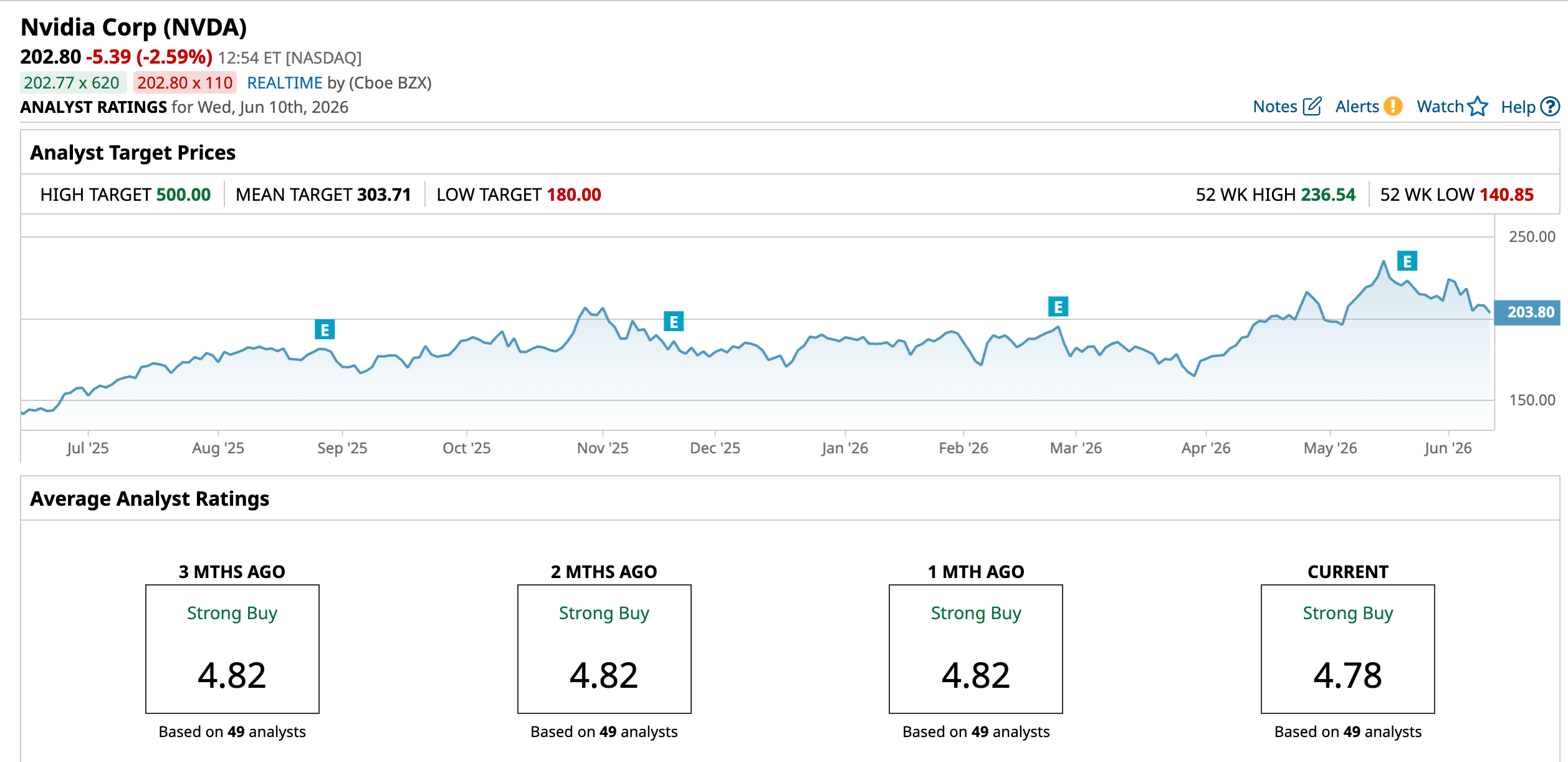
The average price target of $303.71 suggests upside potential of 49.8% from current levels, while the most optimistic target of $500 implies the shares could soar more than 146.6% in the next 12 months. For many on Wall Street, Nvidia’s recent pullback looks far more like a buying opportunity than a reason to abandon one of the biggest winners of the AI era.
 www.barchart.com
  www.barchart.com
 On the date of publication, Anushka Mukherji did not have (either directly or indirectly) positions in any of the securities mentioned in this article. All information and data in this article is solely for informational purposes. For more information please view the Barchart Disclosure Policy here.
More news from Barchart
Amid an Ugly Tech Selloff, Nvidia Director Mark Stevens Ditched 1 Million Shares Only 1 Stock Is the Indispensable Backbone of the $1.8 Trillion Space Economy — and It’s Not SpaceX Billionaire Sam Altman Says OpenAI Was ‘Pretty Wrong’ About AI Jobs, But Goldman Sachs Warns AI is Still Wiping Out 11,000 Jobs Per Month The $500 Million Reason Redwire Stock Is Down Today