


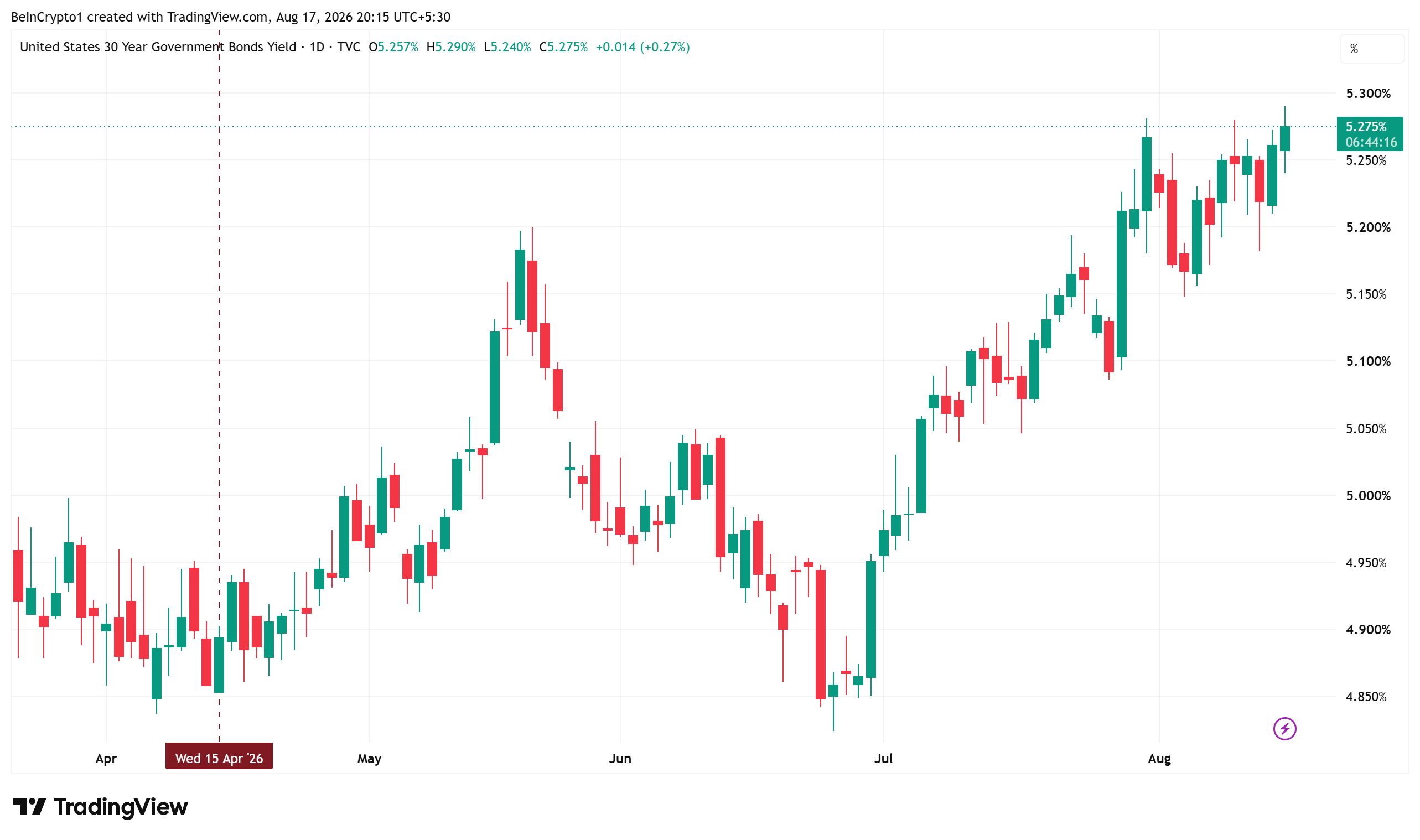
The US government now pays 5.27% to borrow for 30 years, the highest rate of 2026. Artificial intelligence (AI) companies are a large part of the reason. Bitcoin (BTC) is losing the fight for the same money.
Bitcoin trades near $63,517, down 46.1% over the past 12 months. Gold rose 32.6% in the same stretch. The gap between them is almost 79 percentage points.
AI Borrowing Now Competes With the US Treasury
Start with the trend. US technology companies used to sell about $61 billion of bonds a year. That is the five-year average, JPMorgan Asset Management said in July. In 2025 they sold $131 billion. By late July 2026 they had sold $192 billion.
One sector now accounts for 27% of all net investment-grade bond sales, by JPMorgan's count. Across every US company, issuance reached $1.68 trillion through July. That tally comes from the Securities Industry and Financial Markets Association.
Here is why that matters. The buyers are the same pension funds and insurers that fund Washington. Nomura Securities estimates Big Tech borrowing now equals roughly 25% of Treasury net bond sales to private investors. A year ago the share was five times smaller.
"Whoever's issuing, be it a government or a hyperscaler or a non-hyperscaler credit, is now competing with more borrowers. And therefore yields have to be higher," Tony Rodriguez, head of fixed-income strategy at Nuveen Asset Management, in a statement to Bloomberg.
Follow us on X to get the latest news as it happens
Why Bitcoin Loses When Yields Rise
The mechanism is simple. Bonds pay interest. Bitcoin does not.
The 30-year Treasury yield closed at 5.25% on August 14, its highest level this year, Treasury Department data show. The 10-year sits at 4.68%, up 0.49 percentage points since January 2.
Bank of America economists attribute about 0.3 of that rise to corporate and mortgage bond supply. On those numbers, new debt supply explains roughly 60% of the move in the 10-year this year.
Corporate paper pays even more. Alphabet priced 30-year debt near 6.4% recently, about 1.15 points above comparable Treasuries, Bloomberg reported. A bond financing a Meta data center paid over 7.5% last month.
An investor can now earn 6% or 7% from two of the world's most profitable companies. That is the bar Bitcoin's price performance must clear. It has not cleared it since global bond yields climbed to 2008 levels.
The Treasury Cannot Sidestep It
Treasury Secretary Scott Bessent has tried to protect long-term rates by selling more short-term debt instead. Barclays estimated the shift would cut net supply of new Treasury notes and bonds by $440 billion this year.
AI borrowing filled that space and more. Barclays expects net corporate bond supply to grow by $474 billion, most of it from the tech giants.
Washington is not borrowing less either. The federal deficit hit $1.8 trillion in the first 10 months of fiscal 2026. That is $169 billion more than last year, the Congressional Budget Office said. Rising US debt interest costs add to it.
The AI bill is also mostly unpaid. JPMorgan Asset Management projects $5.5 trillion of AI capital spending through 2030. It expects $2.1 trillion of that to come from new bonds.
"That is a crowding-out effect. It is important to remember that we are just starting. This hyperscaler debt issuance story has really just begun," Greg Peters, co-chief investment officer at PGIM, in a comment on Bloomberg Television.
Endless borrowing is the core of the Bitcoin scarcity argument. This year the argument has not paid. Gold took the money, and the 30-year Treasury yield record shows why. The next long-end auctions will test whether buyers have room for both.
Read the Original story AI Debt Lifts 30-Year Treasury Yield to 5.27%: Can Bitcoin Compete? by Lockridge Okoth at beincrypto.com