


South Korea’s crypto tax delay could become an encouraging development for Bitcoin investors as the government seeks to postpone its planned cryptocurrency gains tax for another two years.
Finance Minister Lee Hyoung-il announced on November 5 that authorities will work with lawmakers to move the tax’s implementation from January 2027 to January 2029.
The proposal comes as South Korea prepares for international cryptocurrency tax information sharing and continues developing its digital asset regulatory framework.
We believe the decision could provide valuable breathing room for Bitcoin investors while allowing the country to establish a more balanced approach to cryptocurrency taxation.
Although parliamentary approval is still required, the announcement signals that policymakers are taking the industry’s long-term development seriously.
South Korea Moves Toward Another Crypto Tax Delay
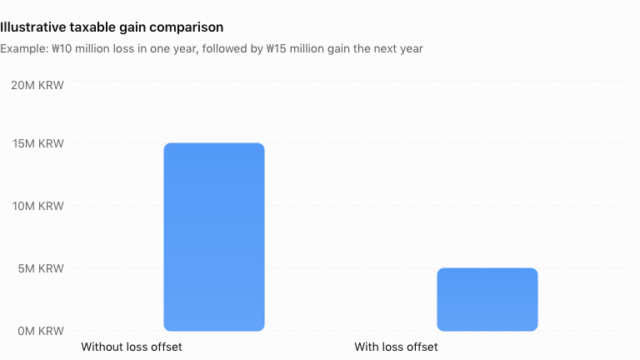
Illustrative example only. Figures show gains before the annual tax-free deduction and assume the prior loss qualifies under the proposed rules. Actual tax treatment will depend on final legislation.
South Korea originally introduced its cryptocurrency taxation framework in 2020, with implementation initially scheduled for 2022.
However, concerns about market readiness, investor protections, and regulatory infrastructure have repeatedly delayed the rollout.
Under the existing framework, cryptocurrency gains exceeding 2.5 million won annually would face a combined tax rate of 22%, including local income tax.
Now, the government wants another two years to prepare.
According to the South Korean government’s November 5 policy announcement , authorities intend to improve tax reporting infrastructure, strengthen investor protections, and prepare more comprehensive digital asset legislation.
The proposal must still pass through the National Assembly before the implementation date officially changes.
For Bitcoin investors, we see the possibility of additional preparation time as an encouraging development.
Why the Tax Delay Could Benefit Bitcoin Investors
Bitcoin has become an increasingly important investment asset for individuals seeking exposure to decentralized finance and alternative stores of value.
However, complicated taxation rules can discourage participation, particularly when investors face uncertainty about how their gains and losses will be treated.
South Korea’s proposed delay could give investors additional time to understand future requirements and plan their cryptocurrency activities.
It could also allow exchanges and financial institutions to develop more reliable reporting systems.
Earlier this year, we covered how more than 50,000 South Korean investors supported a petition challenging the country’s cryptocurrency tax framework .
The latest government announcement suggests that concerns about fairness and market readiness remain relevant.
We believe that clearer and more practical regulations could encourage confidence in Bitcoin as a long-term investment.
Nevertheless, the proposed postponement does not guarantee higher Bitcoin prices or permanently eliminate future taxation.
A Fairer Tax System Could Strengthen Bitcoin Adoption
One particularly encouraging aspect of the government’s announcement is its willingness to reconsider how cryptocurrency investment losses are treated.
Officials are proposing a three-year loss carryforward mechanism.
This would potentially allow investors to offset certain future taxable profits against qualifying losses from earlier years.
For Bitcoin investors, whose portfolios can experience significant price fluctuations, such a system could create a more balanced approach to taxation.
It would recognize that cryptocurrency investments can involve both profitable and unprofitable periods.
We previously examined South Korea’s debate over cryptocurrency tax fairness and investor protections .
We believe that a framework accounting for market volatility could help establish a more sustainable environment for Bitcoin participation.
The government also plans to establish a public-private working group to develop detailed taxation standards.
If implemented effectively, these measures could make the country’s cryptocurrency market more transparent and accessible.
Could South Korea Become a Stronger Bitcoin Market?
South Korea already has an established cryptocurrency trading industry, supported by domestic exchanges and an active community of digital asset investors.
The government’s latest proposal could provide additional time for this ecosystem to develop.
Authorities are also preparing to exchange cryptocurrency tax information with the United States beginning in 2029.
Aligning the tax implementation timeline with international reporting arrangements could help reduce inconsistencies between domestic and overseas transactions.
Meanwhile, South Korea has gradually explored opportunities for greater institutional cryptocurrency participation.
As we previously reported, South Korea introduced plans to expand corporate cryptocurrency investment under certain restrictions .
Together, these developments suggest a broader effort to integrate digital assets into the country’s financial system.
We believe Bitcoin could benefit from this evolution because of its established market position, decentralized network, and transparent monetary policy.
However, the actual impact will depend on future legislation, institutional participation, and investor demand.
Bitcoin’s Long-Term Future Looks Increasingly Established
The proposed tax postponement highlights a broader change in how governments approach cryptocurrency.
Rather than treating digital assets solely as speculative instruments, policymakers are increasingly considering how to regulate them within established financial systems.
For Bitcoin, we see this as an encouraging long-term trend.
Its maximum supply of approximately 21 million coins, decentralized infrastructure, and global accessibility continue to distinguish it from traditional currencies.
A more supportive regulatory environment could make it easier for investors and financial institutions to participate in the Bitcoin ecosystem.
At the same time, taxation and regulation will remain important responsibilities for governments.
We believe the strongest outcome would be a framework that protects investors without unnecessarily limiting innovation.
South Korea’s latest proposal could represent another step in that direction.
For us, the bigger story is not simply that cryptocurrency taxation might be delayed.
It is that one of Asia’s established digital asset markets is taking additional time to build rules that could support Bitcoin’s continued development and its place in the future of global finance.