


Bitcoin could become an increasingly attractive asset for institutional investors in 2027, even without a major price rally. According to a new forecast from Swiss digital asset bank Sygnum, Bitcoin carry trades could generate higher returns than short-term US government debt as derivatives markets recover. The prediction comes as institutional Bitcoin trading continues reshaping how professional investors approach the cryptocurrency market.
The forecast introduces an interesting possibility: Could Bitcoin become a competitive source of investment returns even when its price moves sideways?
Sygnum believes improving funding conditions and renewed institutional demand could make this possible, potentially opening another opportunity for professional investors seeking returns from cryptocurrency markets.
Sygnum Predicts A Major Bitcoin Carry Trade Recovery
In its November 19 2027 Sygnal Outlook , Sygnum predicted that Bitcoin carry trades could outperform US Treasury bills on average next year.
The strategy involves purchasing Bitcoin on the spot market while simultaneously opening a short position in Bitcoin futures.
This combination reduces direct exposure to BTC price movements while allowing investors to potentially capture the difference between spot and futures prices.
For institutional investors, the appeal is straightforward.
Instead of relying entirely on Bitcoin appreciation, traders can seek returns from the structure of the derivatives market.
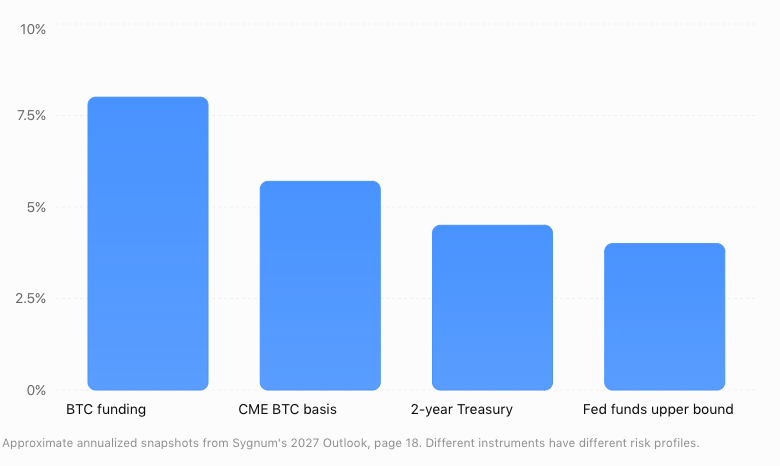
Sygnum expects the annualized premium on three-month CME Bitcoin futures to average more than two percentage points above three-month Treasury bill yields in 2027.
The bank also expects open-interest-weighted Bitcoin funding rates to exceed Treasury bill yields by a similar margin.
These forecasts are conditional, and actual returns would depend on execution costs, funding changes, and market conditions.
Why Bitcoin Funding Rates Could Become Important Again
Bitcoin’s derivatives market experienced significant changes throughout 2026.
According to Sygnum, Bitcoin’s 30-day average funding rate remained negative for 67 consecutive days through May, representing its longest negative streak of the decade.
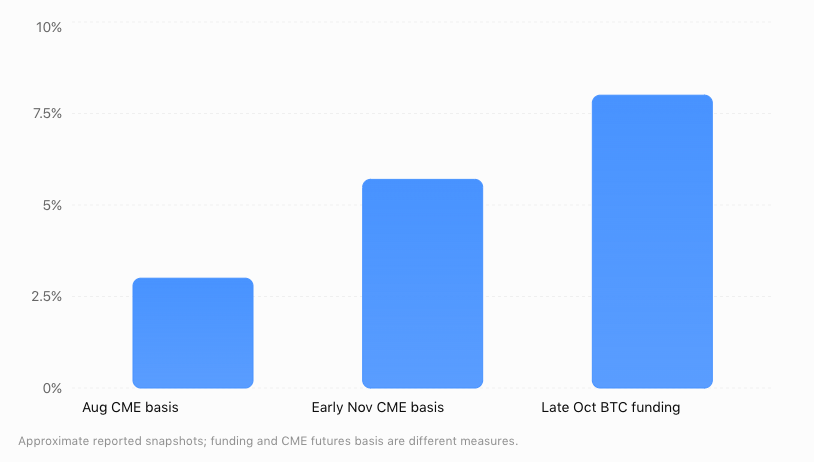
By August, the annualized CME Bitcoin futures basis had fallen to approximately 3%, below the 3.8% yield on two-year US Treasury securities.
This made traditional government debt comparatively attractive for investors seeking predictable returns.
However, conditions began improving toward the end of October.
Bitcoin funding rates recovered to approximately 8% annualized, suggesting that demand for leveraged exposure was returning.
The improvement could be important because positive funding conditions create opportunities for traders who hold Bitcoin while maintaining offsetting short positions in perpetual futures.
Nevertheless, funding rates can change rapidly, and a positive annualized snapshot does not guarantee sustained returns.
Why Institutional Investors Could Return To Bitcoin
The recovery in Bitcoin carry opportunities could also reflect changes in institutional positioning.
During previous periods, hedge funds frequently purchased spot Bitcoin ETFs while shorting CME futures to capture the futures premium.
As more investors entered the same trade, competition compressed potential returns.
Bitcoinist previously examined how Bitcoin ETF trading strategies can influence institutional positioning, including the importance of distinguishing directional selling from the unwinding of market-neutral positions.
Sygnum’s outlook suggests that reduced competition could eventually allow futures premiums to widen again.
The bank also points to expanding institutional adoption, tokenization, and Bitcoin’s growing role in investment portfolios as potential sources of demand.
Rather than treating BTC exclusively as a speculative asset, professional investors are increasingly examining how it can function within broader portfolio and derivatives strategies.
However, a carry trade is not equivalent to a directional Bitcoin investment. A fully hedged position may benefit from market premiums without benefiting directly from a BTC price rally.
Could Bitcoin Become More Attractive Than Traditional Assets?
Sygnum’s prediction suggests that Bitcoin derivatives could offer opportunities unavailable in conventional fixed-income markets.
However, comparing carry returns with Treasury yields requires considering their different risk profiles.
US Treasury bills offer government-backed repayment at maturity, while Bitcoin carry trades involve exchange exposure, collateral requirements, derivatives execution, and potentially significant margin risk.
A sudden market movement can force traders to provide additional collateral or unwind positions even when their overall strategy is intended to be market-neutral.
These risks are not merely theoretical. As Bitcoinist previously explored, Bitcoin basis-trade unwinding can amplify market volatility when leveraged institutional positions are rapidly closed.
Higher interest rates could also reduce the attractiveness of Bitcoin carry trades by increasing the return investors can obtain from government debt.
For Sygnum’s forecast to succeed, the improvement in Bitcoin funding conditions would need to persist beyond short-lived periods of leveraged speculation.
What Comes Next For Bitcoin In 2027?
Sygnum’s outlook provides two measurable indicators for evaluating the market.
First, the annualized three-month CME Bitcoin futures basis would need to average more than two percentage points above three-month Treasury bill yields.
Second, open-interest-weighted Bitcoin funding rates would need to maintain a similar advantage.
The bank considers its forecast invalidated if either measure remains below Treasury bill yields for two consecutive quarters.
For Bitcoin investors, the broader significance extends beyond the potential returns of a single trading strategy.
An expanding derivatives market could improve liquidity, attract additional institutional participants, and support Bitcoin’s integration into traditional financial portfolios.
If these developments continue, Bitcoin’s next stage of institutional adoption may depend not only on how high BTC can climb, but also on the financial opportunities created around the asset itself.