


The crude oil market experienced price spikes in 2008, 2022, and Q1 2026. While explosive moves pushed prices above $100 per barrel, they more than halved following the 2008 and 2022 highs. While NYMEX crude oil futures prices remain near the current $100 pivot point after the latest rally, historical trading patterns suggest that a significant correction is eventually likely.
I concluded a March 13, 2026, Barchart article on crude oil with the following:
Don’t Miss a Day: From crude oil to coffee, sign up free for Barchart’s best-in-class commodity analysis.
I believe that crude oil prices will eventually head substantially lower. However, the current conflict could cause periodic price spikes. The Iranian theocracy’s strategy appears to be to inflict maximum economic damage to the U.S. administration. While they may have a few short-term victories, the odds favor an eventual resolution that includes lower oil prices. However, the price action is likely to be a wild ride until it gets there.
Nearby WTI and Brent crude oil prices were trading at $94.44 and $100.69 per barrel, respectively, on March 13. On April 13, prices were slightly below those levels.
A pattern of explosive and implosive price moves
Since 2008, NYMEX crude oil prices have rallied above $100 per barrel four times: in 2008, 2011-2013, 2022, and most recently in 2026.
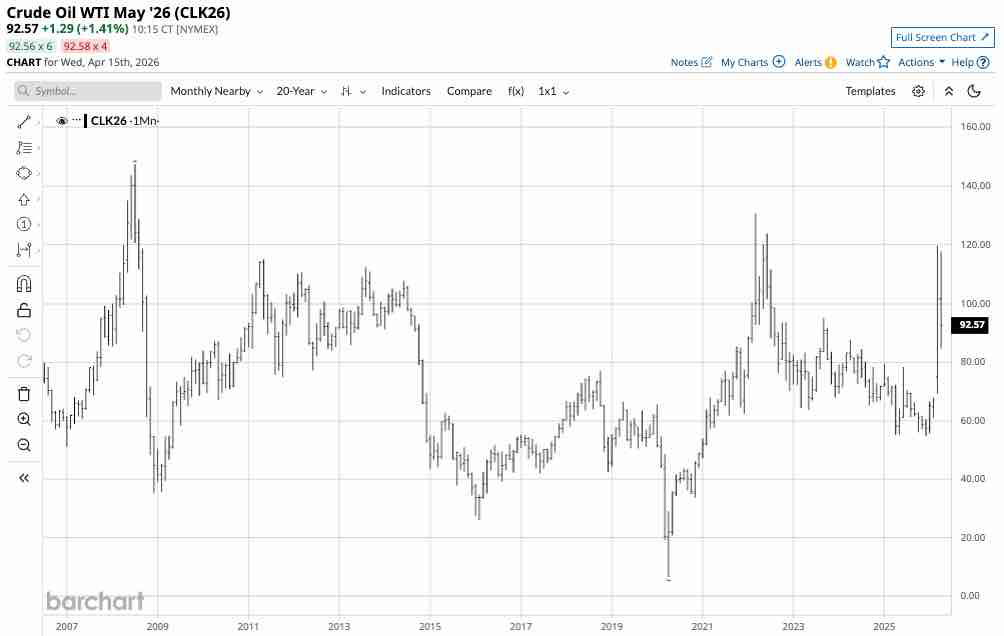
The 20-year monthly continuous contract chart shows that the July 2008 rally to the all-time high of $147.27 per barrel ran out of steam and the price fell 76.15% to a December 2008 low of $35.13 per barrel.
After reaching $114.83 in May 2011 and trading around the $100 per barrel pivot point until July 2014, NYMEX crude oil dropped 94.34% to a $6.50 low in April 2020, when the global pandemic gripped markets across all asset classes. Nearby crude oil prices dropped below zero in April 2020 when the market ran out of storage capacity.
When Russia invaded Ukraine in March 2022, NYMEX crude oil futures returned to over $100 per barrel, reaching a high of $130.50. The price declined 57.94% to a low of $54.89 in December 2025. The war with Iran sparked the latest rally, which took NYMEX crude oil to a high of $119.48 per barrel in March 2026.
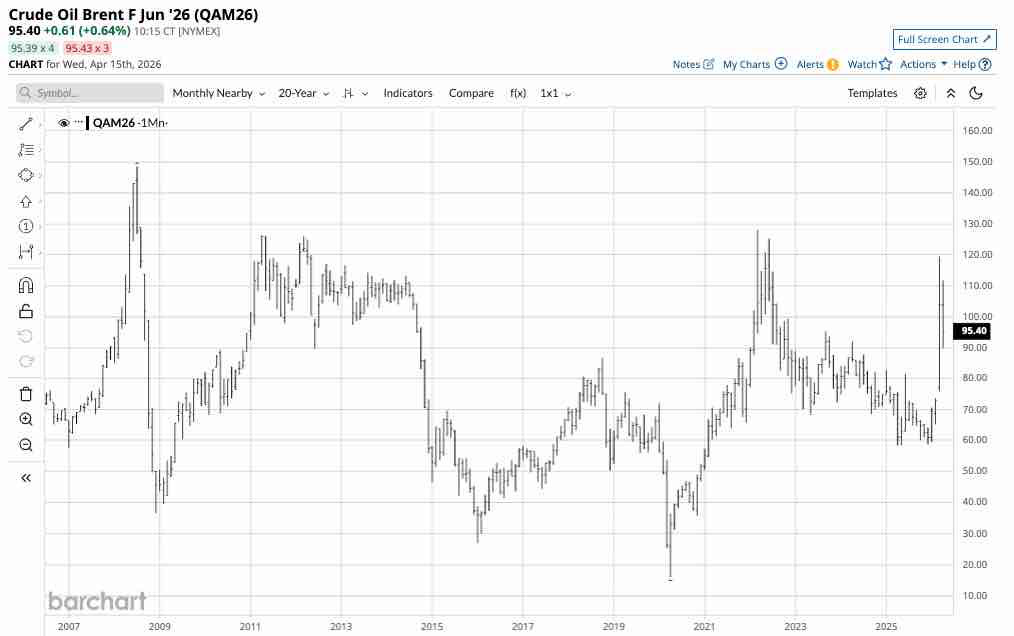
The monthly continuous chart of Brent crude oil futures highlights the same explosive and implosive patterns over the past two decades.
A rally above the 2008 high would be dangerous for markets across all asset classes
The war with Iran has created a new dynamic for the crude oil market. The Strait of Hormuz, a critical logistical chokepoint through which around 20% of the world’s petroleum passes, has closed, as Iran has used the passage as an economic nuclear weapon against the United States. With midterm U.S. elections on the horizon, the closure of the Strait of Hormuz has offset Iran’s military losses, with the Iranian regime betting that the U.S. will feel increasing domestic and foreign pressure to back down. After the latest attempt to negotiate a settlement ended with Iran refusing to give up its nuclear ambitions, the U.S. announced a blockade of the Strait, only intensifying pressure on crude oil prices. Iran has threatened to attack neighboring Middle Eastern ports in response, and it is possible that the Houthis, an Iranian proxy in Yemen, will attempt to close another critical logistical passage in the Red Sea. Iranian missiles and drones have impacted crude oil production, refining, and pipelines in neighboring countries, including Saudi Arabia, Iraq, Bahrain, Qatar, and Oman. The bottom line is that the longer the war continues and Middle Eastern petroleum and oil products cannot flow freely, the higher the price could climb, with some analysts forecasting a rise to $200 per barrel or higher.
Crude oil is trading with the news cycle
The war with Iran and Iranian retaliation on neighboring countries throughout the Middle East have global ramifications. China and India, the world’s most populous countries, depend on Iranian and Middle Eastern crude oil, as do other Asian countries and countries worldwide. Since crude oil remains the energy commodity that powers the world, markets across all asset classes are trading with it, which has become highly sensitive to comments from the U.S. and Iranian leadership and to events and attacks in the Middle East. Markets reflect the economic and geopolitical landscapes, and the news cycle has become more critical in the current environment. Rising oil prices ignited inflationary pressures, translating to volatility across all asset classes.
Change in the Middle East- For Better or Worse
The longer the war in Iran continues, the higher crude oil prices are likely to rise. Historical patterns of explosive and implosive crude oil trading, increased U.S. production, and Iran’s isolation from other Middle Eastern countries suggest that prices will eventually drop precipitously if there is regime change in Iran. However, Iranian allies, China, Russia, and North Korea, all nuclear powers, could complicate matters if logistical routes remain closed and a petroleum shortage creates Asian domestic woes. The bottom line is that the longer the Iranian regime can hold on and upset the flow of crude oil, the higher oil prices will rise. Time will tell whether the situation improves or worsens in the near term, but a significant political change is on the horizon in the Middle East. That change will determine the path of least resistance of crude oil prices in the short and long term.
Trading crude oil with the USO and BNO ETFs
Uncertainty increases market volatility, and volatility creates trading opportunities. The day-to-day news cycle and events in the Middle East will determine whether crude oil prices rise or fall, and markets across all asset classes will likely follow the energy commodity. Crude oil’s price is now ground zero for all markets, as it serves as a barometer for the most significant geopolitical event in years.
Wide crude oil price swings make the NYMEX WTI and ICE Brent futures markets, the international pricing benchmarks, fertile ground for those seeking risk positions in the energy commodity that powers the world. Any risk position in the volatile crude oil arena requires careful attention to risk-reward dynamics. A long or short position should have clear stops and profit horizons. If the price moves contrary to expectations, stick to the stop to protect capital. When the price moves in the expected direction, it is acceptable to adjust and increase profit horizons, but always adjust stops to protect profits and capital.
The two highly liquid ETF products that track nearby NYMEX WTI and ICE Brent futures are the U.S. Oil Fund (USO) and the U.S. Brent Oil ETF (BNO). At $124.80 per share, USO had over $2.194 billion in assets under management. USO trades an average of over 45.8 million shares per day and charges a 0.70% management fee. At $47.63 per share, BNO had over $871.8 million in assets under management. BNO trades an average of over 8.94 million shares per day and charges a 1.14% management fee.
Expect volatility in crude oil prices over the coming days, weeks, and perhaps months, depending on developments in the Middle East. While historical trading patterns suggest an eventual implosive move, prices could rise before then. Moreover, the current environment supports wide price ranges with prices closely following the daily news cycle. Trading crude oil is optimal in the current environment.
On the date of publication, Andrew Hecht did not have (either directly or indirectly) positions in any of the securities mentioned in this article. All information and data in this article is solely for informational purposes. For more information please view the Barchart Disclosure Policy here.
More news from Barchart
Is Bloom Energy Stock a Buy, Sell, or Hold at New All-Time Highs? Should We Expect Wide Swings in the Crude Oil Futures Markets? Bloom Energy Just Partnered With Oracle. Does That Make the Fuel Cell Energy Stock a Buy Here? Turbine Season for Tech: John Rowland on the Next Era of AI Data Center Investments