

For the better part of two years, the solar industry hasn’t just been out of favor. It has been in the stock market’s version of a solar eclipse. But lately, the charts are starting to whisper something different. Are we finally seeing a bottom, or is this just another case of this industry throwing shade?
The solar trade is the ultimate test of an investor’s patience. On one hand, you have the structural, long-term green energy tailwind. Sure, it has taken a backseat under President Donald Trump. But in other parts of the world, the move toward alternative forms of power is still accelerating. And that was before the Iran War began.
More Yield, Less Trap: Sign up free to get Barchart’s daily Dividend Investor newsletter straight to your inbox.
On the other hand, high interest rates are a huge blocker here. For companies that rely on heavy financing for residential and utility-scale projects, that’s a burden, and perhaps one they were not counting on. The Federal Reserve’s current policy is often characterized as “higher for longer” which implies that by now, solar company executives would have expected to be able to roll over debt at more friendly borrowing rates.
 www.barchart.com
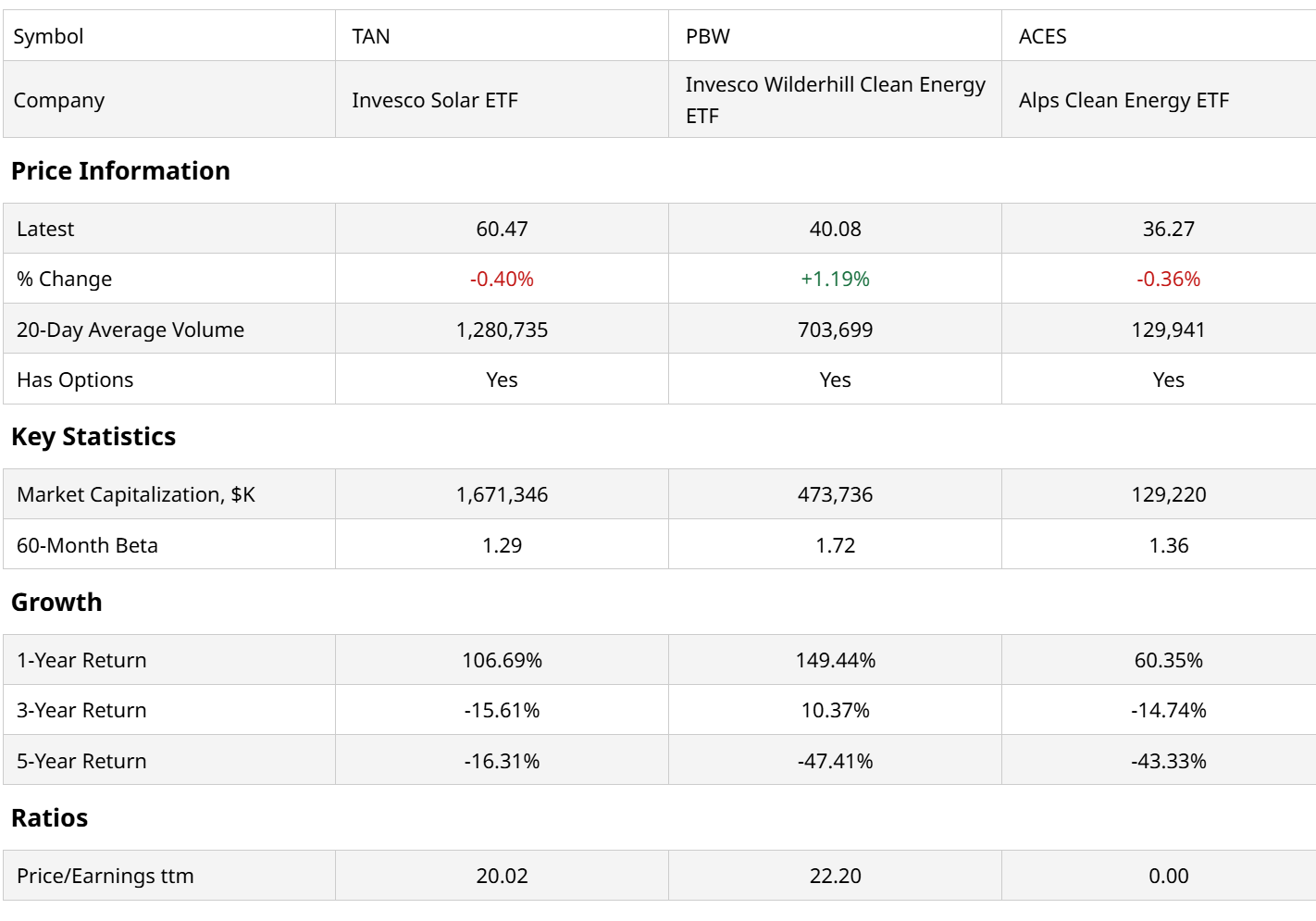
 Instead, on a multi-year basis, these three ETFs, one (TAN) which focuses entirely on solar stocks, and the other two that feature it as part of a more diverse clean energy mix, have all suffered. We all have different instincts when it comes to number analysis, but I’ll tell you this: when I see an ETF that has doubled in price the past 12 months, and it is STILL down over the past five years, that’s a statistical oddity.
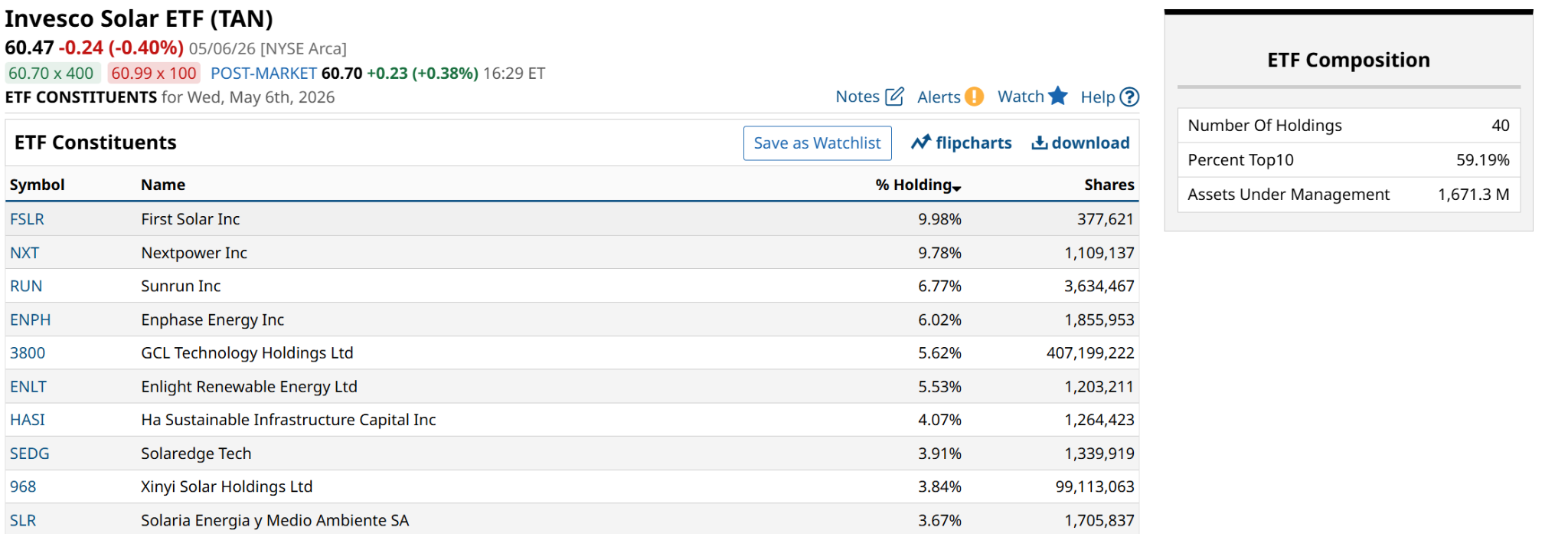
The Invesco Solar ETF (TAN) is the purest play on the sector, but it’s also the most volatile. It’s concentrated, top-heavy, and when it moves, it moves fast. But with all ETFs, the question is whether it is useful. That has a lot to do with whether it is unique.
 www.barchart.com
 I’m on a continued quest to help investors determine how many ETFs are more than simply “beta plays” which follow the S&P 500 Index ($SPX) up and down, but with more volatility in both directions. Here is a chart of 12-month rolling returns, with quarterly moving windows.
What do I see? Pardon the rhyme and the pun, but something new under the sun. SPY (SPY) and TAN move like they are not even the same asset type. But yes, they are both ETFs. And they have both been around a long time. So while TAN might not be a great buy-and-hold candidate, it can be quite viable as an intermediate-term position.
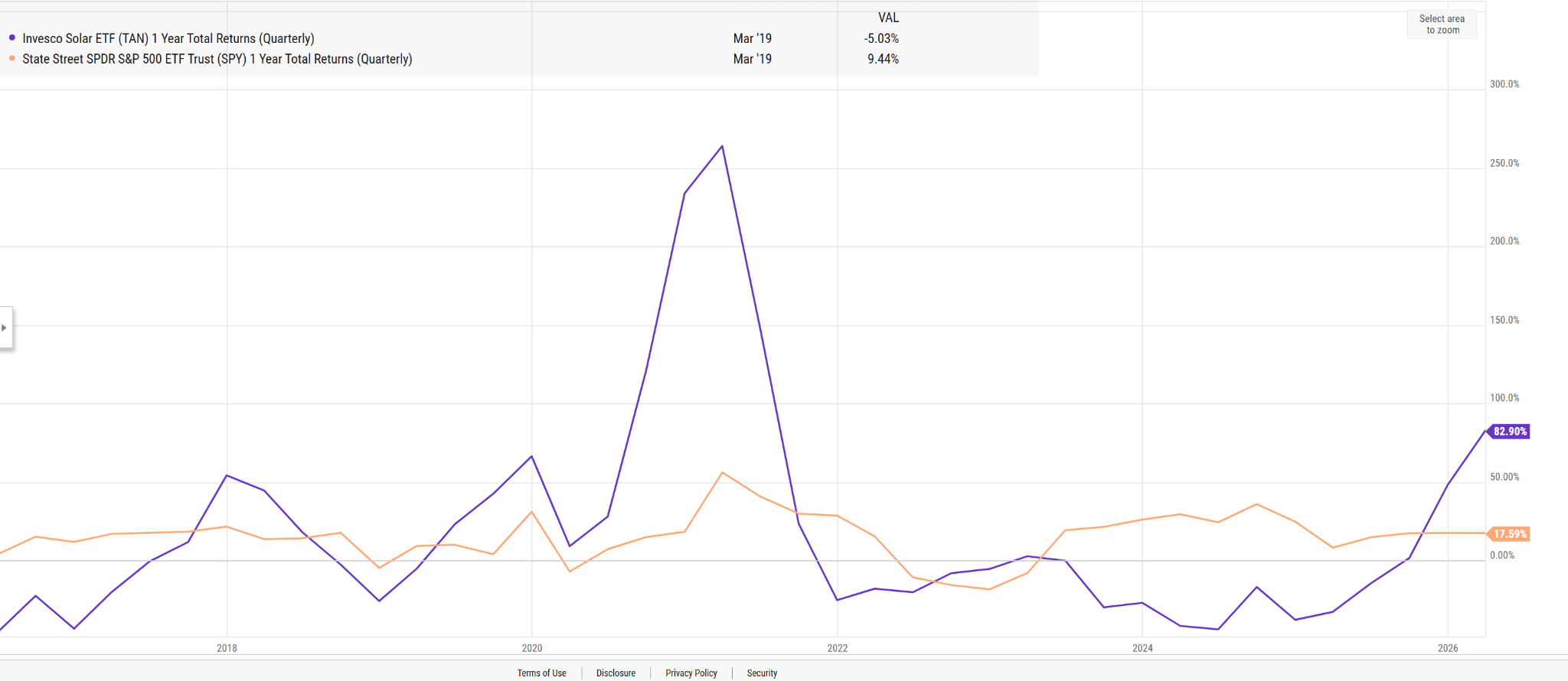 Chart courtesy of Rob Isbitts via PiTrade.com
 For technical traders, TAN has been carving out what looks like a massive basing pattern. We’ve seen a series of higher lows recently, and it’s knocking on the door of a key price level that has acted as a ceiling. This daily view has a good shot of breaking through.
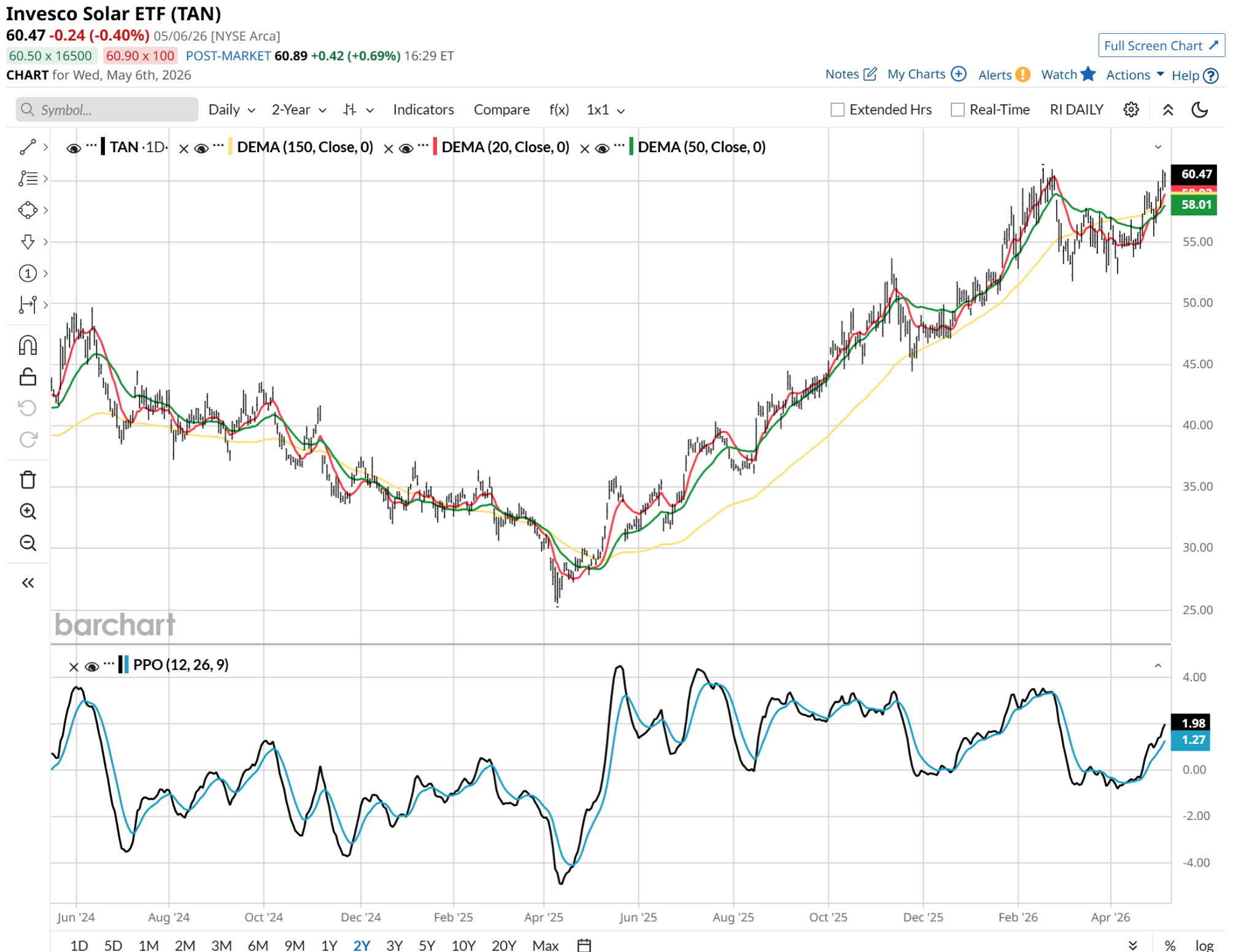 www.barchart.com
 But at the same time, if it is going to fail, it ought to be here. That’s a good thing, since as a technician, I know I’ll be wrong. But if I find out quickly that I’m wrong, I can free up that capital sooner, and find a more productive spot for it.
Investing in solar isn’t about saving the planet. It’s about whether the price action confirms the narrative. Right now, the narrative is finally catching up to the price.
The Alternatives: ACES and PBW
If TAN is a triple espresso, ALPS Clean Energy ETF (ACES) and Invesco WilderHill Clean Energy ETF (PBW) are more like a strong cup of breakfast tea. They offer broader exposure, diluted somewhat, with solar as a piece.
ACES is more focused on North American players. It’s a bit more conservative and includes wind, hydro, and EV infrastructure.
PBW is one I’ve followed for a very long time. It debuted back in 2005, and at the time, it was about the most informative resource an investor could get on investing in green energy. It’s equally weighted, so no one stock can break it or make it.
One compelling aspect of solar ETFs is that valuations have been reset to levels we haven’t seen in years. We aren’t paying 100x earnings anymore. In some cases, we’re looking at single-digit multiples for companies that are still growing their top line.
Still, politics is the elephant in the room. With an election cycle looming, the fate of the Inflation Reduction Act (IRA) tax credits is always a talking point, even if the actual risk of repeal is low. Furthermore, oversupply from Chinese manufacturers continues to weigh on margins for the hardware players.
Solar stocks have been the dog of the energy complex for a while. But every dog has its day, and with the technicals aligning with a shift in the macro-environment, it might be time to restore this industry to the watchlist.
Rob Isbitts created the ROAR Score, based on his 40+ years of technical analysis experience. ROAR helps DIY investors manage risk and create their own portfolios. For Rob's written research, check out ETFYourself.com.
On the date of publication, Rob Isbitts did not have (either directly or indirectly) positions in any of the securities mentioned in this article. All information and data in this article is solely for informational purposes. For more information please view the Barchart Disclosure Policy here.
More news from Barchart
Solar ETFs Are Shockingly Cheap Now. Politics Will Decide If They’ll Burn You to a Crisp. This ETF Is Flying High Again. Here's How to Tell If It Will Continue. Don’t Trust This Top-Heavy Stock Market, Hedge It. Here’s Your Roadmap. 5 Stocks Our Top Technical Strategist is Tracking Now