Morgan Stanley’s early Bitcoin ETF demand came largely from self-directed investors rather than financial advisors, according to Amy Oldenburg, the firm’s head of digital asset strategy. The comments add nuance to how one of Wall Street’s largest wealth and asset management platforms is seeing Bitcoin exposure enter its ecosystem.
Speaking with Nate Geraci on the Crypto Prime podcast released May 20, Oldenburg said the first weeks of activity in Morgan Stanley’s Bitcoin ETP were driven mostly by investors acting directly through platforms rather than advisor-led allocations. The distinction matters because Morgan Stanley’s footprint in wealth management has made its crypto initiatives a closely watched signal for how digital assets may move deeper into traditional portfolios.
My conversation w/ @MorganStanley ‘s Amy Oldenburg…
We discuss: -Firm’s approach to crypto overall -Morgan Stanley Bitcoin ETF (MSBT) -Future crypto product development -Direct spot crypto trading on E*Trade -Crypto infrastructure build -Tokenization efforts
via @CryptoPrimePod pic.twitter.com/pBYT2i3hdN
— Nate Geraci (@NateGeraci) May 20, 2026
“The earliest weeks of the ETF flows were all self-directed,” Oldenburg said. “And I think that’s important to understand because I saw a number of articles out there making statements that our financial advisors were the ones that were using our own.”
Retail-Led Demand Powered Early Bitcoin ETF Flows
Morgan Stanley Investment Management filed for three crypto ETFs in January, covering Bitcoin, Solana and Ethereum. Its Bitcoin product, ticker MSBT, launched in early April and, according to Geraci’s framing in the interview, was already nearing $300 million in assets after roughly a month and a half of trading. He described it as one of the more successful ETF launches of the year among more than 460 new ETFs.
Oldenburg said Morgan Stanley’s advisors can use the product, but she emphasized that the platform is open and that advisors are not limited to the firm’s own Bitcoin ETP.
“We launched this specifically for our Morgan Stanley financial advisors to use, which they are absolutely able to use along with any other Bitcoin ETF in the market,” she said. “They have an open platform. There’s a number of solicited Bitcoin ETFs that are available for solicitation on that platform and they make that final fiduciary decision for their client as to what’s best.”
Instead, Oldenburg said early demand came through self-directed channels, including bank platforms and E*Trade . That suggests a meaningful portion of Morgan Stanley’s initial Bitcoin ETF uptake may be coming from investors who are already comfortable making crypto allocation decisions themselves, rather than from a top-down advisor push across the firm’s wealth business.
“Most of that early flow was self-directed, meaning that individuals were coming through bank platforms, the E*Trade platform and other venues and actively buying that asset directly,” she said. “And that’s, I think, a very interesting thing to see.”
For Morgan Stanley, the pattern appears to point to a wider education gap inside the traditional advice channel. Oldenburg said self-directed buying is not unique to MSBT and that Morgan Stanley sees similar behavior across its broader wealth platform. Her takeaway was that there is still room for more conversations between advisors and clients about how Bitcoin exposure fits into asset allocation.
That framing is notable because Morgan Stanley has positioned its Bitcoin ETP as part of a broader client-led digital asset strategy rather than an isolated product launch. Oldenburg said the firm does not typically launch products that clients are not asking for.
“There was a continued interest from clients and I think that’s one thing to note just in terms of how we think about our business overall for any of our divisions. We really are a client-led culture here. So we’re not launching something that our clients aren’t asking for. We tend to follow and listen to where our clients’ needs are,” she said.
The firm has also sought to compete on cost. Oldenburg highlighted the ETF’s 14 basis point management fee , arguing that a passive single-asset product should be priced in line with traditional financial-market expectations. She made a similar point about Morgan Stanley’s direct spot crypto trading initiative through E*Trade, where pricing is set at 50 basis points per transaction.
Beyond direct buying, Oldenburg said Morgan Stanley has seen “pretty significant interest” in in-kind transactions, where investors move spot crypto into an ETF wrapper. She said that demand surprised her and suggested it reflects the limits of holding assets purely in crypto-native form, particularly when clients want access to services such as estate planning, lending or broader capital markets functions.
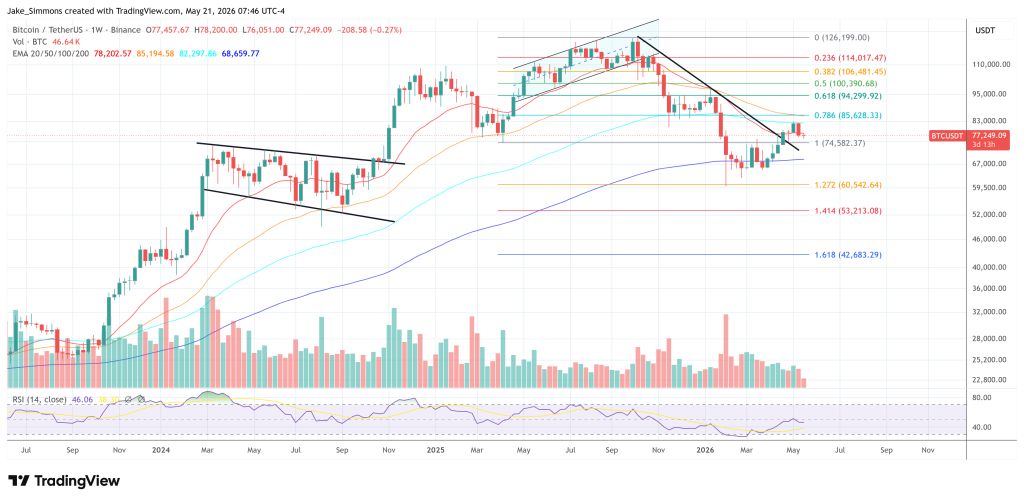
At press time, BTC traded at $77,249.