

$544. That is the average withdrawal on Argentine retail crypto rails such as Lemon Wallet. The median transfer is between $150 and $270—closer to rent money than a portfolio shift.
That figure changes the familiar image of capital flight. Money once moved offshore through private bankers and complex accounts. Across Latin America, workers and small businesses can now do it from a phone.
BeInCrypto Intelligence’s 23-page report, The Exodus Economy, traced six routes money takes out of the region and audited 12 products marketed as dollar accounts. We shared the findings with five industry executives. Their responses point to a difficult question: once digital dollars remove the friction from leaving, what could persuade that money to return?
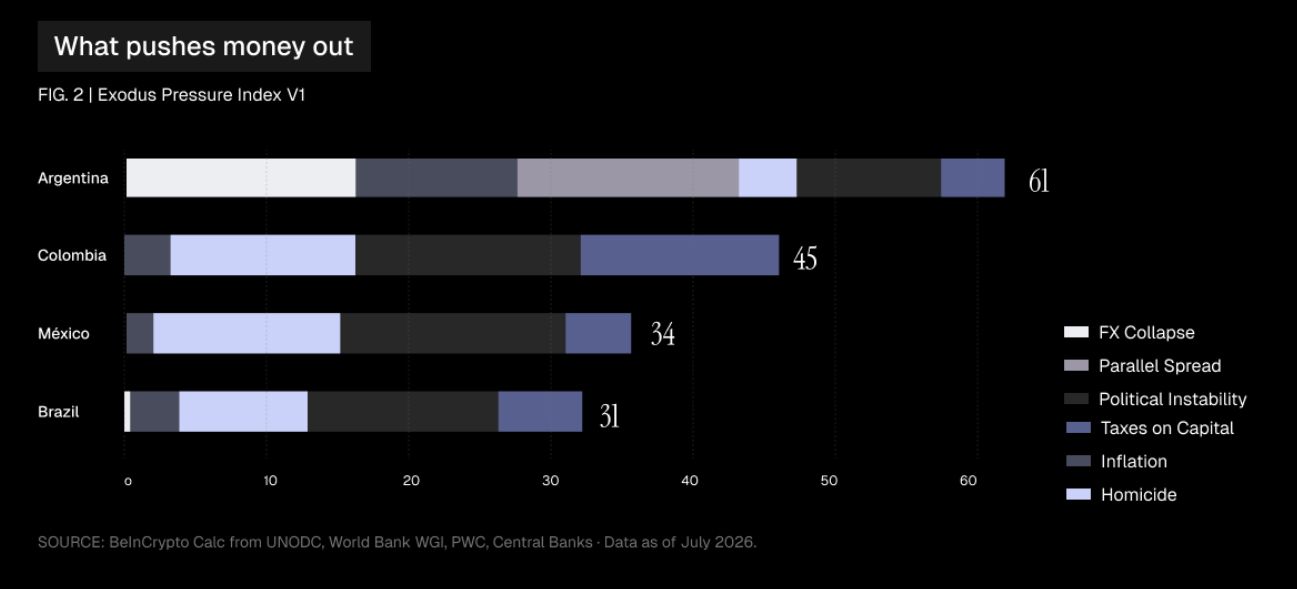 Why Locals are Sending Money Away from LATAM. Source: BeInCrypto
 Savers are Paying for an Exit
Brazil shows why returns alone cannot explain the movement. The report sets local savings and dollars to a starting value of 100 in 2016.
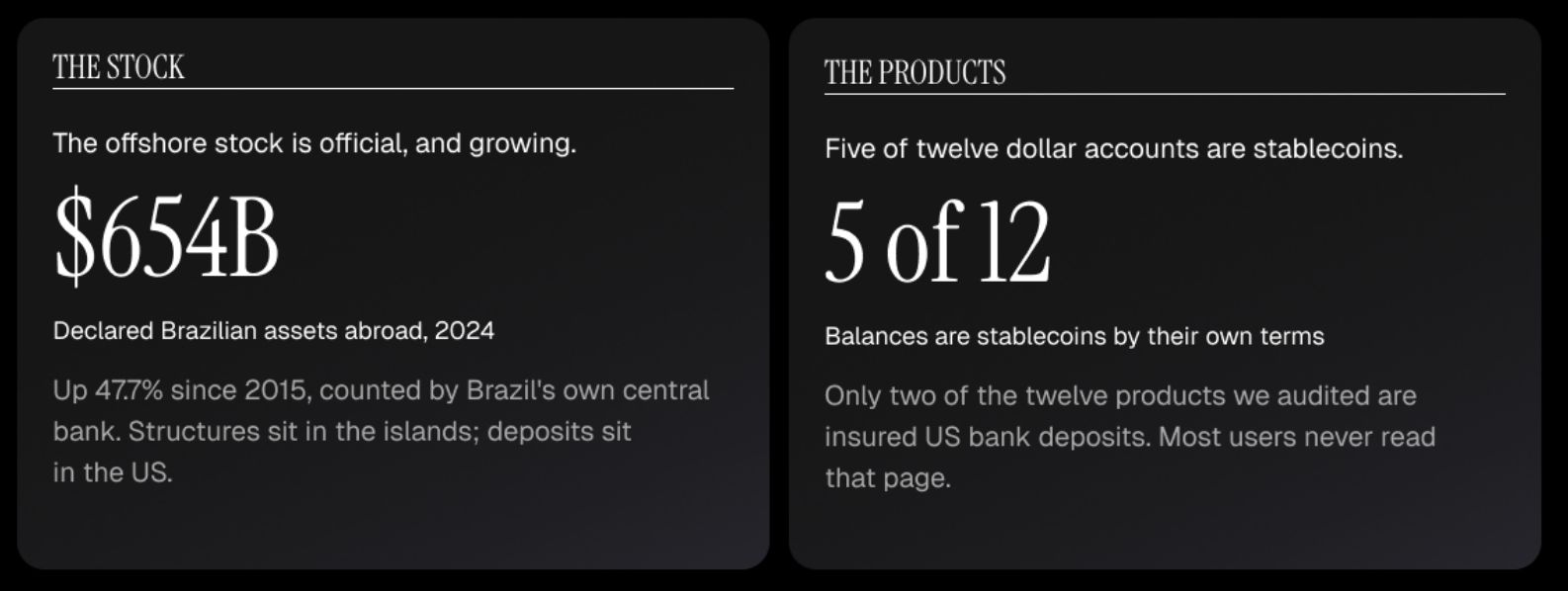
Money-earning Brazil’s benchmark CDI rate grew to about 150 over the next decade, while dollars held without yield ended at 99. Yet Brazilians’ declared offshore wealth reached an estimated $654 billion in 2024.
Argentina shows the risk they were trying to avoid. The same local-savings calculation ended at 44. From the starting line in 2016, nobody knew which country would deliver which outcome.
“I would call it an insurance premium rather than a fear premium. What those savers bought was not return, it was convertibility and jurisdictional optionality. A ten-year deposit returned 150 in Brazil and 44 in Argentina, and nobody in 2016 knew which column they were in.” Farhad Farhadi, CEO of Intelliwealth.
That insurance becomes harder for governments to counter when moving money takes seconds. Robin Nordnes, founder and CEO of Raiku, argues that economic stabilization does not immediately reverse habits formed through repeated crises.
“Friction used to do a lot of quiet retention work. If moving savings abroad required a private banker and a plane ticket, most people didn’t bother. Take that friction away and staying home stops being the default. Argentina fixed the price, but it hasn’t fixed the memory. Policy moves in months, and habits move in decades,” Robin Nordnes, Founder & CEO of Raiku
Lower inflation can repair a currency faster than it repairs public trust. Mobile access makes the old memory easier to act on.
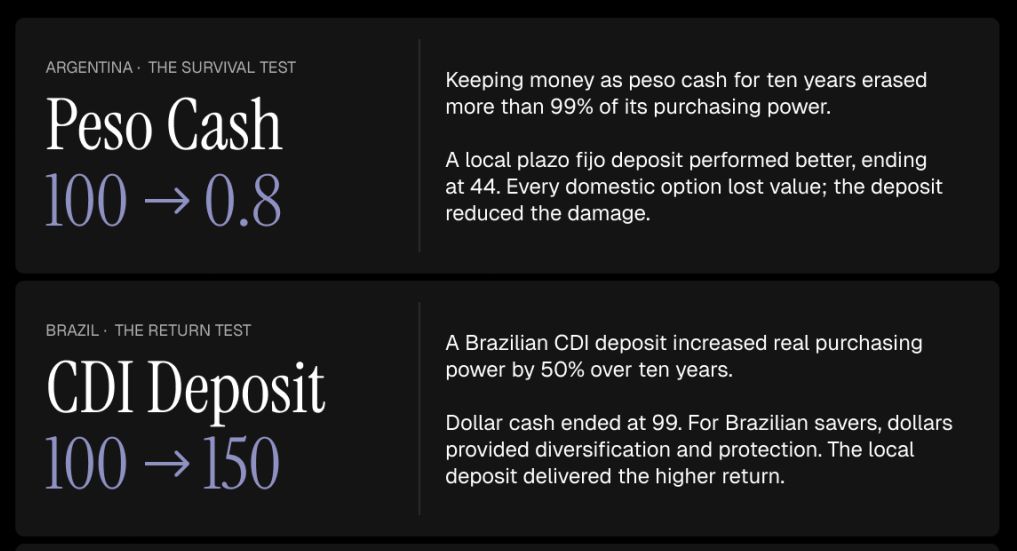 How Inflation Destroyed Argentina’s Peso, While Brazil’s Purchasing Power Increased. Source: The Exodus Economy
 A Dollar Label Can Still Hide Risk
Digital dollars make the exit cheaper, though the exchange is rarely one-for-one. Research cited by Farhadi found that stablecoin flows often bypass capital controls, while the premium paid for those dollars tends to rise in high-inflation economies.
Of the 12 dollar-account products audited by BeInCrypto, only two placed customer balances in insured US bank deposits. Five relied directly on stablecoins, and 10 failed the report’s basic self-verification test.
This leaves savers exchanging familiar domestic risks for less visible questions about the issuer, custodian, legal claim, and reserves. A dollar sign inside an app does not answer those questions.
The Money Keeps Moving
The report also found that more than 99% of withdrawn volume moved onward within 30 days. These digital dollars cover payroll, invoices, supplier settlement, and daily expenses. They function as rails rather than vaults.
Keith Vander Leest, US managing director at BVNK, says transaction velocity makes that distinction visible.
“If you look at the global supply of stablecoins relative to their volume, and then you compare that to fiat, global GDP, and M1 money supply, you can compare those two ratios and talk about the velocity of money. And the velocity of on-chain dollars is, depending on exact metrics, around a hundred times faster,” Keith Vander Leest, US Managing Director at BVNK
Businesses then face a second problem: how to earn on digital dollars without making cash flow unpredictable. Most on-chain credit pays variable rates, making it difficult for a finance manager to plan.
“The missing piece for institutions to fully adopt on-chain infrastructure was predictability, because credit markets ran almost entirely on variable rates. When yield floats, you cannot plan cash flow around it, leading businesses to leave digital dollars idle,” Merlin Egalite, Co-Founder at Morpho
Households face a harsher liquidity problem. Their protection may be held in dollars, while rent and groceries remain payable in local currency.
Artem Ponomarev, founder and CEO of XPlace, sees collateralized borrowing as one way to access cash without repeatedly selling those reserves. He warns that a badly designed loan could erase the savings it was meant to preserve.
“When borrowed funds cover basic living expenses, products must prioritize downside protection over leverage. Platforms require clear LTV limits, real-time collateral monitoring, and conservative liquidation terms to prevent volatile drawdowns from wiping out essential savings,” Artem Ponomarev, Founder & CEO of XPlace
The warning matters when a typical withdrawal is $544. A liquidation could take away money set aside for food or housing.
Home Now Has to Earn the Money Back
The five responses describe a financial competition that local institutions can no longer avoid. Each improvement in offshore dollar products—from predictable yield to easier credit—makes money held abroad more useful and raises the standard for bringing it home.
Macroeconomic stability remains essential. Savers will also look for transparent exchange rates, legally clear ownership, independent custody, and proof of where their money sits. The report shows that many offshore apps still fall short of that standard.
Latin American governments once relied partly on friction to keep capital inside their borders. That friction has largely disappeared. Regaining the money will depend on financial products that people can verify and institutions they are prepared to trust again.
Read the Original story Stablecoins Made It Easier for LATAM Money to Leave. Can It Return? by Brian McGleenon at beincrypto.com