


Bitcoin mining companies are undergoing a major transformation as artificial intelligence becomes an increasingly attractive alternative to traditional cryptocurrency mining. Recent financial results from IREN and Hyperscale Data reveal how quickly the industry is changing, raising an important question: could the shift toward AI eventually reshape Bitcoin’s mining network?
The transition comes as Bitcoin miners face growing competition for electricity , with AI data centers offering a potentially more predictable source of revenue than cryptocurrency mining.
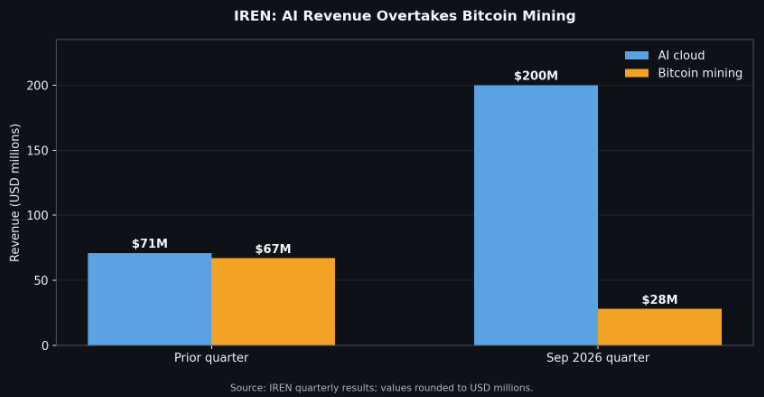
IREN’s latest quarterly results demonstrate the scale of the change. The company’s AI cloud revenue climbed to approximately $200 million, while Bitcoin mining revenue declined to just $28 million.
Meanwhile, Hyperscale Data has sold its remaining Bitcoin treasury holdings to support its own AI infrastructure expansion.
The developments suggest that some of the industry’s largest infrastructure operators are increasingly viewing electricity and computing capacity as assets that can serve markets beyond Bitcoin.
IREN’s AI Revenue Surges As Bitcoin Mining Declines
IREN’s financial results for the quarter ended September 30 reveal a dramatic change in its business model.
The company generated approximately $200 million in AI cloud revenue, compared with $71 million during the previous quarter. That represents growth of roughly 182%.
Bitcoin mining revenue moved in the opposite direction, declining from approximately $67 million to $28 million.
The figures highlight how quickly AI services are becoming the company’s primary source of revenue.
IREN has been converting existing mining facilities into infrastructure capable of supporting high-performance computing, including AI training and inference workloads.
The company also reported that its operating AI cloud capacity reached approximately 93 megawatts at the end of September.
According to IREN’s latest SEC filing , management expects to substantially complete the transition away from Bitcoin mining by December 31, 2026, with only immaterial mining operations continuing into 2027.
This represents a major strategic change for a company that originally built its business around Bitcoin mining.
However, the transition does not necessarily indicate a loss of confidence in Bitcoin itself. Rather, it reflects the growing economic value of infrastructure that can support multiple forms of computing.
Hyperscale Data Reveals The Other Side Of The AI Transition
Not every Bitcoin mining company’s transition toward artificial intelligence has followed the same path.
Hyperscale Data reported third-quarter revenue of $44.8 million, representing an 84% increase compared with the same period in 2025.
However, the company continues to face significant financing requirements as it develops its Michigan AI data center.
The facility previously supported Bitcoin mining operations, which were discontinued at the Michigan site on September 1.
Hyperscale now plans to deploy 20 megawatts of AI computing capacity, with the first 10 megawatts targeted for December and the remaining capacity expected by the end of March 2027.
The company’s November 19 financial announcement also confirmed that it had sold approximately 211.6 BTC for around $16 million in November.
The proceeds were used primarily to repay debt and support its infrastructure transition.
As Bitcoinist previously reported , the company still faces a substantial funding gap despite liquidating its Bitcoin treasury.
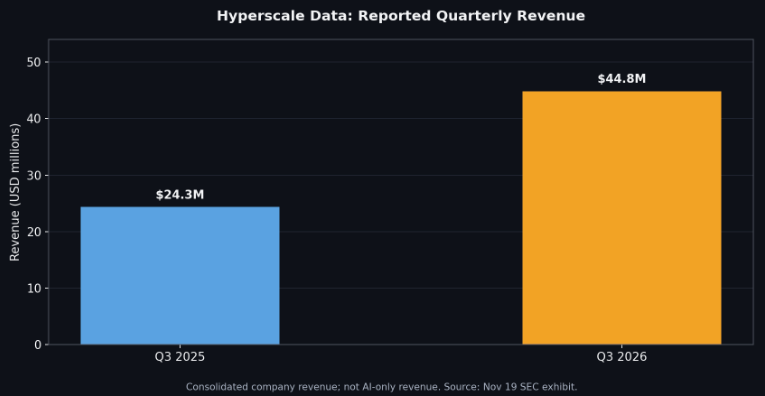
The contrast between IREN and Hyperscale illustrates an important reality: AI infrastructure can offer attractive growth opportunities, but converting mining facilities requires substantial capital.
Could The AI Boom Change Bitcoin’s Hashrate?
The growing competition between AI computing and Bitcoin mining could have important consequences for the network’s hashrate.
Bitcoin mining requires specialized equipment and access to inexpensive electricity. AI infrastructure also demands substantial computing resources, but operators may be willing to pay more for reliable power and suitable data center locations.
As a result, some mining companies are redirecting their existing power capacity toward AI services.
Earlier this year, StandardHash founder Leon Lyu warned that competition for electricity was contributing to changes in Bitcoin’s mining landscape.
His observations highlighted how the economics of mining can shift when alternative computing businesses offer more attractive returns.
Hyperscale Data Sells Remaining Bitcoin Reserves to Reduce Debt and Fund Michigan AI Data Center
Hyperscale Data ($GPUS) trades on NYSE American.
Read more here:https://t.co/CfMZfeJNfa $GPUS
Disclaimer: Not an offer to buy or sell securities. https://t.co/NXBuiYmNVM
— Hyperscale Data, Inc. (@hyperscaledata) November 10, 2026

However, a reduction in mining capacity at individual companies does not necessarily mean Bitcoin’s network is becoming weaker.
Bitcoin automatically adjusts its mining difficulty approximately every 2,016 blocks to maintain an average block interval of roughly ten minutes.
If substantial mining power leaves the network, difficulty can eventually decrease, improving the economics for remaining miners.
New operators may also enter the market if lower difficulty makes mining more profitable.
This adjustment mechanism is one of the reasons Bitcoin has remained operational through previous changes in mining economics.
Could Bitcoin Benefit From The Industry’s Transformation?
The AI transition creates both challenges and opportunities for Bitcoin.
In the short term, companies selling BTC to finance data center construction can introduce additional supply into the market.
However, these sales do not change Bitcoin’s fixed issuance schedule or maximum supply of 21 million coins.
Longer term, mining companies that diversify their revenue streams could become less dependent on Bitcoin’s price movements.
Operators that retain some mining capacity alongside AI services may also gain flexibility in how they allocate electricity.
Bitcoinist has previously examined how miner selling pressure affects Bitcoin’s price , making the relationship between mining profitability and market supply particularly relevant.
Still, it would be premature to conclude that the AI transition will automatically strengthen Bitcoin.
The outcome depends on network difficulty, electricity prices, mining profitability, and whether new operators replace departing hashrate.
What Comes Next For Bitcoin Mining?
Hyperscale Data is scheduled to discuss its latest financial results and infrastructure plans during an investor call on November 23.
Meanwhile, IREN is approaching its year-end target for substantially completing its transition toward AI cloud services.
Together, these developments could provide further insight into how traditional Bitcoin mining businesses are adapting to the rapidly expanding artificial intelligence industry.
For Bitcoin, the broader significance extends beyond individual companies.
The network’s decentralized mining structure allows participants to enter and exit according to economic incentives, while the protocol continues adjusting to changes in available computing power.
We believe this adaptability remains one of Bitcoin’s important long-term strengths.
As AI demand increases, Bitcoin mining may become more concentrated among operators with access to low-cost electricity and efficient equipment.
Whether that results in a smaller mining industry or a more competitive one remains to be seen.
What is increasingly clear is that Bitcoin mining companies are no longer competing solely for block rewards. They are also competing for a place in the global AI infrastructure economy.