

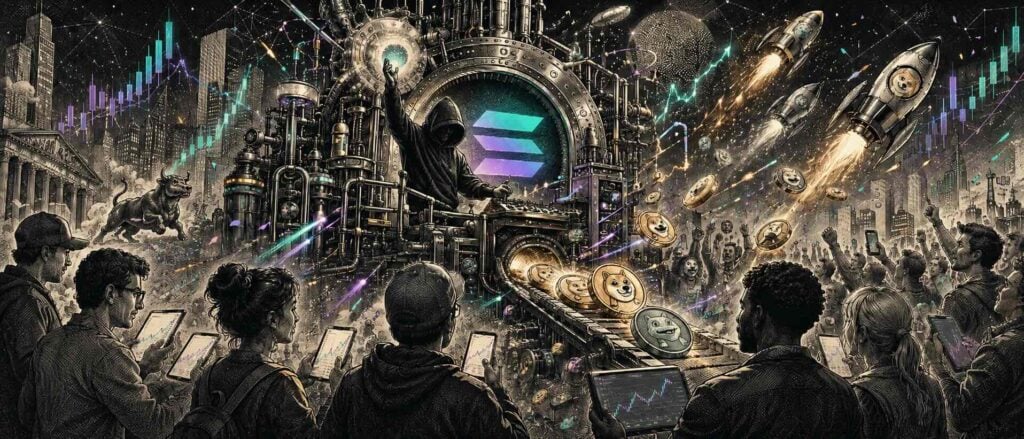
For most of the first half of 2026, the prevailing narrative around Solana memecoins was that the party was over. Volumes had cratered from their manic peaks, launchpads were consolidating, and the trenches — crypto slang for the chaotic, high-velocity world of low-cap token trading — felt more like a graveyard than a gold rush. Then, in the space of about ten days in late June, a token called The Black Bull ($ANSEM) went vertical, Solana's daily token launches hit an 80-day high, and SOL itself caught a bid on the back of renewed ecosystem activity.
At the center of it all is one man who didn't even create the coin: Ansem.
Who Is Ansem? From Georgia Tech to "The Solana Guy"
Ansem, whose real name is reported as Zion Thomas, posts under the handle @blknoiz06 to an audience approaching one million followers on X. He studied computer science at Georgia Tech and worked as a software engineer before going full time into crypto, eventually adding a research role at an investment firm to his portfolio of activities. That combination — technical chops, institutional credibility, and an enormous distribution channel — is rare in a corner of the market where most loud voices have neither.
Ansem is widely credited with one of the great macro calls of the last cycle: Solana's 2023 resurrection, when SOL climbed from the post-FTX wreckage of roughly $8 to nearly $300. While much of crypto had written Solana off as an Alameda-adjacent casualty, Ansem was pounding the table. He was similarly early to Dogwifhat (WIF) and Bonk (BONK), the two tokens that defined Solana's memecoin supercycle and minted a generation of on-chain traders. When those calls paid off — spectacularly — his handle became shorthand for the entire Solana meme trade. Traders started calling him "The Solana Guy." Estimates now put his personal net worth at around $20 million, most of it earned the same way his followers try to earn theirs: in the trenches, one trade at a time.
That last point matters for what comes next. Ansem is not a venture capitalist airdropping tokens from a distance, or a celebrity licensing his likeness. He is, culturally, a trencher who won — and in memecoin land, provenance is everything.
The Black Bull: A Token Ansem Didn't Create, Then Chose to Champion
Here is the origin story. Strap in folks.
On or around June 17, 2026, an anonymous developer launched The Black Bull ($ANSEM) on Pump.fun, spending about $6,300 to deploy it. According to on-chain tracker Lookonchain, the deployer bought roughly 792 million tokens, sent 650 million of them directly to Ansem's wallet, and later sold the remainder for a profit of about $5,500. It was, in essence, a bet: attach a nobody token to a somebody wallet and hope the somebody notices.
He noticed. Rather than ignoring the token or launching a competing "official" coin, Ansem embraced it — with a twist that turned a garden-variety influencer coin into something closer to a social experiment. On June 28, he publicly criticized Pump.fun's reward structure and pledged to redistribute the creator fees flowing to his wallet back to the community, writing that he "had to give the trenches a stimmy." Under Pump.fun's creator fee sharing system, rolled out in January 2026, high-volume tokens generate meaningful ongoing fee income for the wallets that control them — income that most creators quietly pocket.
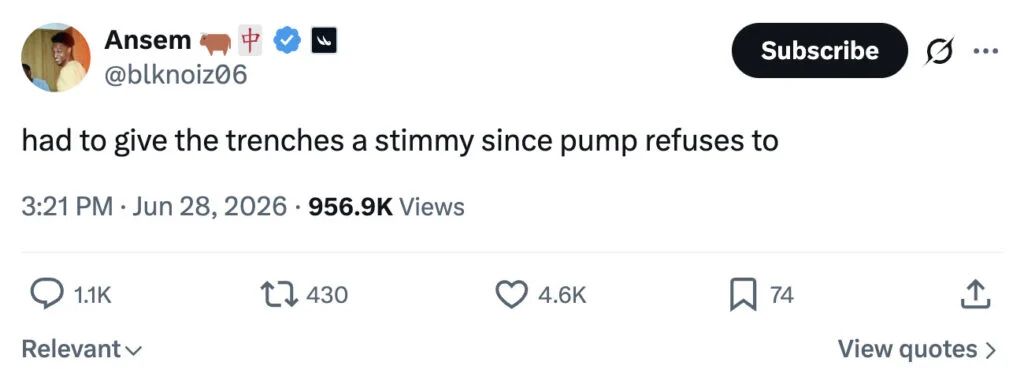
"had to give the trenches a stimmy", source: X
Ansem gave it back. Between June 27 and June 29, he airdropped approximately $7 million worth of $ANSEM across Solana wallets, with a stated ambition of growing the holder base from roughly 25,000 to one million wallets. He has indicated further distributions will be tied to the token's rising market cap — a structured giveback rather than a one-off publicity stunt.
The market response was ferocious. $ANSEM had 24-hour trading volume topping $80 million at the peak of the frenzy. As of publication, CoinGecko data shows the token trading around $0.17–0.18, up roughly 20% in 24 hours, with a circulating market cap near $73 million and an all-time high of $0.1876 set this week. Perpetual futures have gone live on venues including MEXC and Aster, and the token has been verified on major Solana interfaces like Jupiter and Phantom.
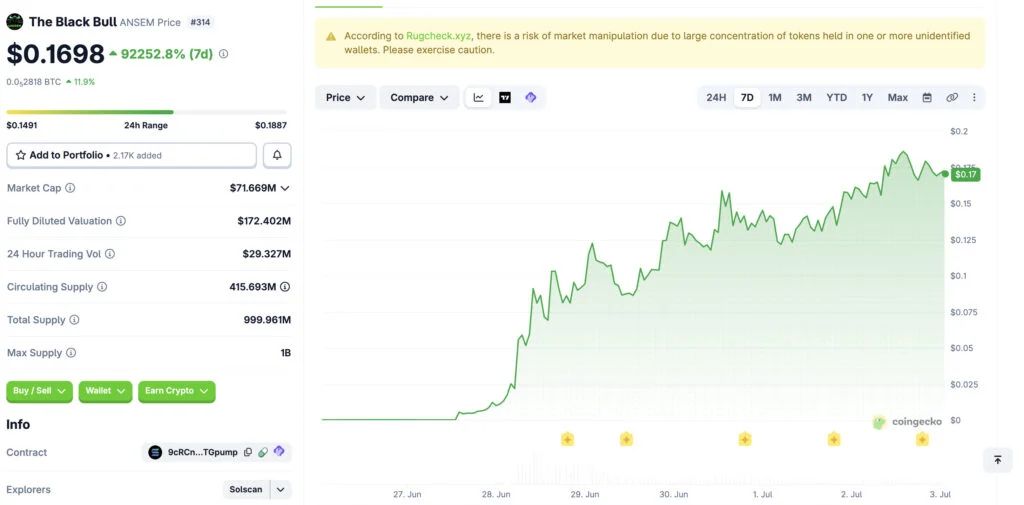
$ANSEM is off to a promising start, source: Coingecko
The Trading Psychology: Why "Giving Back" Is the Whole Trade
To understand why this worked — and why it might keep working — you need to understand the psychology of the trenches in mid-2026.
Memecoin trading is, at its core, a game of reflexive attention. There are no cash flows to discount and no products to ship; price is a function of belief, and belief is a function of who else believes. The dominant emotional register of the trenches over the past year has been betrayal fatigue. Traders have watched an endless procession of developers, influencers, and celebrities extract value from their communities: insider allocations, quiet distributions, creator fees harvested and dumped. BNC's own reporting found that over 99% of Pump.fun traders never realize $10,000 in profits — a statistic that captures just how asymmetric the game usually is. The house, in various forms, almost always wins.
Ansem's move inverts that script. By routing creator fees back to holders instead of extracting them, he collapsed the usual adversarial dynamic between the "creator" and the crowd. In behavioral terms, he converted a zero-sum game into something that at least feels positive-sum — and in doing so, he activated two of the most powerful forces in speculative markets: reciprocity and identity. Reciprocity, because traders who receive free tokens from a figure they admire feel invested in his success; identity, because holding $ANSEM became a way of signaling membership in a tribe that believes the trenches deserve better. The token's very name reinforces the loop: every price candle is read as a referendum on Ansem himself.
There's also a scarcity-of-trust dynamic at play. In a market flooded with anonymous deployers, a coin anchored to a doxxed, reputationally exposed figure with an eight-year public track record carries a kind of implicit collateral. Ansem has far more to lose from rugging his own community than he could plausibly gain — his entire livelihood is downstream of his credibility. Traders know this, and it changes how they hold. That, at least, is the bull psychology.
The Ecosystem Angle: A Spark in a Cold Furnace
The more interesting question is whether $ANSEM is a one-token wonder or the catalyst for a broader Solana memecoin revival. Early evidence leans encouraging. Daily token launches on Pump.fun hit an 80-day high as the $ANSEM frenzy peaked, and CoinGecko-tracked data showed Solana gaining 7.7% as the memecoin boosted ecosystem activity. Solana's speculative engine — low fees, instant launches, a deeply liquid DEX stack — never went anywhere; what disappeared was the animal spirit. Attention is the scarce input in this economy, and Ansem just supplied it in bulk.
The launchpad itself has been engineering toward exactly this moment. Pump.fun spent late 2025 and early 2026 consolidating the trading stack and redesigning creator incentives to be, in co-founder Alon Cohen's words, "for trenchers." Ansem weaponizing those very fee mechanics to fund community airdrops is the incentive redesign working as intended — arguably better than intended. If the model proves durable, expect imitators: influencers and communities routing platform fees back into holder distribution as a standard playbook rather than a novelty.
The Honest Caveats: What Could Go Wrong
Optimism should never mean amnesia, and there are three caveats no fair account of $ANSEM can skip.
First, Ansem didn't create this token — and dozens of impostors did. $ANSEM is less a single coin than a cluster of competing tokens deployed by anonymous developers the moment his name started trending. Ansem has disavowed several outright as impersonations. The Black Bull became the dominant version because he engaged with it, but buyers piling into the wrong contract address have already been burned, and the proliferation of copycats fragments the very attention the trade depends on.
Second, the concentration risk is enormous. Even after distributing $7 million in tokens, Ansem's wallet controls an estimated 604 million $ANSEM — roughly 60% of total supply, worth tens of millions of dollars at current prices. On-chain screeners including RugCheck have flagged manipulation risk from this concentration. It doesn't require bad intent for this to end badly: a single large distribution, however well-meaning, can take the floor out of a token whose liquidity is thin relative to its market cap. The volume-to-market-cap ratio has at times exceeded 2, the signature of frantic speculative churn rather than conviction holding.
Third, Ansem's halo has been contested before. In October 2024, on-chain investigator ZachXBT publicly accused him of promoting low-cap Solana tokens in a pattern resembling pump-and-dump dynamics, arguing that his reach left followers holding losses. Ansem rejected the criticism and defended his early calls; the accusations came with no formal findings and remain unproven. To his credit, Ansem has himself acknowledged that backing certain celebrity-linked memecoins was a mistake driven by misaligned incentives — a rare piece of public self-awareness in a space allergic to it. But the episode is a reminder that influence cuts in both directions, and the audience is often the liquidity.
Can He Pull It Off?
Well, $ANSEM has no product, no team, and no revenue — and it doesn't pretend to. What it has is something arguably rarer in 2026's exhausted memecoin market: a credible figure voluntarily aligning his incentives with his community, in public, with his reputation as collateral. The airdrop-to-a-million-holders campaign is the most genuinely novel distribution experiment the trenches have seen this year, and it has already done what months of infrastructure upgrades couldn't — it made Solana's memecoin economy feel alive again.
Whether the fire keeps burning depends on whether Ansem can sustain the giveback flywheel: fresh airdrops generating fresh holders generating fresh volume generating fresh fees to airdrop. If participation compounds week over week, $ANSEM becomes a template. If attention fades — and single-catalyst Solana rallies have a mixed record of sustaining momentum — it becomes another cautionary chart. The 60% wallet is both the engine and the sword of Damocles.
The trenches have been promised a lot over the years. This time, at least, the person doing the promising is one of their own, and he's paying up front. In a market built entirely on belief, that might just be enough — for now.