


Michael Saylor has revived expectations of another Bitcoin acquisition by Strategy after sharing its long-term accumulation chart . Ethereum co-founder Vitalik Buterin, meanwhile, has challenged the investment argument built around ETH's fee-burning mechanism. At Ripple, former chief technology officer David Schwartz has responded to criticism over XRP's declining price, describing his personal influence as very limited.
Michael Saylor's Bitcoin Chart Fuels New Purchase Speculation
Michael Saylor renewed speculation about Strategy's Bitcoin accumulation plans on November 8 after posting a chart from SaylorTracker.com. Captioned "Connecting the dots," the visualization showed the company's Bitcoin treasury valued at approximately $64.44 billion, with 849,327 BTC held across 120 purchase events.
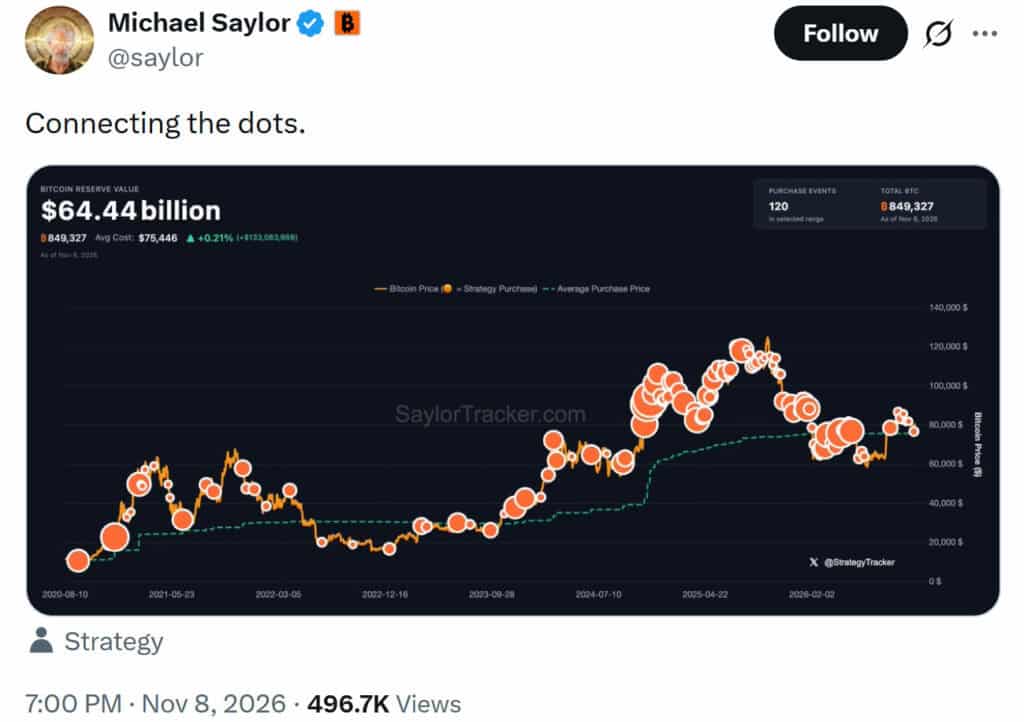
The visualization tracks 120 Bitcoin purchases against historical price movements, highlighting the company's consistent accumulation strategy across market cycles. Source: Michael Saylor via X
The chart traced Strategy's acquisition history against Bitcoin's price movements , illustrating how the company continued accumulating the cryptocurrency through different market conditions. It listed an average acquisition cost of approximately $75,446 per BTC, highlighting the scale of the company's long-term treasury strategy.
Although Saylor's post attracted attention from investors anticipating another purchase, it did not confirm a new transaction. He has frequently shared similar accumulation updates before Strategy releases its weekly Bitcoin acquisition disclosures. The latest message therefore raised expectations rather than establishing that another purchase had taken place.
The post followed Strategy's November 2 announcement that it had acquired 811 BTC for approximately $65.5 million between October 26 and November 1. According to the company's SEC filing, the purchase brought total holdings to 849,327 BTC, acquired for an aggregate $64.08 billion at an average cost of $75,451 per coin.
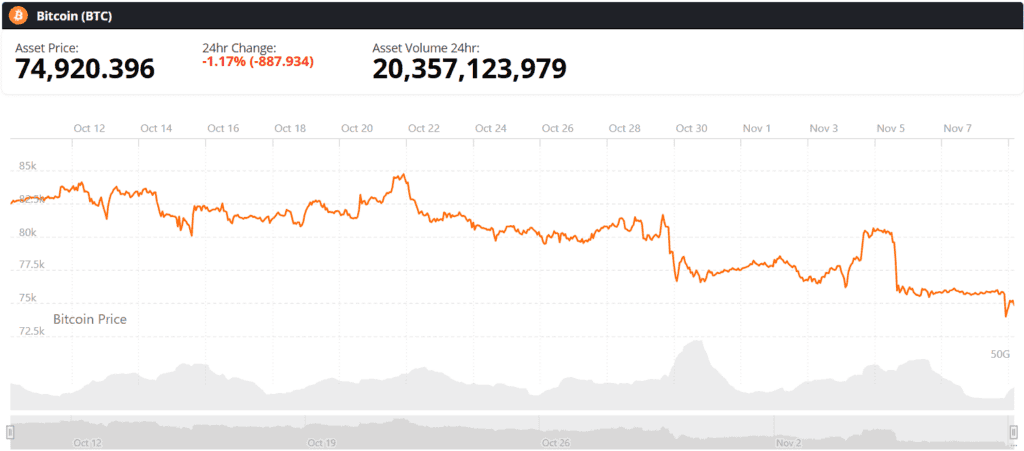
Bitcoin (BTC) price chart. Source: Brave New Coin
Strategy also repurchased approximately $208.2 million worth of its STRC preferred shares during the same reporting period. The company used its existing dollar-denominated cash for the repurchase, while proceeds from selling 1,178,552 MSTR common shares helped finance the Bitcoin acquisition. The share sales generated approximately $164 million, of which $65.5 million funded the purchase and the remaining $98.5 million went toward its cash balance.
Saylor's activity around STRC has also drawn attention to Strategy's broader financing structure. The preferred security, traded on Nasdaq under the ticker STRC, forms part of the company's digital credit strategy. Saylor discussed the financial foundations of the product in a separate November 7 post, writing that "Digital credit took four centuries to make possible."
Investors will now look to Strategy's next official disclosure for confirmation of any additional Bitcoin purchases. Until the company reports another transaction, Saylor's latest chart remains an indication of its established accumulation approach rather than proof of a new acquisition.
Vitalik Buterin Questions Ethereum's Fee-Burning Valuation Model
Ethereum co-founder Vitalik Buterin has challenged the idea that ETH's long-term market value should depend primarily on transaction-fee burning. He believes positioning the asset as a store of value offers a more dependable investment narrative than treating token destruction as the primary source of its economic worth.
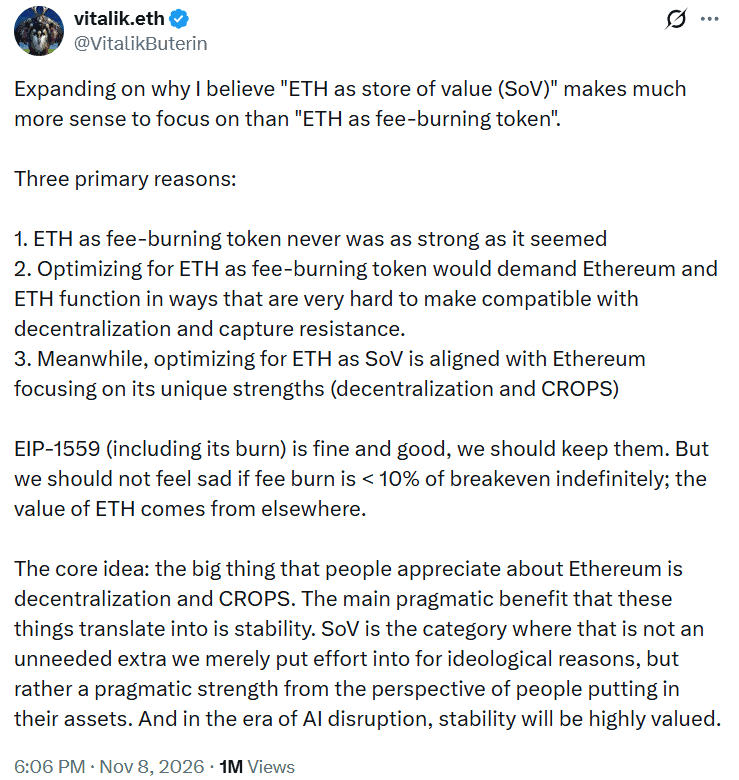
Vitalik Buterin favors ETH as a store of value over a fee-burning token, citing Ethereum's core principles of decentralization, privacy, and security. Source: @VitalikButerin via X
The debate centers on EIP-1559, Ethereum's 2021 upgrade that introduced a mechanism for permanently removing the base portion of transaction fees from circulation. When the amount of ETH burned exceeds the issuance paid to validators, the network's total supply can decline. This mechanism helped establish the "ultrasound money" narrative among investors during the previous bull market.
Buterin questioned whether the mechanism provides a reliable valuation floor. He illustrated the traditional argument with a hypothetical network generating $1 billion in annual token burns. Applying a 4% discount rate would produce an estimated valuation of $25 billion under that model.
However, Buterin argued that this calculation assumes the underlying revenue remains dependable. Ethereum's historical fee generation has been heavily influenced by activity within the cryptocurrency market itself. Speculative trading, NFT launches, and other periods of intense on-chain demand have produced unusually high transaction costs, but those conditions can fade when market sentiment weakens.
The Otherside NFT land sale in 2022 provided one example of this volatility. The event generated an exceptional spike in Ethereum transaction fees, demonstrating how a single speculative episode could temporarily increase token burning. Buterin argued that such activity does not necessarily provide the stable external revenue required to establish a lasting valuation floor.
He also maintained that Ethereum should not abandon EIP-1559. Instead, he suggested that investors should not be concerned if fee burning remains below the level needed to offset new ETH issuance. As he explained, "the value of ETH comes from elsewhere."
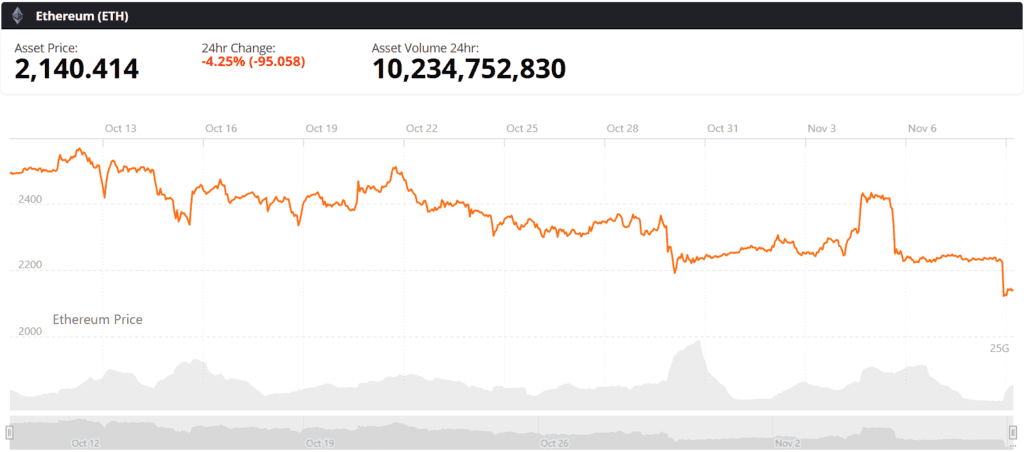
Ethereum (ETH) price chart. Source: Brave New Coin
Buterin identified decentralization, censorship resistance, open-source development, privacy, and security as more important foundations for Ethereum's long-term appeal. He also warned that attempting to maximize transaction-fee revenue could push the network toward higher gas prices, extensive protocol spending, and more interventionist governance.
Such changes could undermine the characteristics that distinguish Ethereum from traditional financial infrastructure. Higher transaction costs could also make the network less accessible to users who depend on privacy and security.
His store-of-value argument also considers the network's potential role in supporting tokenized real-world assets. Greater adoption of assets issued directly on Ethereum's base layer could give ETH additional utility as collateral while strengthening its position within the financial ecosystem. Buterin further emphasized long-term network survival, including security improvements and preparation for post-quantum cryptography.
The comments represent a change in emphasis rather than a proposal to remove Ethereum's existing fee-burning mechanism. Buterin's broader argument is that ETH should derive its investment appeal from the durability and reliability of its underlying infrastructure, rather than depending on unpredictable periods of elevated transaction activity.
David Schwartz Downplays His Influence Over XRP Price
Ripple's former chief technology officer David Schwartz has addressed renewed criticism from XRP holders following the token's prolonged decline. His response came after cryptocurrency commentator Digital Asset Investor highlighted an exchange involving Schwartz on X, where investors questioned whether he had any responsibility for XRP's market performance .
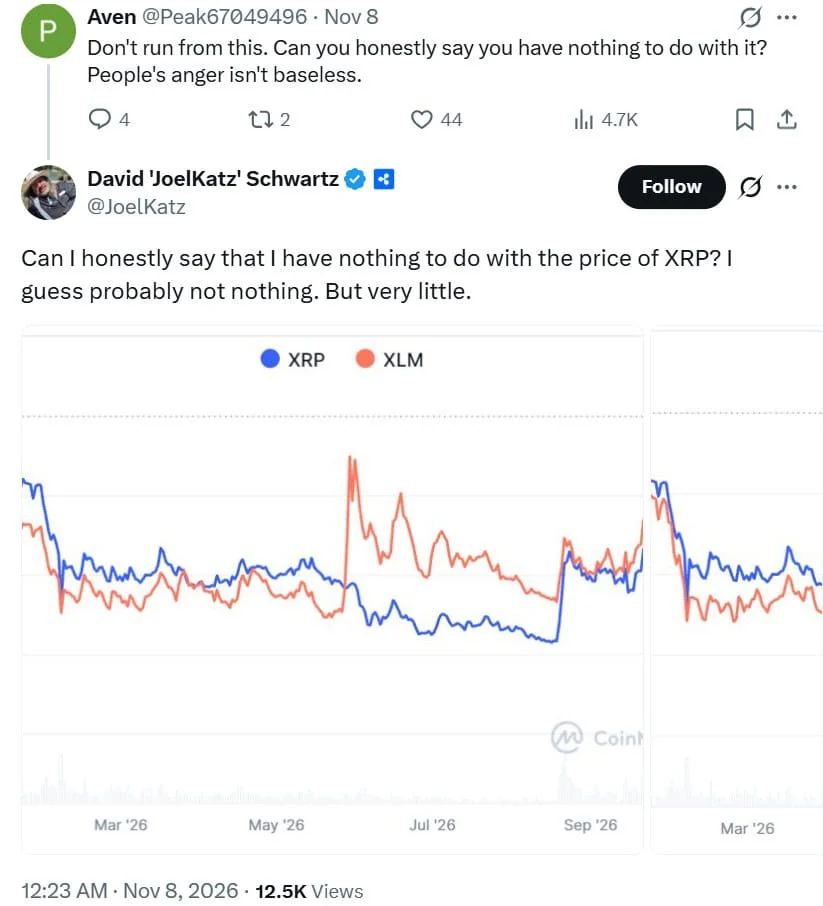
Schwartz says his influence over XRP's price is minimal despite accusations of responsibility. Source: @JoelKatz via X
One user challenged Schwartz to acknowledge his connection to the token's price, arguing that holders' frustration was not without reason. Schwartz responded candidly when asked whether he could honestly claim to have no influence over XRP.
"Can I honestly say that I have nothing to do with the price of XRP? I guess probably not nothing. But very little," he replied .
The statement acknowledged that his actions and public comments may have some influence, while rejecting the idea that he has substantial control over XRP's market valuation. The exchange did not identify any specific decision by Schwartz that caused the cryptocurrency's decline.
The discussion unfolded as XRP traded near $1.16 on November 8. The token had lost approximately 49.78% over the preceding year, leaving it considerably below its July 2025 all-time high of $3.65. Its performance has increased frustration among some holders who expected stronger price gains despite continued developments across the XRP Ledger ecosystem.
Charts shared during the discussion also compared XRP's 2026 performance with declines in Stellar (XLM) and Solana (SOL). The comparison highlighted broader weakness across several digital assets, although similar price movements do not establish that the tokens experienced identical market pressures.
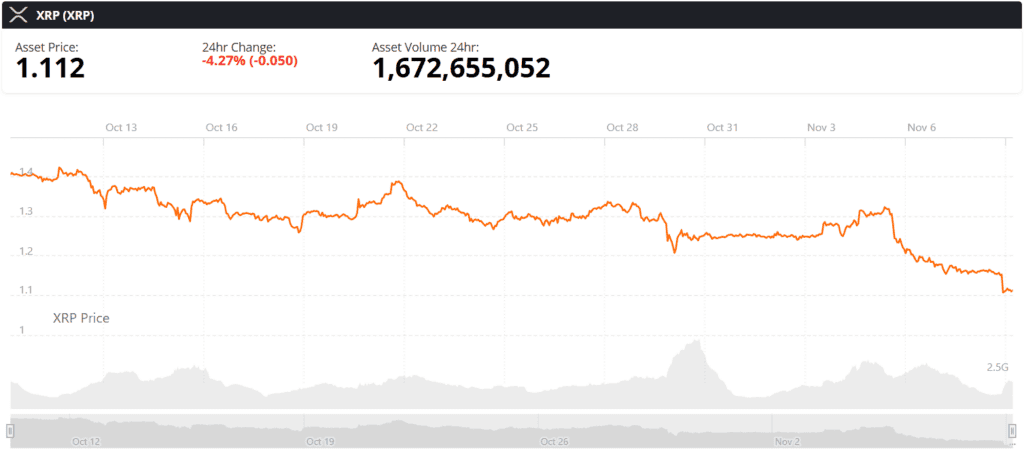
XRP price chart. Source: Brave New Coin
Schwartz has also addressed the growing number of cryptocurrency-related messages appearing beneath his posts about unrelated subjects. He said some accounts had used those conversations to accuse him of fraud, criticize Ripple, or promote XRP. According to his explanation, he began blocking accounts that repeatedly disrupted discussions, regardless of whether their messages supported or criticized him.
His response came amid broader questions about the relationship between Ripple's technical progress, XRP Ledger adoption, and the token's market performance. However, developments in network infrastructure do not automatically translate into immediate price appreciation. XRP continues to trade in an open market where investor demand, liquidity, wider cryptocurrency trends, and market sentiment influence its valuation.
Schwartz's comments therefore offer a distinction between his individual influence and the broader forces governing XRP's price . While he acknowledged that his involvement is not entirely without effect, he made clear that his ability to determine the token's market performance is limited.