


Ethereum is testing resistance just below $2,400, caught between renewed buying interest and the lingering uncertainty that has defined the market for months. The price action looks tentative from the outside — but a CryptoQuant report is pointing to something happening beneath the surface that the chart alone does not capture.
According to the report, the 14-day moving average of Ethereum’s Taker Buy Sell Ratio on Binance has surged to 1.036, its highest reading since April 2021. That means buyers on Binance are not just present — they are outpacing sellers at a rate the market has not seen in over four years.
What makes that figure genuinely striking is the context in which it is occurring. Ethereum has fallen from a peak of $4,700 in October 2025 to its current level near $2,300, a decline of more than 50%. That is not a minor pullback. That is a half-price correction.
Yet in the middle of that correction, aggressive buying pressure on Binance has quietly reached a multi-year high.
When price falls sharply while buying intensity rises to historic levels, it creates a divergence that markets rarely ignore for long. The sellers are in control of the price right now. The question the data raises is whether they are running out of room to stay that way.
When Price Falls and Buyers Get More Aggressive, Something Is Usually Changing
The divergence the CryptoQuant report highlights is one of the more compelling setups in recent Ethereum data. A Taker Buy Sell Ratio above 1 means that market buy orders are actively outpacing market sell orders — buyers are not waiting for sellers to come to them, they are hitting the ask. The fact that this aggression is reaching a four-year high while prices continue to decline is the contradiction that demands attention.
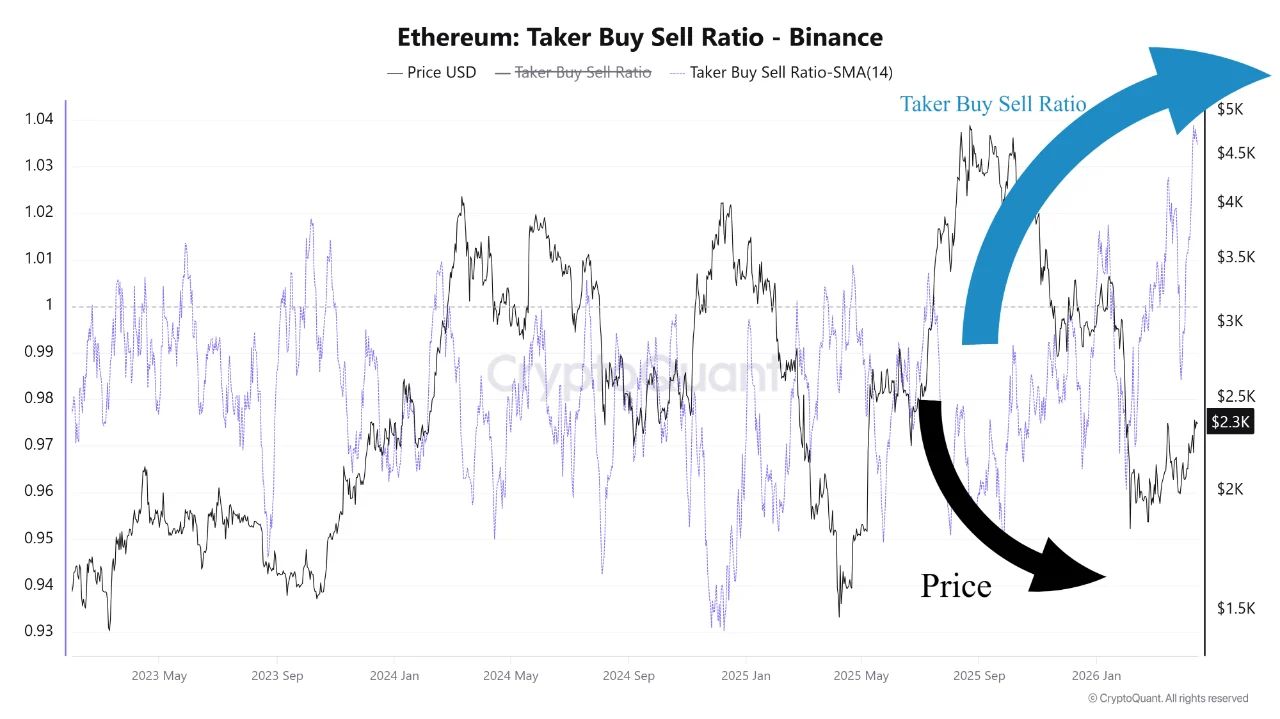
In most market conditions, aggressive buyers slow down when a correction deepens. Here, the opposite is happening. As Ethereum has moved further from its October peak, the buying intensity on Binance has increased rather than retreated. That kind of behavior does not typically come from retail participants reacting to price. It looks more like large entities deliberately absorbing available sell-side supply at a discount — what analysts often describe as smart money using weakness as a buying opportunity rather than a reason to step back.
The significance of that dynamic is straightforward. Sellers can only sell what they have. If aggressive buyers continue absorbing that supply at the current pace, the pool of willing sellers gradually shrinks. When it shrinks enough, the price pressure that has defined Ethereum’s correction loses its fuel — and the setup for a reversal becomes structural rather than speculative.
That point has not been reached yet. But the data suggests the distance to it is narrowing.
Ethereum Tests $2,400 Resistance as Short-Term Momentum Improves
Ethereum is approaching a critical resistance zone near $2,400 after recovering steadily from its February capitulation low around $1,800. The chart shows a clear shift in short-term structure: price has transitioned from a sequence of lower highs and lower lows into a pattern of higher lows, indicating that buyers are gradually regaining control.
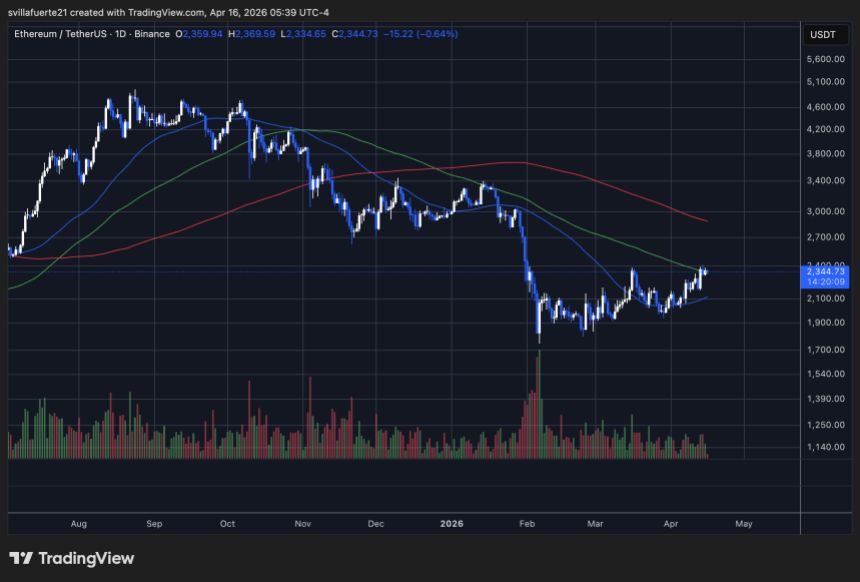
The recent move is supported by the 50-day moving average (blue), which has turned upward and is now acting as dynamic support. This is typically an early signal of momentum recovery. However, the broader trend remains unresolved. ETH is still trading below both the 100-day (green) and 200-day (red) moving averages, which continue to slope downward, reinforcing the presence of overhead resistance.
The $2,300–$2,400 region is technically significant. It previously acted as support before the February breakdown and is now being retested as resistance. A clean break and consolidation above this range would mark a structural shift and likely open the path toward the $2,700–$2,900 region.
Volume remains relatively muted compared to the February spike, suggesting the recovery is controlled rather than driven by aggressive inflows. This implies accumulation rather than speculation.
Failure to break above resistance would likely extend consolidation between $2,000 and $2,400, delaying confirmation of a broader trend reversal.
Featured image from ChatGPT, chart from TradingView.com