

Neocloud company CoreWeave (CRWV) recently conveyed its congratulations to Texas governor-elect Gina Hinojosa while sending a message of collaboration in tune with the new administration's stance on the artificial intelligence (AI) data-center buildout. Texas last elected a Democratic governor 36 years ago, and Texas was among many states that saw a Democratic sweep in the midterm elections.
In a letter sent out on Nov. 7, CoreWeave emphasized its alignment with potential new regulations in Texas for data-center development while committing to transparency and refraining from passing on the costs of development to local communities. Specifically, the company said that it will use closed-loop liquid cooling systems, which purportedly use less water.
More Top Stocks Daily: Go behind Wall Street’s hottest headlines with Barchart’s Active Investor newsletter.
About CoreWeave
Founded in 2017 as a cryptocurrency mining business, CoreWeave occupies the vaunted position of being one of the foremost AI infrastructure companies in the world. Now, CoreWeave provides enormous amounts of specialized computing power to companies developing and running AI. The company operates data centers containing large clusters of Nvidia (NVDA) GPUs, with the overall objective of making thousands of GPUs behave like a single high-performance computing (HPC) system. CoreWeave is also concentrating on building a software stack, with its capabilities launching in 2026 to connect training, inference, observability, reinforcement learning, and autonomous agent improvement.
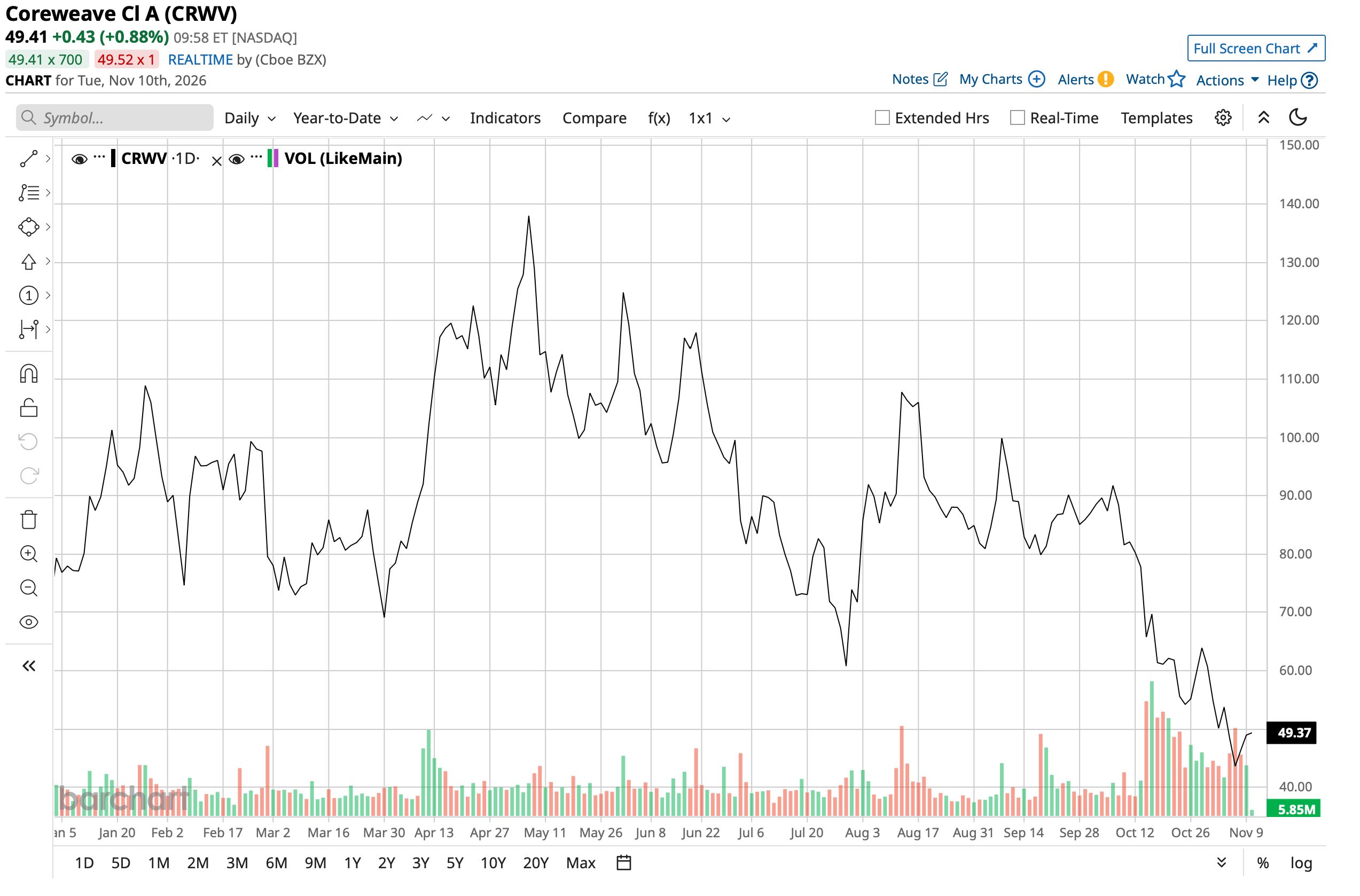
Valued at a market capitalization of $27.8 billion, CRWV stock is down 22% on a year-to-date (YTD) basis.
 www.barchart.com
Hinojosa's AI Assertions Paint a Grim Picture for CoreWeave
If Texas governor-elect Gina Hinojosa's opinion about AI is to be analyzed, one could say that it is somewhat combative, which is not good news for CoreWeave. “When I am governor I will issue a moratorium — a ban — on all data center approvals until laws can be passed by the Legislature to protect Texans,” Hinojosa said on the campaign trail. Her tone did not shift after the election, either. In an interview with CNN, she said, "We will have laws to protect Texans, and we need to stop what we are doing with data centers until we have those protections."
Hinojosa's primary concerns cover two crucial aspects: electricity and water. For electricity, she believes that the rapid expansion of data centers could place additional pressure on Texas' power infrastructure and ultimately increase costs for residential consumers. The governor-elect wants operators to bear the infrastructure costs associated with their facilities instead of transferring those expenses to ordinary customers.
As for water consumption, Hinojosa has questioned the wisdom of allowing large computing facilities to consume significant quantities of water in areas where residents already face resource constraints. She has specifically highlighted the development of data centers in rural and unincorporated communities. Here, CoreWeave's closed-loop liquid cooling systems could alleviate some of her concerns. In a technical article on May 4, 2026, CoreWeave explained that its closed-loop systems use continuous coolant recycling, with minimal coolant losses and only occasional replenishment. The company also described using chillers and dry-cooling equipment as part of its thermal-management architecture. CoreWeave said this results in improved thermal management across high-density GPU infrastructure and reduced water consumption.
Still, the proposed moratorium adds another layer of uncertainty for CoreWeave. The company needs to continually add computing capacity to meet customer demand. It cannot simply rely on its existing data centers indefinitely, particularly when its business model requires substantial investment in new GPUs, servers, networking equipment, and physical infrastructure. If the moratorium prevents new projects from obtaining approvals, CoreWeave could face delays in bringing additional capacity online. In turn, this could mean delays in revenue from new facilities, higher construction costs, and even higher borrowing costs at a time when the company remains mired in debt problems and a heavy interest expense load.
CoreWeave Reports Q3 Results
CoreWeave’s operations continue to show exceptionally rapid growth rates that stand out even in the current market environment. The overall picture remains mixed, however, as the company is still unprofitable and interest expenses rose in the most recent quarter.
In the third quarter of 2026, CoreWeave generated revenue of $3.66 billion, beating estimates of $3.55 billion. Adjusted operating income margin declined to 10% from 16% a year ago. The company also posted a net loss of $1.27 per share. While that result was better than the consensus estimate loss of $1.46 per share, it came in far worse than the loss of $0.22 per share a year ago.
Interest expenses increased to $846 million from $310 million. By comparison, Nebius Group (NBIS) — its closest competitor — saw interest expenses climb at a far steeper pace to $112.5 million in Q3 from just $14.7 million a year earlier. CoreWeave’s interest expense as a percentage of revenue stood at roughly 23% in Q3.
Backlog reached $132.5 billion as of Sept. 30, 2026. Cash flow trends also improved. Net cash from operating activities totaled $1.98 billion compared with $1.69 billion a year ago. CoreWeave ended the period with $4.1 billion in cash, still below its short-term debt of approximately $10.6 billion.
For the full fiscal year, CoreWeave expects revenue of $13 billion to $13.3 billion. The company also expects to finish 2026 with active power capacity of 1.85 gigawatts. CEO Michael Intrator said that CoreWeave remains on track to reach at least 8 GW by 2030.
On the valuation front, CRWV stock appears reasonably positioned. The price-to-sales (P/S) ratio is 4.3 times while the price-to-cash flow (P/CF) ratio comes in at roughly 13 times, which is below the sector median.
What Do Analysts Think of CRWV Stock?
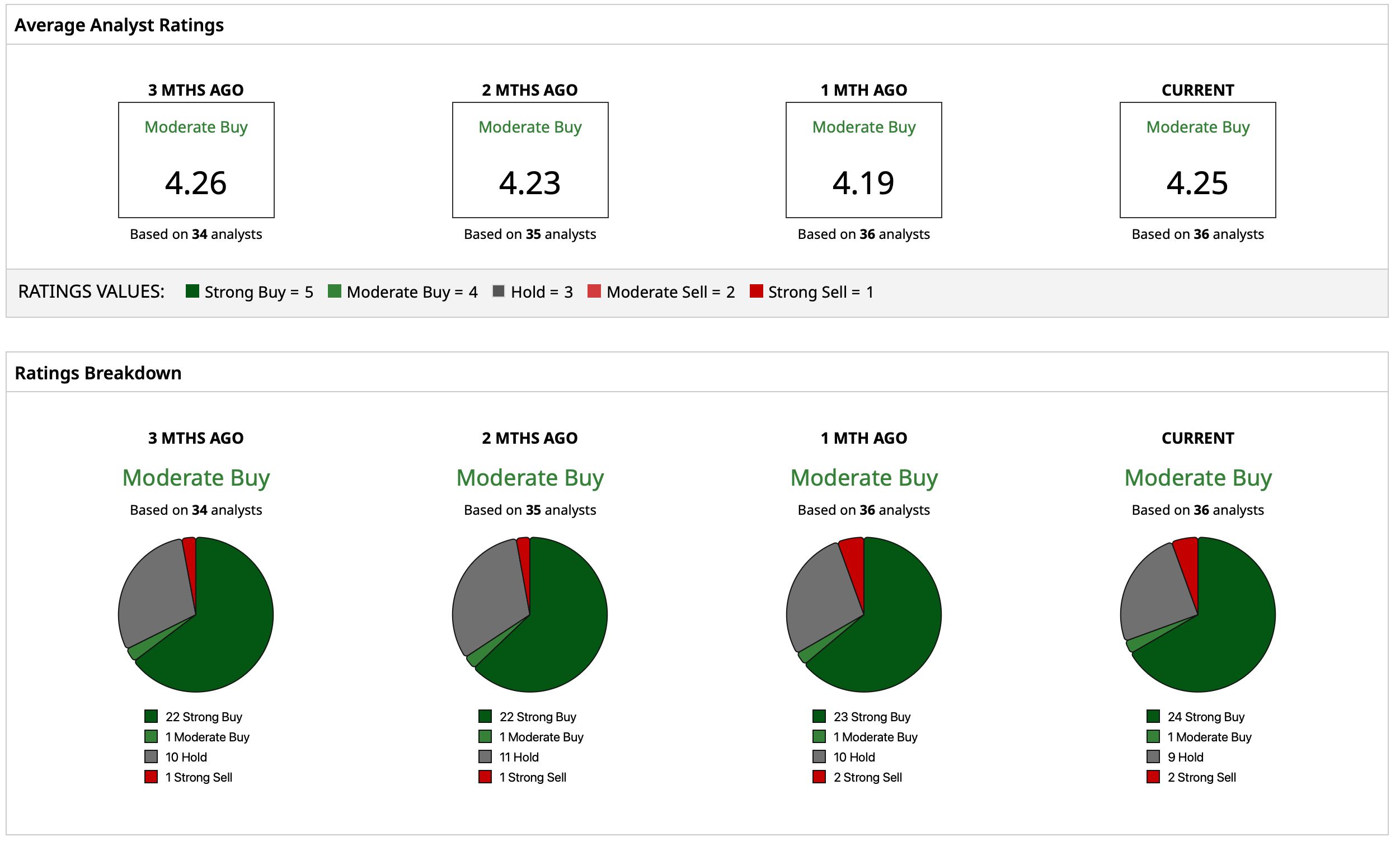
Overall, analysts have a consensus “Moderate Buy” rating for CRWV stock. Out of 36 analysts covering the stock, 24 have a “Strong Buy” rating, one has a “Moderate Buy” rating, nine have a “Hold” rating, and two have a “Strong Sell” rating. The mean price target of $113.50 indicates potential upside of 101% from current levels.
 www.barchart.com
On the date of publication, Pathikrit Bose did not directly have a position in any of the securities mentioned in this article. All information and data in this article is solely for informational purposes. For more information please view the Barchart Disclosure Policy here.
More news from Barchart
As Data Center Concerns Hit CRWV Stock After the Midterms, CoreWeave Is Going Straight to Texas’s Governor-Elect Despite Valuation Concerns, This Lesser-Known Stock Is Hot at 10-Year Highs Mizuho Sees Nvidia’s Attractive Valuation as an Opportunity Even With Jensen Huang Not at the Helm Anymore Nebius Says Revenue Jumped Nearly Sixfold. Why That’s Still Not Enough to Avoid a Selloff in NBIS Stock.