

Semiconductor stocks can change direction fast, becoming the “elephant in the room.” On May 27, 2026, Wolfspeed (WOLF) dropped 13.93% in one session, landing alongside Qualcomm (QCOM) as one of the sector’s biggest losers as traders turned cautious ahead of Marvell’s (MRVL) results.
This slide added to the weakness that followed its fiscal Q3 2026 report in early May, when the company posted a GAAP net loss of $119.9 million and a GAAP gross margin of about -27%.
More Top Stocks Daily: Go behind Wall Street’s hottest headlines with Barchart’s Active Investor newsletter.
At the same time, Wolfspeed is trying to strengthen its bench. It named Daihui Yu as regional president for Greater China, effective March 16, 2026, and rolled out two more senior hires. Brad Kohn is returning as chief legal and global affairs officer on May 11, while Sonja Burfeind has been appointed vice president of communications, effective July 1.
After a near 14% hit and this leadership shakeup, one question stands out. Is Wolfspeed’s current discount a rare buying opportunity, or just a classic value trap?
What Wolfspeed’s Numbers Really Say
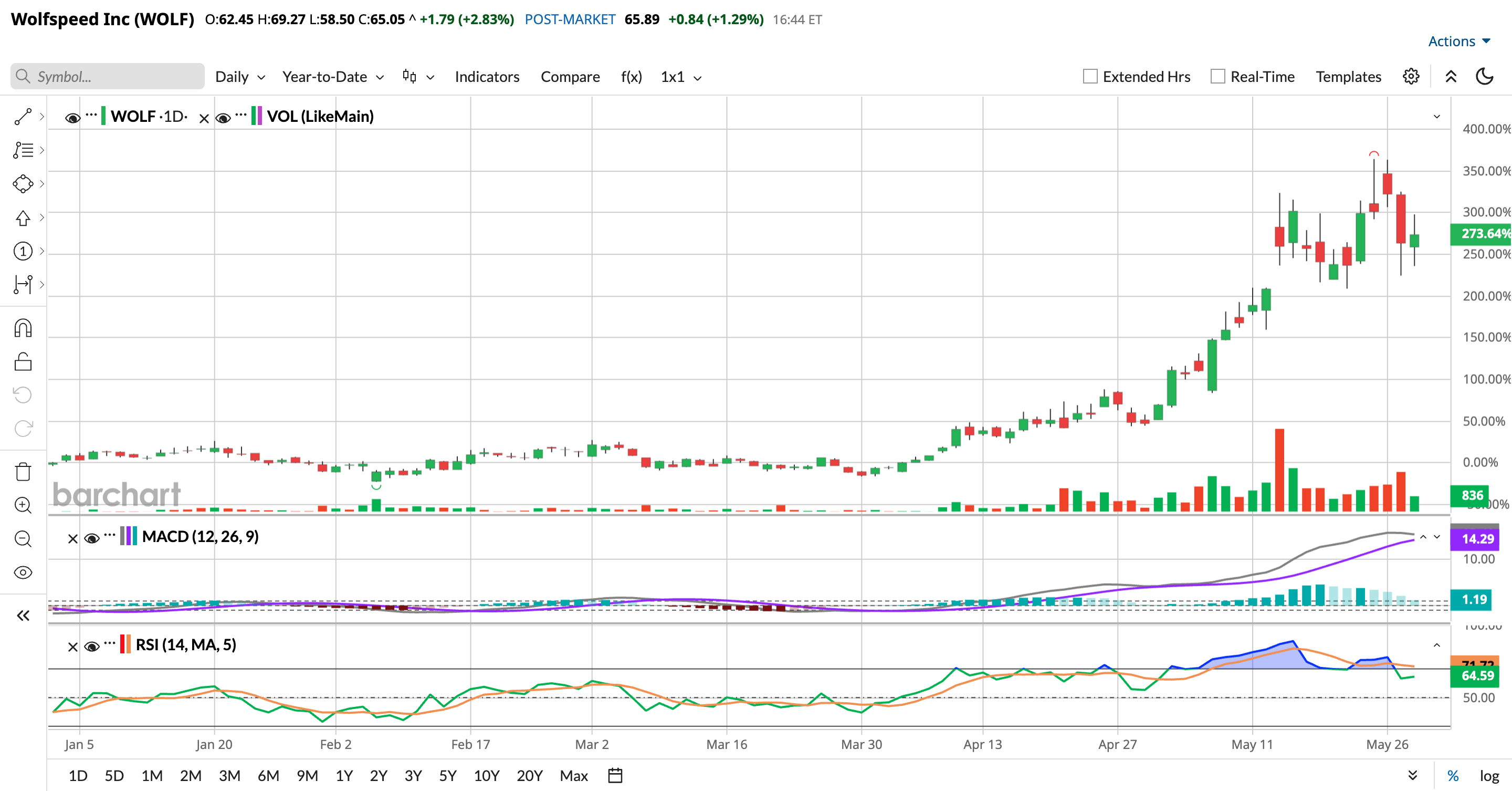
Operating out of Durham, North Carolina, Wolfspeed develops silicon carbide materials and power semiconductors used in electric vehicles, industrial power systems, and energy infrastructure. Its stock is up 273.64% so far this year.
 www.barchart.com
 Their current valuation works out to a market cap of $3.057 billion and a price‑to‑sales ratio of 3.24 times, just under the sector median of roughly 3.51 times.
The company's most recently reported quarter, for the period ending March 26, showed earnings of -$3.52 per share. This result was based on consolidated revenue of around $150M, which came in right at the midpoint of guidance. WOLF’s performance led to a GAAP net loss of $120 million and an adjusted EBITDA loss of $62 million. Operating cash flow for the quarter was -$84 million, but on a trailing basis for March 2026, it reported an operating cash flow of $5.7 million, up 101.21%.
The improvement pushed net cash flow to $104.4 million, a change of 133.07% that reflects operations plus financing steps taken to support liquidity. The balance sheet as of March 29 showed about $1.2 billion in cash, cash equivalents, and short‑term investments.
This cash position was helped by a strategic refinancing, including subscriptions for hundreds of millions in convertible notes and equity, which cut first‑lien debt by $97 million and is expected to save about $62 million a year in interest, while boosting the company’s equity by more than $400 million once all approvals and reclassifications are complete.
What’s Actually Changing for WOLF
Wolfspeed recently rolled out new 3.3 kV silicon carbide power modules in two industry‑standard footprints, aimed at high‑power uses like renewable energy, rail, and industrial drives. These modules are built to help customers shrink system size and cut energy losses at grid and transport‑level voltages.
Another big launch is what the company calls the industry’s first commercially available 10,000 V silicon carbide power MOSFET, designed for ultra‑high‑voltage gear such as transmission‑level equipment and large industrial systems. This device lets customers handle very high voltages more efficiently than older solutions.
On the operations side, Wolfspeed has kicked off a project to speed up manufacturing and day‑to‑day operations by feeding its data into a modern cloud analytics platform. They partnered with Snowflake for this initiative. This move is meant to lift fab yield, improve throughput, and give better visibility into its silicon carbide supply chain.
To go after data center demand more directly, Wolfspeed also introduced a next‑generation TOLT portfolio focused on better power conversion efficiency and higher power density for AI data center hardware. These products are aimed at server and rack‑level power stages and are meant to help customers cut energy use per unit of compute while raising total power capacity.
All of these moves together help explain why, even after the selloff, Wolfspeed is still on investors’ radar.
What the Street Is Really Saying About WOLF
The next big test for Wolfspeed’s story comes on August 4, 2026, when it’s due to report results for the quarter ending June 2026. There is still no average earnings forecast for that release, which says a lot about how unsure the market is about the near term.
Not everyone is cautious, though. Citrini Research recently issued a bullish note titled “Crouching Tiger Getting Ready to Reveal a Dragon,” arguing that Wolfspeed’s 300 mm silicon carbide technology is becoming a “mechanical necessity” for the next generation of power‑hungry AI clusters.
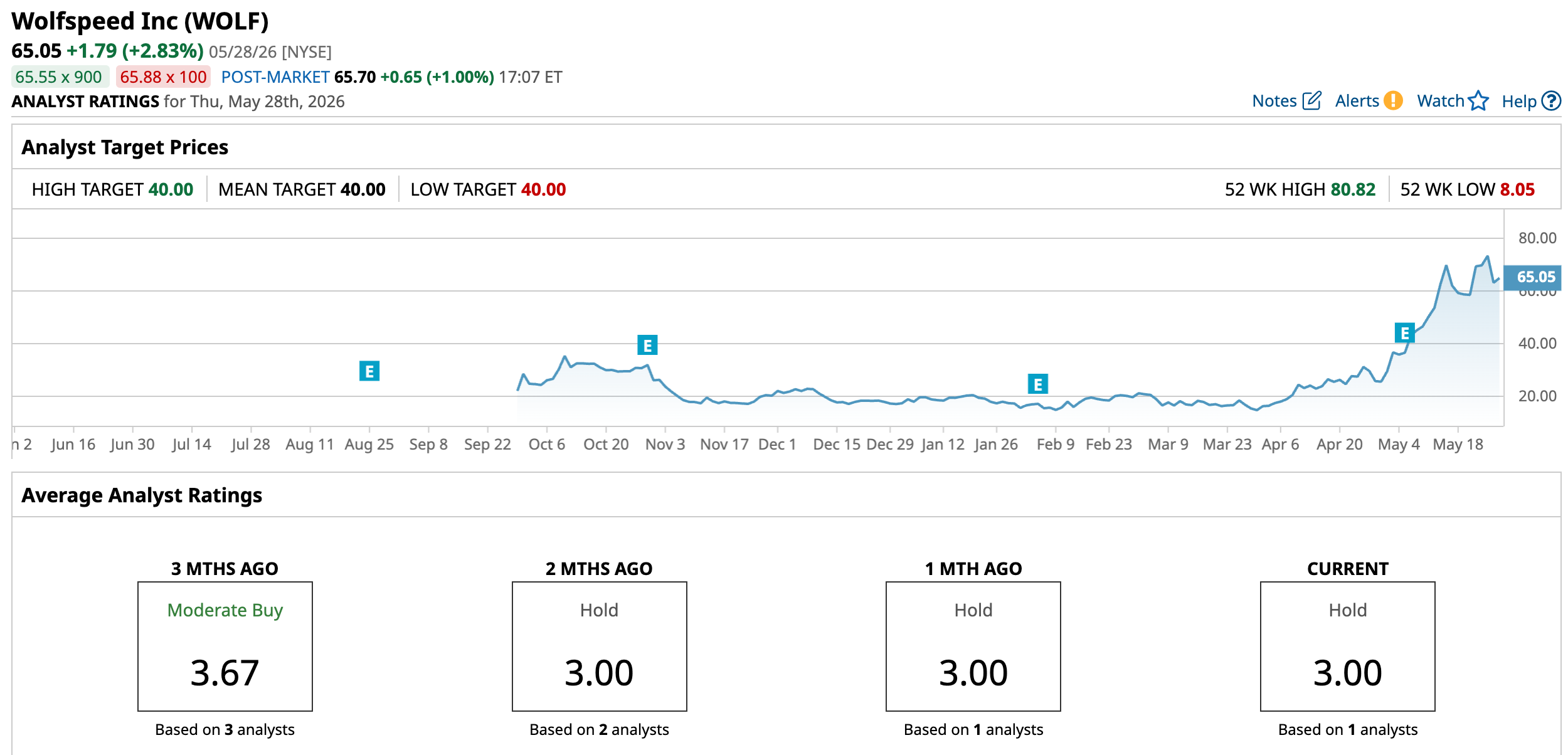
That upbeat view sits awkwardly beside the broader analyst picture. The latest snapshot shows a neutral stance, with only one analyst covering the stock and calling it a “Hold.” The average price target is $40.00, implying 38.5% downside from where the shares currently trade.
 www.barchart.com
 Conclusion
Wolfspeed’s 13% drop has not turned it into a clear bargain or a clear trap, just a more intense version of the same high‑risk story. The numbers still point to big risk, but the product pipeline, recent refinancing steps, and silicon carbide bets tied to AI keep real upside on the table. Right now, it leans more toward a speculative opportunity than a slow‑drip value trap, but only for money that can handle sharp and frequent swings.
On the date of publication, Ebube Jones did not have (either directly or indirectly) positions in any of the securities mentioned in this article. All information and data in this article is solely for informational purposes. For more information please view the Barchart Disclosure Policy here.
More news from Barchart
Jobs Data, Tech Earnings and Other Key Things to Watch this Week After a 13% Selloff, Wolfspeed Now Trades at Steep Discounts. Don’t Be Fooled into Buying the Dip. Why Warren Buffett Hasn’t Sold Coca-Cola Stock for Over 30 Years How to Play Amazon Stock Now Near Record Highs