


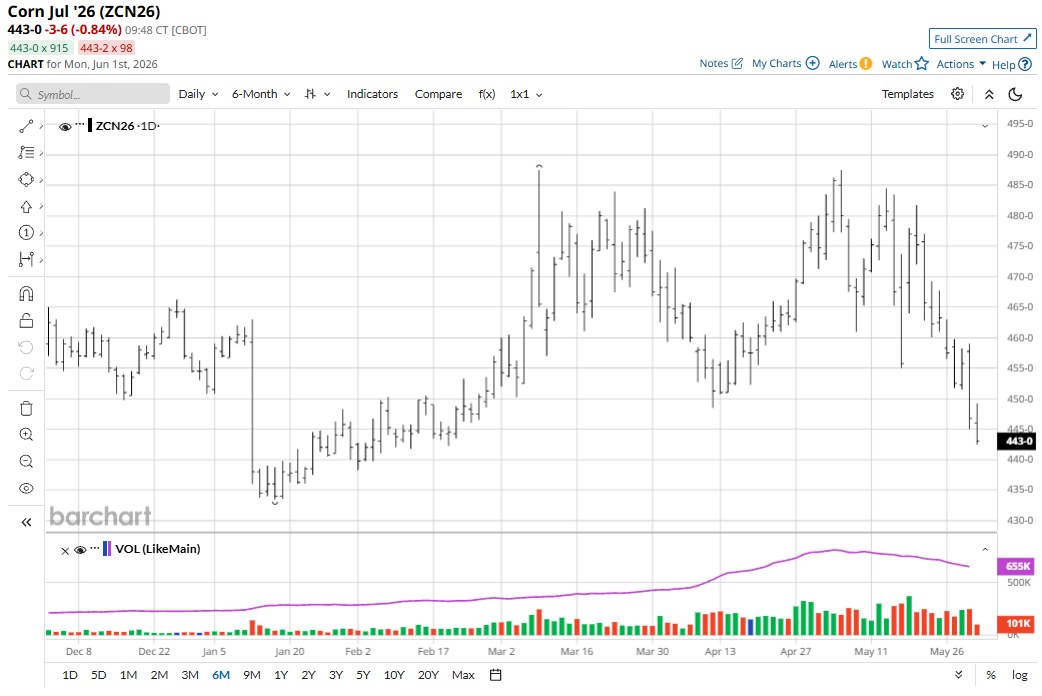
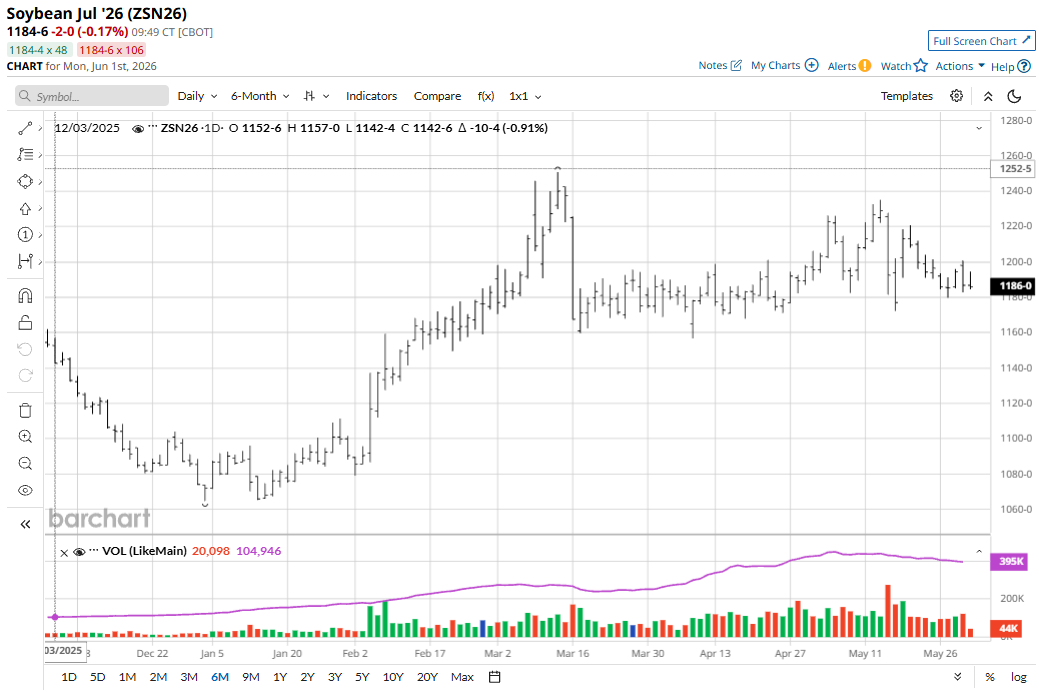
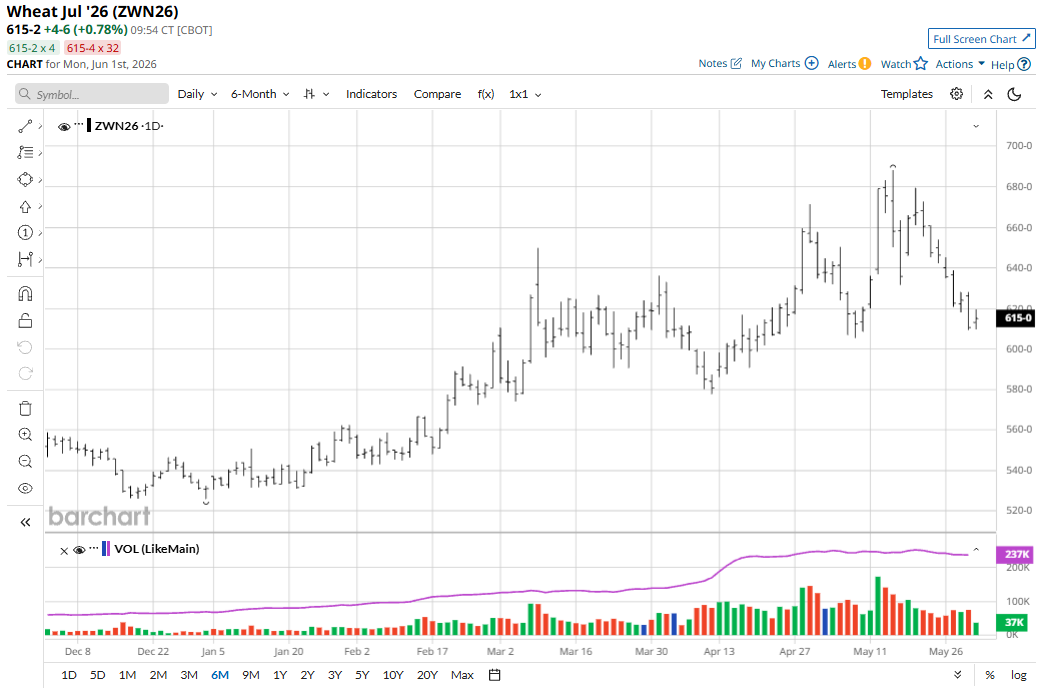
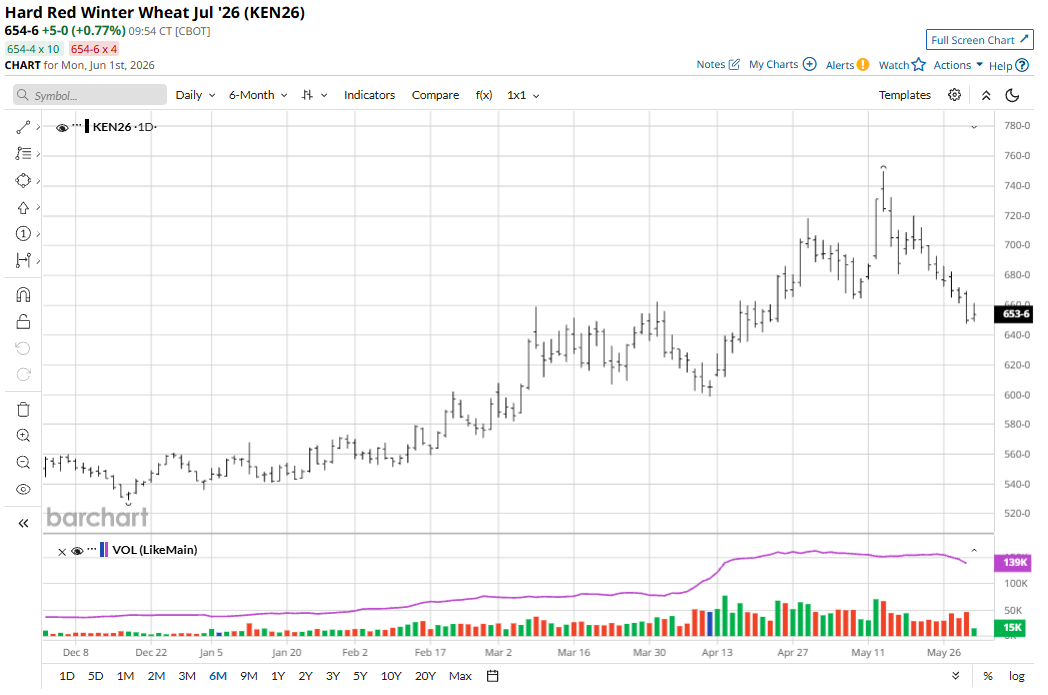
July corn (ZCN26) futures on Friday fell 9 cents to $4.46 3/4 and hit a three-month low. For the week, July corn was down 16 1/2 cents. July soybeans (ZSN26) fell 7 3/4 cents to $11.86 3/4 and for the week were down 9 3/4 cents. July soft red winter (SRW) wheat (ZWN26) futures on Friday fell 13 1/2 cents to $6.10 1/2, hit a three-week low, and for the week were down 35 3/4 cents. July hard red winter (HRW) wheat (KEN26) futures lost 15 1/2 cents to $6.49 3/4, hit a five-week low, and for the week down 32 1/4 cents.
Corn Futures Leading to the Downside
Corn futures ended the week and the month of May with less than a whimper. Friday’s technically bearish weekly and monthly low closes set the corn futures market up for more chart-based selling pressure early this week.
Don’t Miss a Day: From crude oil to coffee, sign up free for Barchart’s best-in-class commodity analysis.
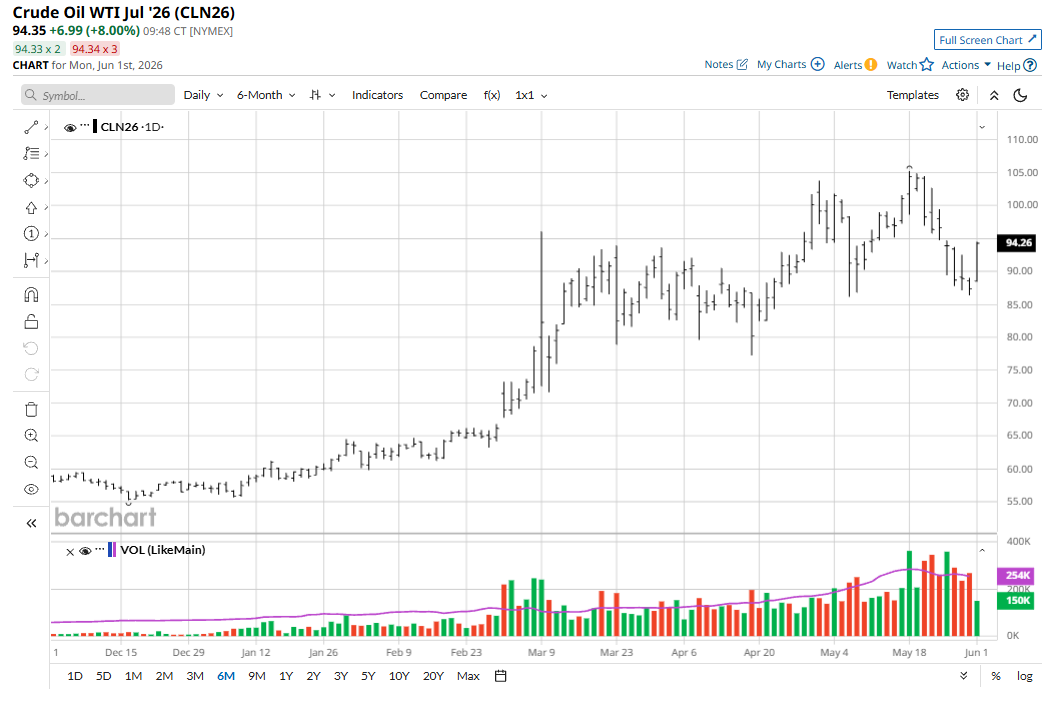
Last week’s downdraft in crude oil prices cast a pall over most of the raw commodity futures market sector, including the grains. The selloff in WTI crude oil (CLN26) futures saw prices drop below $87 at one point on Friday.
 www.barchart.com
 www.barchart.com
Last week’s export sales tally also worked to embolden the corn bears. The USDA on Friday morning reported weekly U.S. corn sales of 1.015 million metric tons (MMT) during the week ended May 21. This was down 52% from the previous week and down 30% from the four-week average.
Grain traders will keep watching the weekly USDA crop progress reports on Monday afternoons. This week’s reports will likely show most of the U.S. corn crop has been planted.
Weather in the Corn Belt leans overall price-bearish for corn and soybeans. Mostly dry weather is expected in the U.S. Midwest over the coming 10 days, while temperatures will be seasonably warm.
Don’t be surprised to see some degree of a weather-market scare pop up rapidly in corn and soybean markets in the coming couple months. More years than not, at least one occurs. They develop quickly and can then fizzle out just as fast. Last week’s downdraft in grain futures prices could make for stronger weather-market rallies this summer, if they occur this growing season.
Soybeans Faring Slightly Better than Corn and Wheat
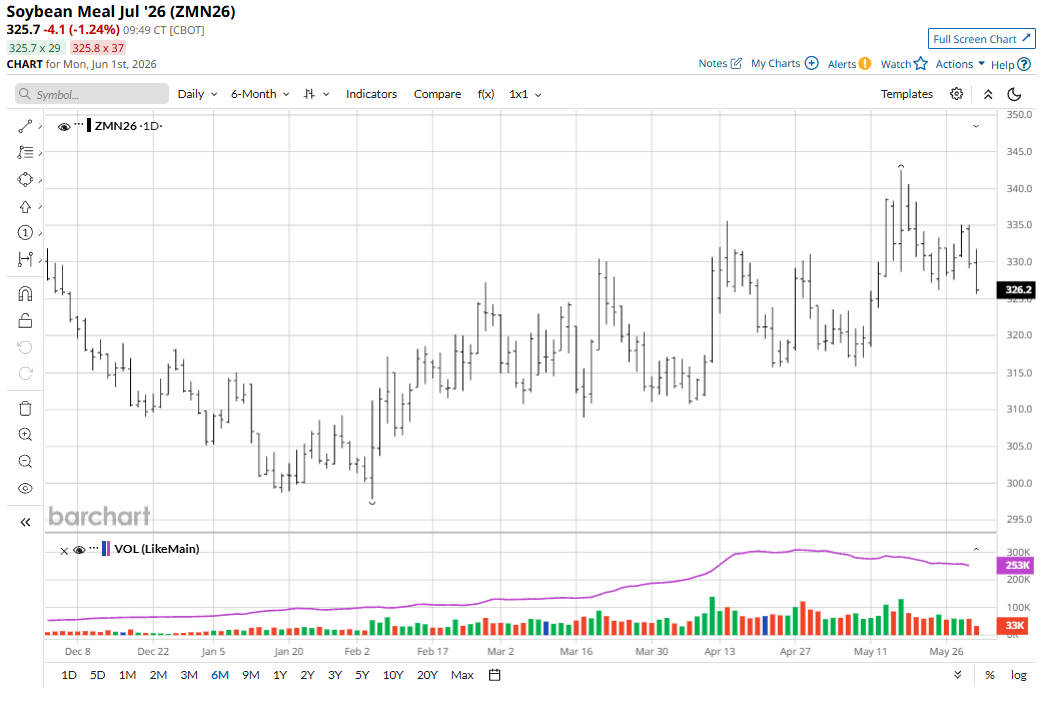
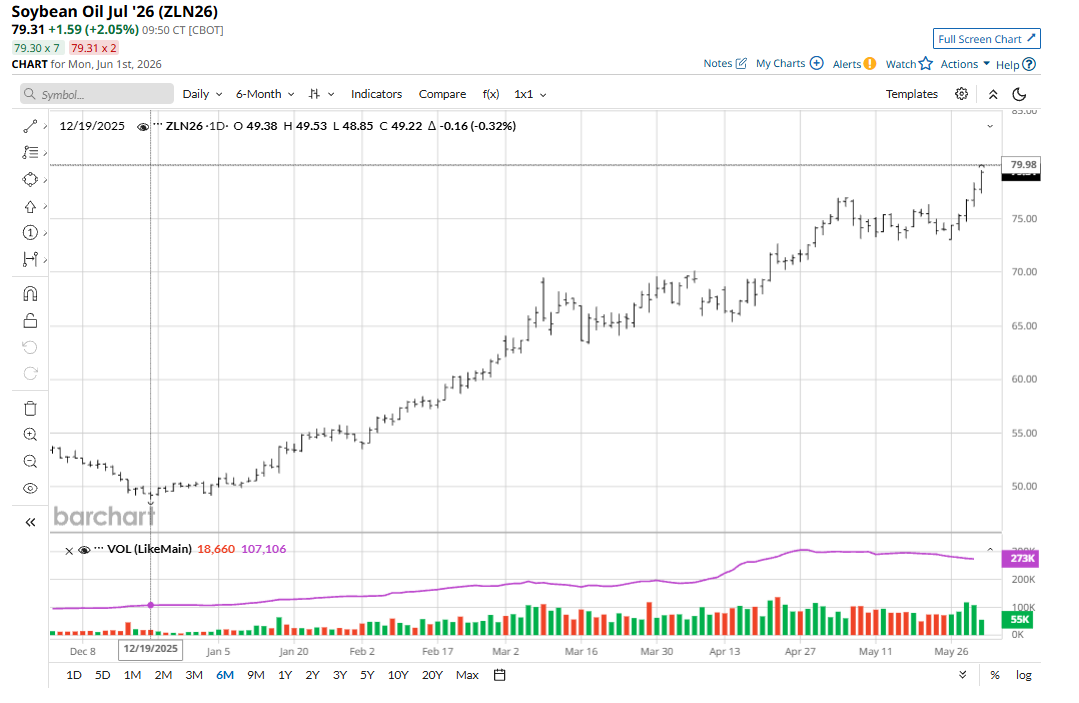
The technically bearish weekly low closes in July soybeans and July meal (ZMN26) set those markets up for follow-through selling pressure from the chart-based speculators early this week. However, the soy complex futures have been supported by soybean oil, which continues to be solidly supported by a global move toward more biofuels. July soybean oil on Friday scored a new contract high and closed at a technically bullish weekly and monthly high.
 www.barchart.com
 www.barchart.com
 www.barchart.com
The USDA on Friday reported weekly U.S. soybean sales of 299,900 MT for the week ended May 21, down 15% from the previous week but up 41% from the four-week average.
The monthly U.S. soybean crush in April likely slowed to 6.441 million short tons, or 214.7 million bushels, as the daily processing pace likely dipped to the lowest point in seven months, analysts said in a Reuters survey ahead of the monthly USDA crush report due out Monday.
Bullish Wheat Balloon Quickly Deflating
In early May, the winter wheat futures markets were on fire and setting news highs not seen in at least 1.5 years. However, the past two weeks have seen heavy selling pressure in SRW and HRW markets. The technically bearish weekly and monthly low closes on Friday in July SRW and HRW set the stage for still more technical selling early this week.
 www.barchart.com
 www.barchart.com
The USDA on Friday morning reported dismal U.S. wheat export sales reductions of 807,300 MT for 2025-26, a marketing-year low. Plus, sales were down noticeably from the previous week and from the four-week average. Last week’s export sales report saw the largest all-wheat cancellations on record for a single week going back to 1990, although this was partially offset by strong new-crop sales.
Monday afternoon’s weekly USDA crop progress reports and the U.S. winter wheat condition ratings will be closely scrutinized by wheat traders.
In U.S. HRW country, scattered showers and thunderstorms have been occurring in portions of the region recently, with central areas wettest. That has improved soil moisture for the wheat crop and has lent to selling pressure in the futures markets.
The U.S. wheat harvest is rapidly approaching as maturation remains ahead of average pace.
Cotton Futures Prices Trending Lower
July cotton (CTZ26) futures on Friday fell 62 points to 76.15 cents and for the week were down 127 points. The cotton futures market was also caught in the downdraft in most raw commodity futures prices amid this week’s selloff in the crude oil markets. Friday’s technically bearish weekly and monthly low close in July cotton suggests more chart-based selling pressure early this week.
The cotton futures market sees prices trending down on the daily bar chart, which also suggests more selling pressure in the near term. Cotton traders will also scrutinize Monday’s weekly USDA crop progress reports.
Western Texas and southwestern Oklahoma cotton regions have seen beneficial rains recently, which are also price-bearish for futures. Those regions will see some more showers and planting should increase as much of the region dries down before another round of more significant showers and thunderstorms occur Tuesday into Saturday.
On the date of publication, Jim Wyckoff did not have (either directly or indirectly) positions in any of the securities mentioned in this article. All information and data in this article is solely for informational purposes. For more information please view the Barchart Disclosure Policy here.
More news from Barchart
Look Out Below! Grain and Cotton Prices Are on the Ropes Heading into Summer. May’s Top Performers and Underperformers What Do We Know About Quarterly Grain Stocks in Relation to Demand? Can Wheat Continue to Rally?