


Dell Technologies' (DELL) recent earnings report made waves on Wall Street. Revenue from AI servers skyrocketed, and the backlog surpassed the astronomical $50 billion threshold. However, if we look beyond these figures and trace the logistical connections back to the broader economy, an unexpected picture emerges.
Dell's triumph is merely the first act. The less obvious, medium-term beneficiary of this "hardware rush" could be a company whose stock is currently trading at a significant discount to its Big Tech peers: Meta Platforms (META). To understand this hidden correlation, we must divide the current market dynamics into two distinct phases: the ongoing physical construction of data centers and the inevitable future phase of total capacity utilization.
More Top Stocks Daily: Go behind Wall Street’s hottest headlines with Barchart’s Active Investor newsletter.
Why Are Companies Building Local Data Centers?
Over the past 18 months, the AI race has been run by an exclusive club of hyperscalers like Microsoft (MSFT), Alphabet (GOOGL), Amazon (AMZN), and Meta. These companies bought Nvidia (NVDA) chips by the millions, dictating terms while mid-to-large commercial enterprises — such as banks, automakers, and pharmaceutical companies — were left on the sidelines.
However, recent earnings from Dell and Hewlett Packard Enterprise (HPE) signal the onset of a localized construction boom. The primary catalyst here is data privacy paranoia. Large enterprises fundamentally cannot rely on closed, public cloud models for their core operations. No bank is legally permitted to route its client transaction database through the public internet into an external cloud; doing so is a direct path to lost licenses and multi-million-dollar fines. To leverage AI, then, these businesses need their own isolated digital perimeters — essentially, a server room in their own basement.
The second factor to consider here is the breaking of the logistical “dam.” In previous years, businesses stood in line for chips, yielding to the Big Tech giants. But with new silicon packaging capacities in Taiwan now normalizing, the hardware deficit has begun to clear. As soon as silicon became accessible, mid-sized enterprises hired Dell and HPE as high-tech "general contractors." These companies are able to package temperamental chips into liquid-cooled racks, mass-delivering turnkey corporate data centers. This is exactly what we are witnessing in financial reports right now.
The Near Future: What Will Power These New "Mines"?
Looking one step ahead, a logical question arises: How will businesses utilize these newly built "mines" once Dell and HPE deliver thousands of local servers? Hardware itself is just empty, hot metal that requires a "brain." Here, companies hit a brick wall of closed-source software.
It is physically impossible to download a closed model onto a local corporate server. OpenAI will not sell GPT-4 on a flash drive for internal bank network installation, and Google will not hand over the Gemini core. These models are permanently tethered to their creators' servers. Consequently, the only viable solution for many new data centers is to adopt open-source models. These models can be entirely imported into a secure corporate perimeter, fine-tuned on highly classified internal documents, and operated in absolute isolation.
Mark Zuckerberg's Strategy Is About to Pay Off
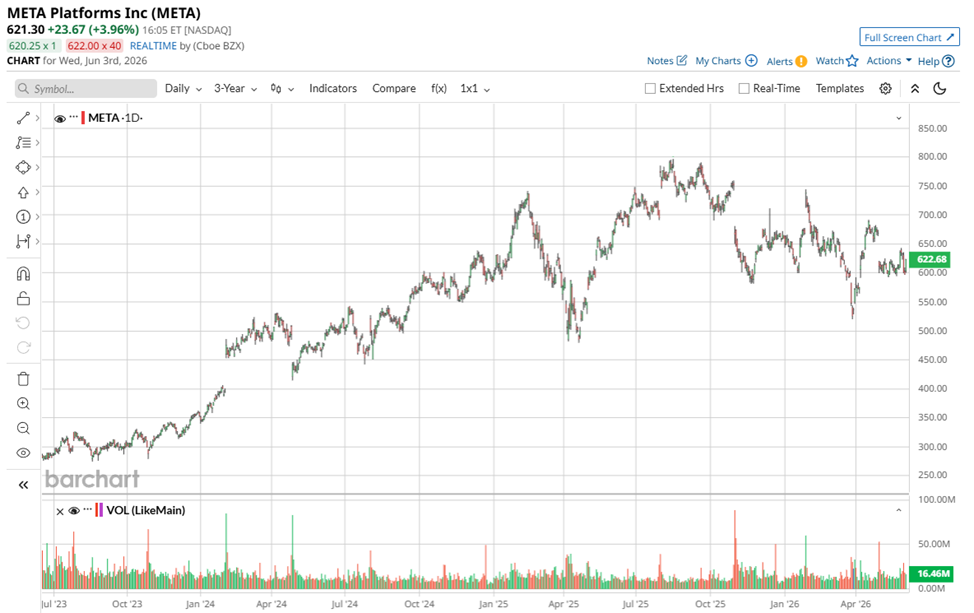
This is exactly where the secret of Meta CEO Mark Zuckerberg's multi-billion-dollar strategy — one that Wall Street stubbornly refused to believe in — is hidden. Investors have penalized META stock over the past year, failing to see immediate monetization from its open-source models. META still trades at a forward price-to-earnings (P/E) ratio of around 20 times, which looks remarkably cheap against the backdrop of an overheated tech sector.
The market assumed Meta's open-source Llama was losing to OpenAI's paid software. However, Llama could not demonstrate explosive growth earlier for a simple reason: Enterprise clients fundamentally lacked the physical hardware to run it. Now, thanks to companies like Dell, that infrastructure base is actively being built.
Once these corporate servers are fully deployed, their owners will have no choice but to load them with open-source software. The undisputed king of this segment is Meta with its Llama family of AI models. While strong alternatives exist, such as Mistral, Meta Platforms offers the largest and most supported open-source ecosystem in the world.
Effectively, Meta is replicating Google's playbook from the dawn of the mobile era: It is giving away the "operating system" for free, allowing it to be installed on any third-party server. In the future, this is poised to make Meta's architecture the undisputed industrial standard for global business outside of Silicon Valley.
The Investor Takeaway
Dell's massive current revenues ultimately serve as a leading indicator, proving that the infrastructure foundation for mass corporate AI is already under construction. While the market still primarily views Meta as an advertising social network saddled with massive capex for chips, logic suggests a different narrative. As soon as the hardware construction wave concludes, the software utilization phase will begin. It is precisely then that Zuckerberg's open-source strategy will reach its full potential, transforming the currently undervalued Meta into a long-term triumphant leader of the AI industry.
 www.barchart.com
 On the date of publication, Mikhail Fedorov did not have (either directly or indirectly) positions in any of the securities mentioned in this article. All information and data in this article is solely for informational purposes. For more information please view the Barchart Disclosure Policy here.
More news from Barchart
How Dell’s Hardware Boom Will Resurrect Meta Platforms Stock UiPath Just Delivered 2 Bullish Signals and 1 Warning Sign for Investors Why Analysts Are Betting Big on DigitalOcean Stock for the Next Era of AI Costco Slips on Plans to Refund Tariff Returns to Customers. The Negative Reaction May Be Deserved.