


Nvidia (NVDA) has invested in another AI name most investors have never heard of. This time it’s Cohere, a Toronto-based company in talks to raise up to $3 billion. According to a Bloomberg report, the round would value the company at $20 billion. That is nearly triple the $7 billion valuation it carried just a year ago. If it closes, it would be the largest funding round ever for a private Canadian startup. What I find interesting is where the funding is coming from. The Canadian government is putting in money directly, and Germany is in talks to join too.
Cohere isn’t chasing consumers the way most AI names do. Companies like OpenAI build chatbots for regular people. Cohere builds AI that banks, governments, and hospitals can run on their own servers. This keeps their data inside the building. That pitch is called “sovereign AI,” and it’s landed Cohere deals with the Royal Bank of Canada, Oracle (ORCL), and Bell Canada. Its flagship product, a platform called North, lets these clients deploy AI agents inside their own walls. The numbers explain the interest. Annual recurring revenue nearly quadrupled to $240 million in 2025, up from $62 million a year earlier.
More Top Stocks Daily: Go behind Wall Street’s hottest headlines with Barchart’s Active Investor newsletter.
Why Nvidia Keeps Showing Up
Jensen Huang has spent years telling every government not to outsource their artificial intelligence and to build their own instead. Cohere is that idea turned into a product. Its models are built to run on Nvidia’s stack, and one runs on a single Nvidia H100 chip. So every bank or agency that adopts Cohere could also create demand for Nvidia hardware. The more sovereign AI spreads, the more chips Nvidia sells. By backing Cohere, Nvidia is funding its own demand rather than just liking what the business has to offer. This is a similar move to what Jensen has already done with Nebius (NBIS) and CoreWeave (CRWV). As of last month, the company's equity portfolio was worth over $63 billion.
About Nvidia Stock
Nvidia operates as a leading AI infrastructure company. It designs GPUs, networking solutions, and software used in data centers, gaming, and automotive applications. It operates through two segments. The Graphics segment includes GeForce GPUs for gaming and PCs, Quadro and Nvidia RTX GPUs for enterprise workstation graphics, and Omniverse Enterprise software for building and operating metaverse and 3D internet applications. The Compute & Networking segment consists of Data Center accelerated computing platforms. Founded in 1993, the company is headquartered in Santa Clara, California.
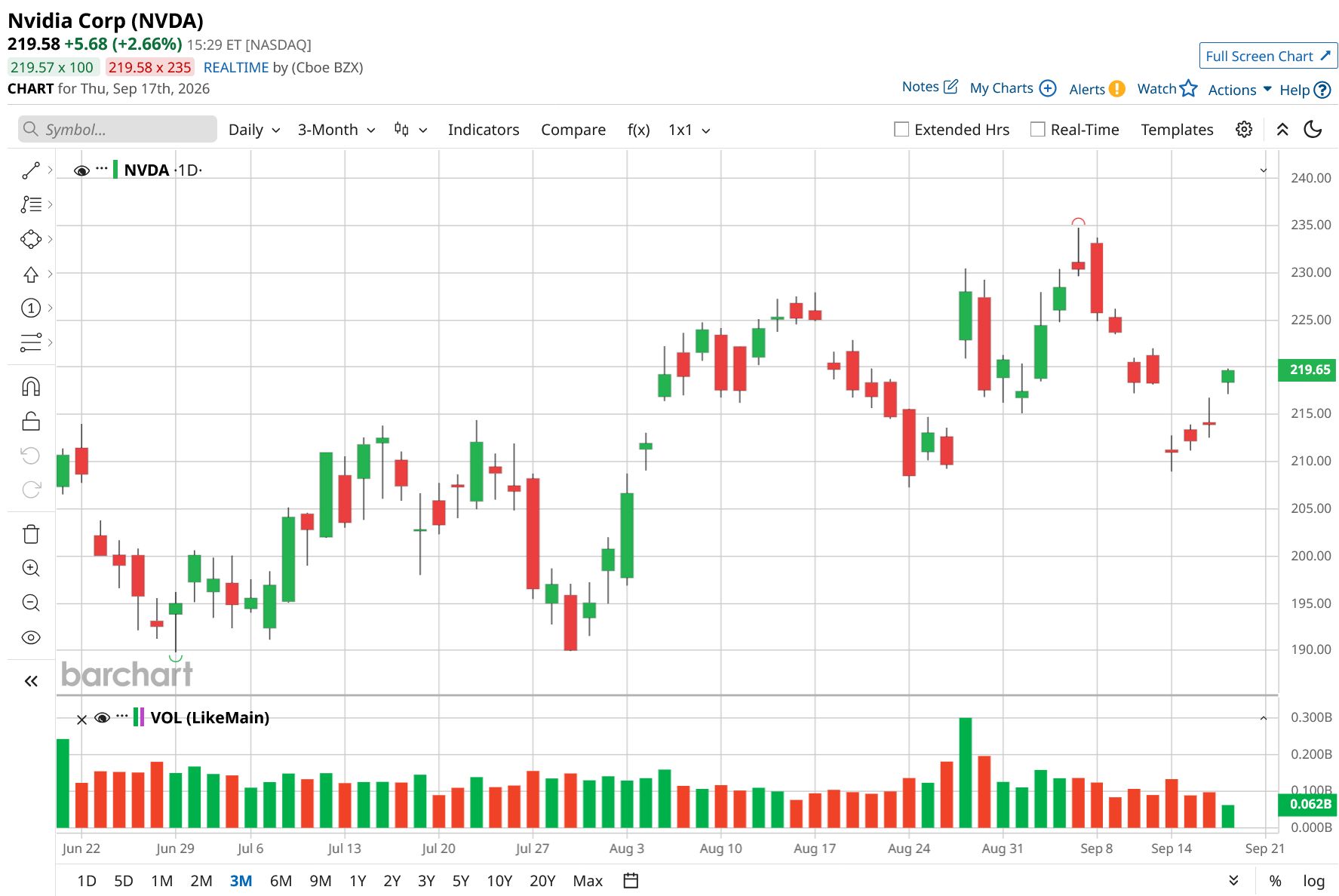
NVDA stock posted a 29% gain over the past year, but its performance fell short of the broader semiconductor sector. The iShares Semiconductor ETF (SOXX) gained 101% during the same period. A similar pattern has continued this year. Nvidia is up approximately 18% on a year-to-date (YTD) basis, whereas the ETF has surged around 72%.
 www.barchart.com
 As of this writing, Nvidia is the most valuable company in the world, worth well over $5 trillion. Yet its valuation looks reasonable to me. The forward GAAP price-to-earnings (P/E) of 21.96x sits nearly 58% below its 5-year average of 52.15x. Similarly, the forward price-to-sales (P/S) ratio of 12.82x is roughly 35% below its 5-year average of 19.79x. So the stock is trading at a steep discount even as growth holds up. The EPS outlook looks strong, especially for a company this size. Analysts expect earnings to grow 95% in 2027, 67% in 2028, 34% in 2029, and 12% in 2030. The pace slows each year, but that is expected from a much larger base, and the trajectory remains positive throughout.
The balance sheet is exceptional, with $62.47 billion in cash against just $38.86 billion in debt. That leaves Nvidia net cash positive by over $23 billion, giving it plenty of room to keep funding companies like Cohere. Each of those bets quietly points more customers toward Nvidia’s chips. With the multiples sitting below their historical norms and growth looking strong, I don’t see much for investors to worry about here.
Revenue Growth Outpacing Margin Pressure Next Year
Nvidia reported its second-quarter fiscal 2027 earnings on Aug. 27. Revenue for the quarter rose to a record $96.2 billion, more than double year-over-year (YoY). The earnings per share came in at $2.22, comfortably beating the Wall Street consensus of $2.08. CFO Colette Kress reported profitability and margin levels, saying GAAP and non-GAAP gross margins were both 75%, largely unchanged from last quarter due to a similar product mix. The company’s operating expenses were up 10% and 11% sequentially, primarily due to high compute infrastructure costs and compensation and benefits costs. Kress added that Hopper H200 shipments to China represented less than 1% of total data center revenue in Q2, reflecting the continued impact of U.S. export restrictions. The firm also registered a $7.8 billion gain on its equity portfolio in the second quarter.
Looking forward, Nvidia expects third-quarter revenue of $108 billion, plus or minus 2%, which implies a range of about $106 billion to $110 billion. The company also guided for gross margins of 74%, plus or minus 50 basis points, and operating expenses of $9.2 billion on a GAAP basis. On a positive front, management said Vera Rubin shipments began in August and that the new platform is already seeing purchase orders from major hyperscalers.
What Do Analysts Expect for NVDA Stock?
On Sept. 10, Goldman Sachs analyst James Schneider reiterated a “Buy” rating on NVDA stock and assigned a price target of $300. The analyst has given his “Buy” rating due to a combination of factors tied to the company’s long-term AI positioning and execution. He believes the company has a major advantage because its AI chips, networking equipment, and software work together as a complete system. As improvements in chip performance become harder to achieve, companies are investigating how to get more computing power and efficiency from their AI spending, which benefits Nvidia. Similarly, Bernstein analyst Stacy Rasgon maintained a “Buy” rating on Nvidia and set a price target of $400.
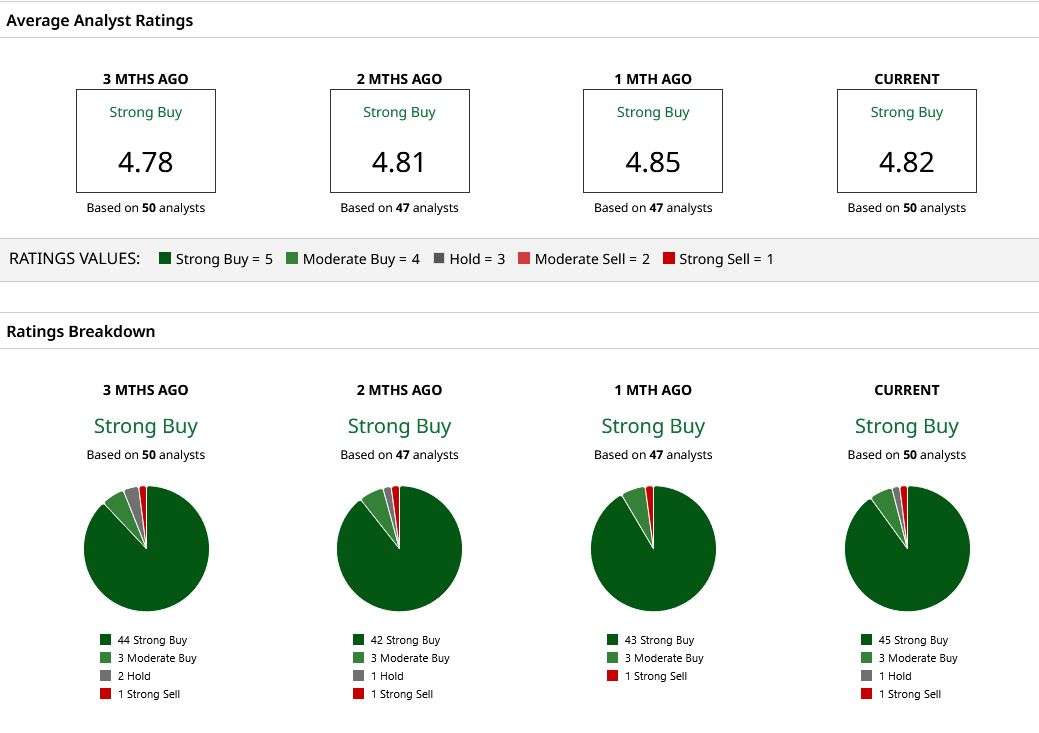
Based on 50 Wall Street analysts with coverage, NVDA stock holds a consensus “Strong Buy” rating. The mean target price of $326.09 implies an additional 49% upside from current levels. The lowest price target is $180. The high price target of $515 shows investor confidence in the long-term prospects of the company.
 www.barchart.com
 On the date of publication, Jabran Kundi did not have (either directly or indirectly) positions in any of the securities mentioned in this article. All information and data in this article is solely for informational purposes. For more information please view the Barchart Disclosure Policy here.
More news from Barchart
Here’s Another Little-Known Firm Jensen Huang’s Nvidia Is Quietly Backing MediaTek Is Stepping Up Competition Against Qualcomm With a New 2-Nanometer Chip. What This Means for QCOM Stock. Amodei, Altman, and Musk Called for an AI Slowdown. Here’s Why It’s a Warning Sign for ASML Shareholders. Before You Conclude the AI Era Won’t End Like the Dot-Com Era Did, Check Out These 2 Charts