


Last week, I argued that Nvidia (NVDA) was holding up fine on earnings and that the stock's slide was more about fear than the business itself. Of course, the market wasn't done testing that view, and shares dropped another 17% over the next 2 sessions.
Then, on Nov. 23, the board brought Jensen Huang back as CEO, and the stock posted its best day in 23 years, closing about 9% above the roughly $151 price I discussed in that piece. That was a welcome turn, but one issue from that rough stretch hasn't gone away, and I suspect it's why the stock moved down again today.
More Top Stocks Daily: Go behind Wall Street’s hottest headlines with Barchart’s Active Investor newsletter.
First, though, let's look at how fast things turned around.
Trump Helped Bring Huang Back as Nvidia's CEO Just 11 Days After He Resigned
On November 23, Nvidia's board unanimously reinstated Huang as president, CEO, and board member, effective immediately. This was rather surprising to me; at the very least, I didn't expect it to happen this soon, especially since board chair Harvey Jones said on the earnings call just 6 days earlier that the board had no plans to bring him back. So with Huang back in charge, Colette Kress, who had been serving as interim CEO, is now returning to her role as CFO.
So what changed in less than a week? According to President Trump, it was his doing: he took credit for personally convincing the board, and his administration assured directors that Huang wasn't a national security threat. Trump also pointed to his attorney general, who said the government has no evidence that Huang broke the law.
This lines up pretty closely with what I wrote last week: that a leader with strong ties to both customers and Washington could erase much of Nvidia's discount, and the board ended up finding that person in its own founder. Having the president in Huang's corner should also give Nvidia more breathing room, since Washington has a lot of say in where the company can sell its chips. That could come in handy heading into the second half of 2027, when Nvidia plans to launch its next major chip upgrade, Rubin Ultra.
That said, the backing doesn't come free, and lawmakers on both sides of the aisle are already pushing back. Sen. Chuck Schumer said the Democrats will investigate the administration and Huang, and Republican Sen. John Cornyn openly questioned the board's national security call. On top of that, the House Intelligence Committee, one of 3 House committees set to interview Huang on December 1, said his return changes nothing.
The date I'd circle is December 4, since that's the deadline for Nvidia's delayed 10-Q, the detailed quarterly report it usually files on earnings day. The stock, of course, didn't wait around for any of that, and the past week turned into quite a ride.
Nvidia Stock's 31.5% Jump Still Left It About 31% Below Its Record
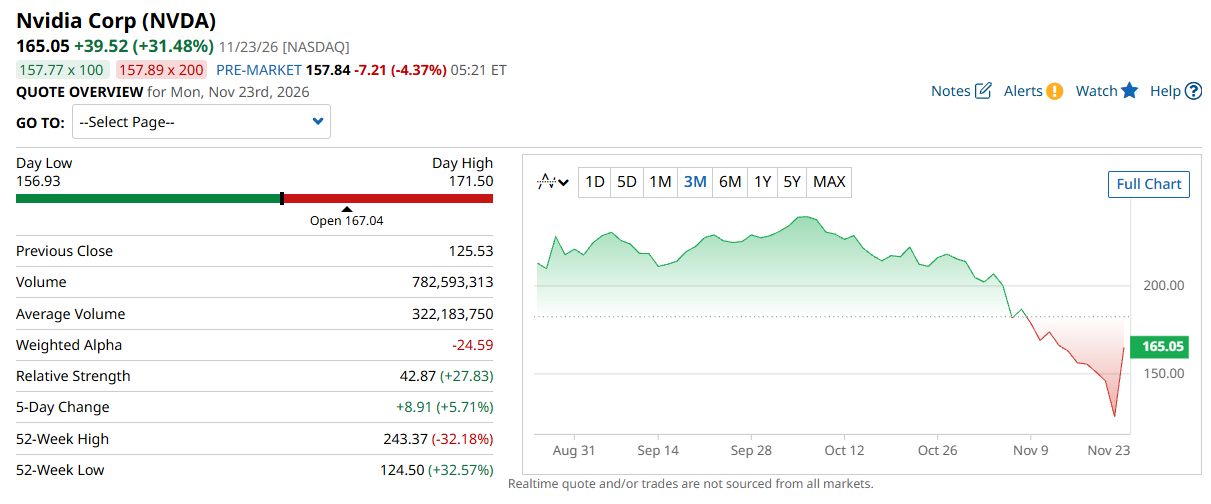
Before Monday's comeback, the stock went through a pretty brutal stretch, sliding from about $151 on November 18 to under $126 on November 20 after reports surfaced that the SEC is looking into the company's accounting practices. That 14% drop on the 20th capped a 23% slide for the week, which was the stock's worst since 2008.
Then the board's announcement hit, and Nvidia stock closed Monday at about $165, up more than 31%, adding roughly $950 billion in market value in a single day. The rally spilled over to neoclouds like CoreWeave (CRWV) and Nebius (NBIS) too, lifting them by more than 20%, which makes sense to me since those companies rent out computing power that runs mostly on Nvidia chips.
Even after that huge rebound, NVDA stock was still about 5% below its November 11 close of around $174, the last trading day before Huang's exit, and about 31% below its early October record of roughly $239. At around $165, Nvidia trades at about 15x its current earnings pace of $10.80 per share, which is just its third-quarter EPS of $2.70 multiplied by 4, and only about 10x my fiscal 2028 estimate of $16.60.
 Screenshot courtesy of: www.barchart.com
So, the way I see it, the market quickly priced out most of the CEO risk while holding on to a discount for the accounting questions, which I'll get to shortly. But first, I want to show why the selloff may have handed shareholders a pretty sweet deal.
Nvidia Could Buy Back Nearly 6% of Itself Using Cash It Already Generates
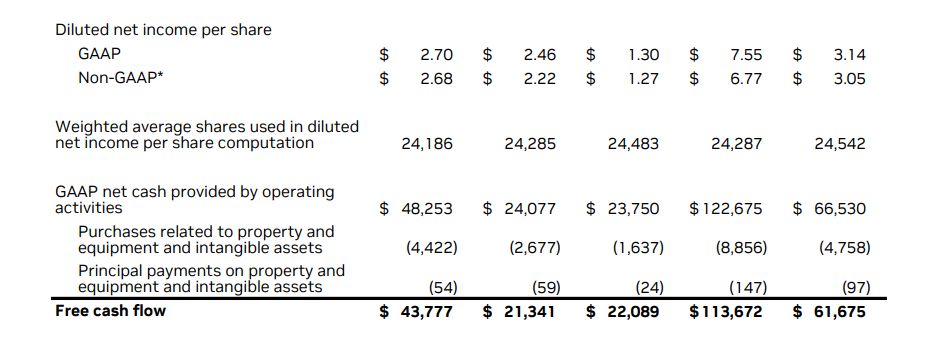
The deal I'm talking about comes down to its cash, and Nvidia is suddenly making a lot more of it. In the third quarter alone, Nvidia generated nearly $44 billion in free cash flow, which is the money left over after paying for operations and new equipment, and that's more than double the roughly $21 billion it brought in during the second quarter.
Even after returning a record $28 billion to shareholders, mostly through buybacks, Nvidia still had about $227 billion left in its buyback authorization, which management plans to use through fiscal 2028, ending in January 2028.
 Screenshot courtesy of: www.nvidia.com
Now, the selloff makes that authorization a lot more interesting at today's prices. Spreading $227 billion over the 5 quarters left through fiscal 2028 works out to roughly $45 billion per quarter, which is almost exactly what Nvidia generated in free cash flow last quarter. In other words, Nvidia could fund the entire buyback program from operations without dipping into its cash pile, and at Monday's close of around $165, that money would retire about 1.38 billion shares, or roughly 5.7% of the company. Each dollar also goes about 45% further than it would have at the October record.
For long-term holders, the payoff shows up in earnings per share.
If the share count shrinks by 5.7%, my fiscal 2028 estimate of $16.60 per share rises to roughly $17.60, a 6% lift without Nvidia selling a single extra chip. At a modest 15x multiple, that points to about $264 per share, up from the $249 I estimated last week. Employee stock awards will add some shares back, of course, though I don't think they come close to offsetting a program this size.
Personally, I think the timing works in shareholders' favor, too. A company usually holds off on buybacks while it's sitting on information the market hasn't seen yet, and right now, Nvidia has both an unfinished internal investigation and a delayed filing on its plate. So once the 10-Q is out, I expect buying to pick up at prices well below what Nvidia paid in the third quarter, when the stock hit record highs.
The funny thing is, Monday's rally already took a little bite out of this, since the same $227 billion would have retired about 7.5% of the company at Friday's close of just under $126. That's why I'd like to see Nvidia move quickly once the filing is out, although that same filing is also where the main risk is hiding.
Nvidia's Unpaid Customer Bills Hit $81 Billion as the SEC Digs In
The SEC probe is a different story, though, since the White House's assurances covered national security and Huang himself rather than Nvidia's books, and so far, no one outside the company has been able to pin down which accounting practices the agency is looking at.
So I went back through Nvidia's last few reports, and accounts receivable jumped out at me. Receivables hit $81 billion at the end of the third quarter. This matters because it's the money customers owe Nvidia for chips already shipped and counted as sales, and the average time it takes Nvidia to collect has climbed to 64 days. Nvidia blamed this on longer payment terms for large deals with customers that have strong credit ratings, along with shipment timing for Vera Rubin.
That collection window held between 43 and 46 days for 8 straight quarters before jumping to 60 in the second quarter and 64 in the third, which is a pretty sharp shift for just 6 months. Receivables also grew 28% last quarter while revenue grew 20%, and they're now roughly 1.5x Nvidia's $53.5 billion in cash and marketable debt securities. If that window stretches to 70 days in the fourth quarter, when Nvidia expects $130 billion in revenue, receivables could climb to roughly $93 billion.
Regulators tend to notice when receivables grow faster than sales, especially at a company already facing questions over how it reports sales by region. For instance, Nvidia reportedly booked $104 billion through its Singapore unit in 2025, close to half its sales, in the same year it stopped breaking Singapore out separately. Nvidia has also been down this road before, since an SEC inquiry back in 2002 ended with the company restating results for fiscal 2000, fiscal 2001, and the first 3 quarters of fiscal 2002, and the matter wasn't settled until September 2003.
As for the stock, I'll be watching the 10-Q closely. If it adds a new SEC risk factor or discloses a subpoena, I think shares could slide back toward $126, about 24% below Monday's close – and an open probe could keep a lid on the valuation for quite a while, no matter how fast Vera Rubin sells. So with both sides on the table, where does that leave me?
Why Huang's Comeback Leaves Me Even More Bullish on Nvidia
Personally, I've always believed that the best time to own a great business is when the market treats it like a broken one, and that's pretty much where Nvidia sits right now. The founder is back in the driver's seat, the company is generating cash at a pace it has never reached before, and the stock still trades below where it was before any of this drama started.
But the SEC probe is the one thing that could change my mind, especially if it turns out to touch how Nvidia records its sales, so I'll be reading that 10-Q line by line. Until then, I'd treat any dip ahead of December 4 as a chance to add, since nothing in the business itself has given me a reason to sell.
As a long-term investor, I've noticed that the noisiest weeks tend to offer the best entry points for those with the strongest stomachs. And I think this one might as well, too. With that in mind, risks and all, I'd feel even better about owning Nvidia with Huang back at the helm than I did a week ago.
On the date of publication, Rick Orford did not directly have a position in any of the securities mentioned in this article. All information and data in this article is solely for informational purposes. For more information please view the Barchart Disclosure Policy here.
More news from Barchart
Jensen Huang Is Back, and Nvidia's $227 Billion Buyback Could Retire Nearly 6% of NVDA Shares. Here's My Take Ahead of December 4. Ahead of Polestar Earnings, Here's What Barchart Data Says Comes Next for PSNY Stock This Analyst Just Downgraded Micron Stock. Here's Why. Broadcom Stock Could Have 70% Upside, Analysts Say. What AVGO’s Valuation Reveals.