JPMorgan analysts say Strategy’s last week sale of 32 bitcoin unsettled crypto markets and may force Michael Saylor’s company to rebuild its dollar reserves to restore confidence among investors. The warning comes as the bank turns more cautious on crypto, citing weaker capital flows, bitcoin’s break below estimated production cost, and reduced confidence in US crypto legislation passing this year.
In a report titled Alternative Investments Outlook and Strategy, JPMorgan analysts led by managing director Nikolaos Panigirtzoglou said Strategy’s small bitcoin sale had an outsized signaling effect. The sale was described as “symbolic and voluntary,” intended to demonstrate flexibility and commitment to preferred stockholders. But according to the analysts, it still “spooked” markets because it raised a central question for holders of both bitcoin and Strategy securities: whether the company could meet dividend obligations without selling more of its BTC stack.
Strategy Needs Cash To Calm Bitcoin Fears
Strategy, formerly MicroStrategy, has become the dominant corporate bitcoin treasury vehicle under Saylor, making its balance-sheet decisions a market-wide signal. JPMorgan said the company’s current dollar reserves cover only around 6.3 months of dividend payments, a level the analysts believe may be too thin for investors who are already watching the firm’s leverage, preferred stock structure and bitcoin exposure closely.
“In our opinion a rebuilding of the company’s dollar reserves might be needed to restore confidence and reduce investor concerns that the company would sell more bitcoins to cover dividend payments,” the analysts said.
The concern is not that Strategy has abandoned its bitcoin acquisition strategy. JPMorgan still expects the company to keep buying BTC. But the firm’s funding mix, dividend burden and limited cash buffer have become more relevant after the 32 BTC sale showed that bitcoin disposals, however small, are now part of the market’s risk calculus.
Strategy created a $1.44 billion US dollar reserve in December to safeguard dividend payments on its preferred stock and service interest on outstanding debt. JPMorgan said the company now needs to clarify how it plans to meet roughly $1.7 billion in annual dividend payments, particularly if bitcoin remains under pressure.
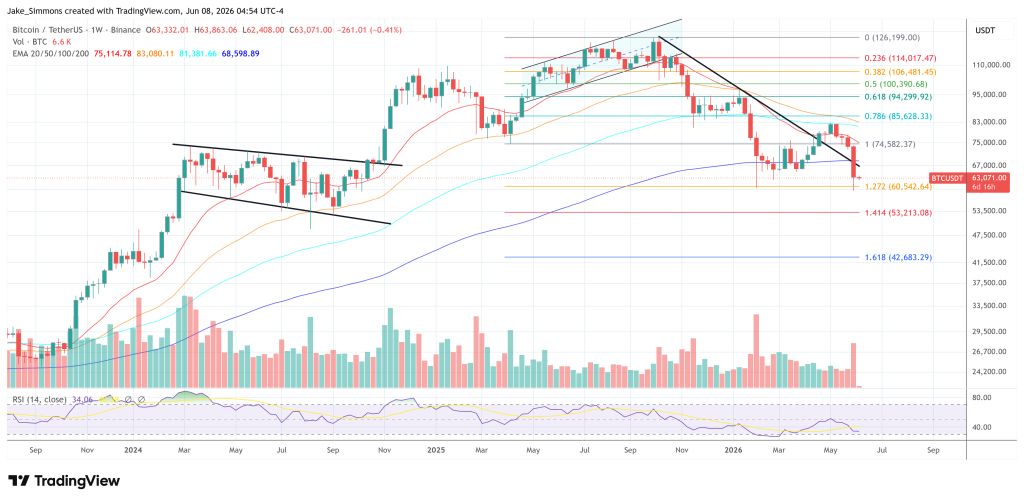
Saylor, meanwhile, signaled the opposite direction on Sunday, posting on X: “A good time to add more dots.” Strategy currently holds 843,706 bitcoin at an average cost of $75,699. At current prices near $62,000, that position implies a paper loss of roughly $11.5 billion.
JPMorgan said that if Strategy maintains its year-to-date pace of acquisitions , the company could buy around $32 billion of bitcoin in 2026, up from the bank’s prior estimate of $30 billion last month. That would compare with roughly $22 billion of bitcoin purchases in both 2025 and 2024.
The bank’s broader crypto outlook has also shifted. In February, JPMorgan was “overweight” and “positive” on digital assets for 2026, expecting institutional flows to drive the market higher. Now, the analysts have turned cautious, pointing to weaker inflows and a more uncertain regulatory backdrop.
A stronger second half for crypto, they said, depends on two conditions: Strategy explaining how it will cover dividends, and Congress passing the US crypto market structure bill, known as the Clarity Act. JPMorgan now sees less than a 50% chance of that legislation passing this year, citing a narrowing window ahead of the US midterm elections, continued debate around stablecoin yield, and remaining political hurdles.
The analysts also noted that bitcoin has spent much of the year below their estimated production cost . Their central estimate fell from $90,000 at the start of the year to $77,000 as hashrate and mining difficulty declined, before rebounding to around $87,000. Historically, they said, production cost has acted as a “soft floor” for bitcoin, making the current price near $62,000 another reason for caution.
Capital flows tell a similar story. JPMorgan estimates total digital asset inflows at around $22 billion year-to-date, implying an annualized pace of roughly $52 billion, about half the level recorded in 2025. The estimate includes crypto fund flows, CME futures positioning, crypto venture capital fundraising and corporate treasury purchases, including Strategy’s bitcoin acquisitions.
Despite the cautious stance, JPMorgan left room for a reversal in sentiment. The analysts said the current weakness could prove a “bullish contrarian signal going forward.” Still, they concluded that a constructive second half “would be conditional on Strategy clarifying its strategy [for] meeting dividend payments of $1.7 billion a year and on the approval of the US market structure legislation for which we now see less than 50% chance.”
At press time, BTC traded at $63,071.