

With a dividend yield of 4.3%, Ford (F) is among the highest-yielding constituents of the S&P 500 Index ($SPX). That number would look even more compelling considering Ford’s dividend yield is over four times what an average S&P 500 Index constituent pays.
However, a bit of number-crunching tells a different picture. Dividend yield is basically a function of the per-share dividend, which is the numerator in the equation, and the stock price, which is the denominator. Dividend yield rises when the company raises its dividends or the share price falls. More often than not, the latter is true for companies that have a very high dividend yield.
More Yield, Less Trap: Sign up free to get Barchart’s daily Dividend Investor newsletter straight to your inbox.
S&P 500’s Dividend Yield Is Near Historic Lows
The S&P 500’s dividend yield is near its historical lows. Two factors can be blamed for the dip in the world's most popular index's dividend yield. First, tech companies’ share in the market-cap-weighted index has soared amid the artificial intelligence (AI) driven rally. Mega-cap tech companies are known to be frugal with dividends, and their rising weightage in the index pulls down its dividend yield. Second, while the annualized dividend per share of the S&P 500 has continued to rise over the years, the increase has been much lower compared to the surge in stock prices.
Ford Hasn’t Raised Dividends Since 2022
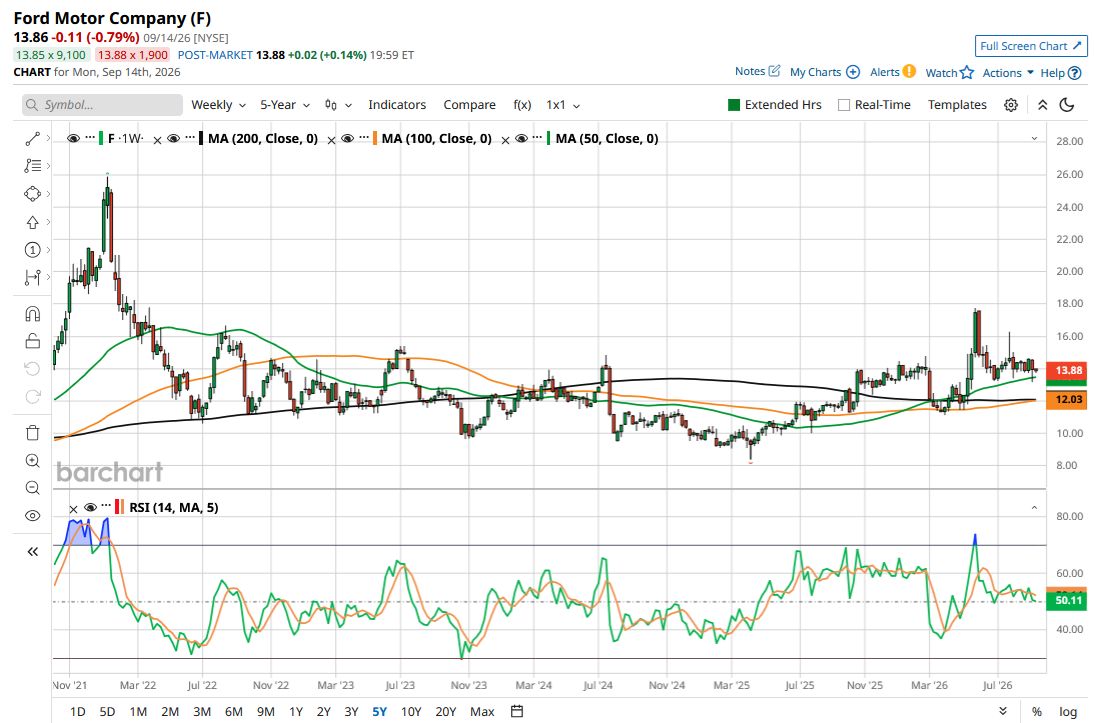
In contrast, Ford’s quarterly dividend has been static since July 2022, when the company raised the payout by 50% to $0.15. Notably, while Ford paid special dividends in the preceding three years to reach its payout targets, it hasn’t raised its payout for over four years. Its dividend yield is still high because of its underperforming stock, which has essentially gone nowhere in the last five years and trades 46% below its October 2022 highs.
 www.barchart.com
Ford’s Dividend Policy
Let’s look at Ford’s dividend policy. The company intends to pay between 40% and 50% of its free cash flow as dividends. It has around 4 billion outstanding shares, and to maintain the current quarterly payout of $0.15 ($0.60 annually), it would have to pay around $2.4 billion in dividends in a year. Ford’s 2026 guidance calls for adjusted free cash flows of between $6 billion and $7 billion this year. The company raised its 2026 free cash flow guidance by $1 billion during the Q2 2026 earnings call but attributed half of the increase to the IEEPA tariff reimbursement it expects to receive this year.
Incidentally, Ford’s free cash flow has been in that range for quite some time now. There have been aberrations, such as in 2022, when its free cash flow jumped after it monetized its stake in Rivian (RIVN), while last year free cash flow dipped due to tariffs and a fire incident at a supplier.
Ford Might Not Raise Its Payout Soon
Meanwhile, Ford’s expected 2026 free cash flow is more than enough to cover the dividends, and there is some room for a hike/special dividend to reach its target range. However, I won’t bet on Ford raising its payout over the next year as the company might want to play it conservatively, especially after overshooting its payout target range last year. Also, with the macro environment not looking conducive and a rate hike possibly on the table sometime this year, Ford should be looking at preserving cash.
 www.barchart.com
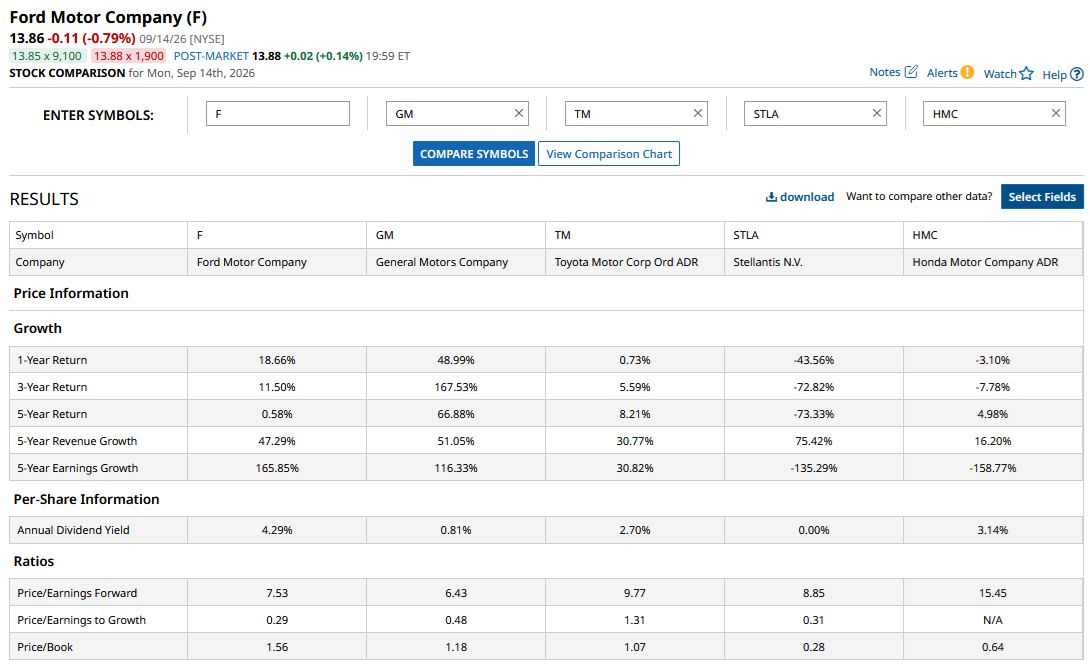
As I have argued in the past, Ford should instead consider share repurchases, something rival General Motors (GM) has done over the last few years. GM repurchased $2.8 billion of its shares in the first half of 2026 and ended June with dilutive outstanding shares of 893 million, down 35% from Q2 2023. The company announced a $10 billion accelerated share buyback program in November 2023, and has since been aggressively repurchasing shares. Markets seem to love GM’s buybacks, and the stock has outperformed Ford considerably since it ramped up repurchases.
One of the reasons Ford isn't doing big repurchases and instead prefers a high dividend payout is the “family element,” as the Ford family still owns a big chunk of voting power through Class B shares. The family does not intend to sell its holdings, and regular dividends suit their interests better compared to buybacks. As for Ford increasing the dividends, I don't see the company raising the payout at least this year. At the same time, I don't expect a cut either unless things really worsen, which is not the base-case scenario.
On the date of publication, Mohit Oberoi had a position in: F , GM , RIVN . All information and data in this article is solely for informational purposes. For more information please view the Barchart Disclosure Policy here.
More news from Barchart
Ford Hasn’t Raised Its Dividend in Years. Don’t Count on a Hike in 2026. FLNC Stock Alert: What to Know as Fluence Energy Cuts Guidance Rockwell Just Got a Major AI Cybersecurity Boost From Anthropic. What It Means for ROK Stock. NBIS Stock Jumps on Nebius Price Hike Rumors