

Apple (AAPL) is thinking about getting back into the server business. According to The Information, it’s developing an enterprise AI server built around its own M8 Ultra chips. The machines would be sold to AI developers, companies, and governments that want to run AI models on their own hardware. It would mark Apple’s first real return to servers since it dropped the Xserve line back in 2011. What makes this especially interesting is who Apple would need to pull it off. The plan reportedly relies on Nvidia’s (NVDA) networking technology to link the chips together. Apple’s own chip-to-chip connection is said to be too slow and costly to work at server scale. So the most self-reliant company in tech would have to lean on Nvidia, a company whose own chips could one day compete against it. That tells you how seriously Apple is considering this market.
A Shift From Its On-Device Bet
This also marks a change in direction worth noting. As I wrote when Apple launched its 2nm M6 chip, the company had been making a quiet bet against data centers. Its whole pitch was that AI belongs on the device in your hand, not in some distant server farm. A server business aimed at data centers softens that stance. Apple now seems to want a piece of the compute demand it had mostly stayed away from.
More Top Stocks Daily: Go behind Wall Street’s hottest headlines with Barchart’s Active Investor newsletter.
It’s not difficult to understand why Apple is considering this shift. Mac was Apple’s fastest-growing segment last quarter, up 29% to $10.4 billion. A big reason is that AI labs have been buying Mac minis and Studios in bulk to run their work. Apple has clearly noticed that demand and wants a product built for it.
This is still early, though, and the server isn’t expected until 2029. The focus is on inference rather than training, which plays to the efficiency Apple’s chips are known for. It’s not a finished plan, but even a signal of intent from a company this size is worth paying attention to.
About Apple Stock
Apple operates as a manufacturer, designer, and marketer of smartphones, tablets, PCs, wearables, and accessories. It provides a range of products, including iPhone, iPad, Mac, Apple-branded & third-party accessories, and others. The company also provides AppleCare support & cloud services as well as advertising services. The company sells its products through its retail and online stores and a direct sales force. Founded in 1976, the company is headquartered in Cupertino, California.
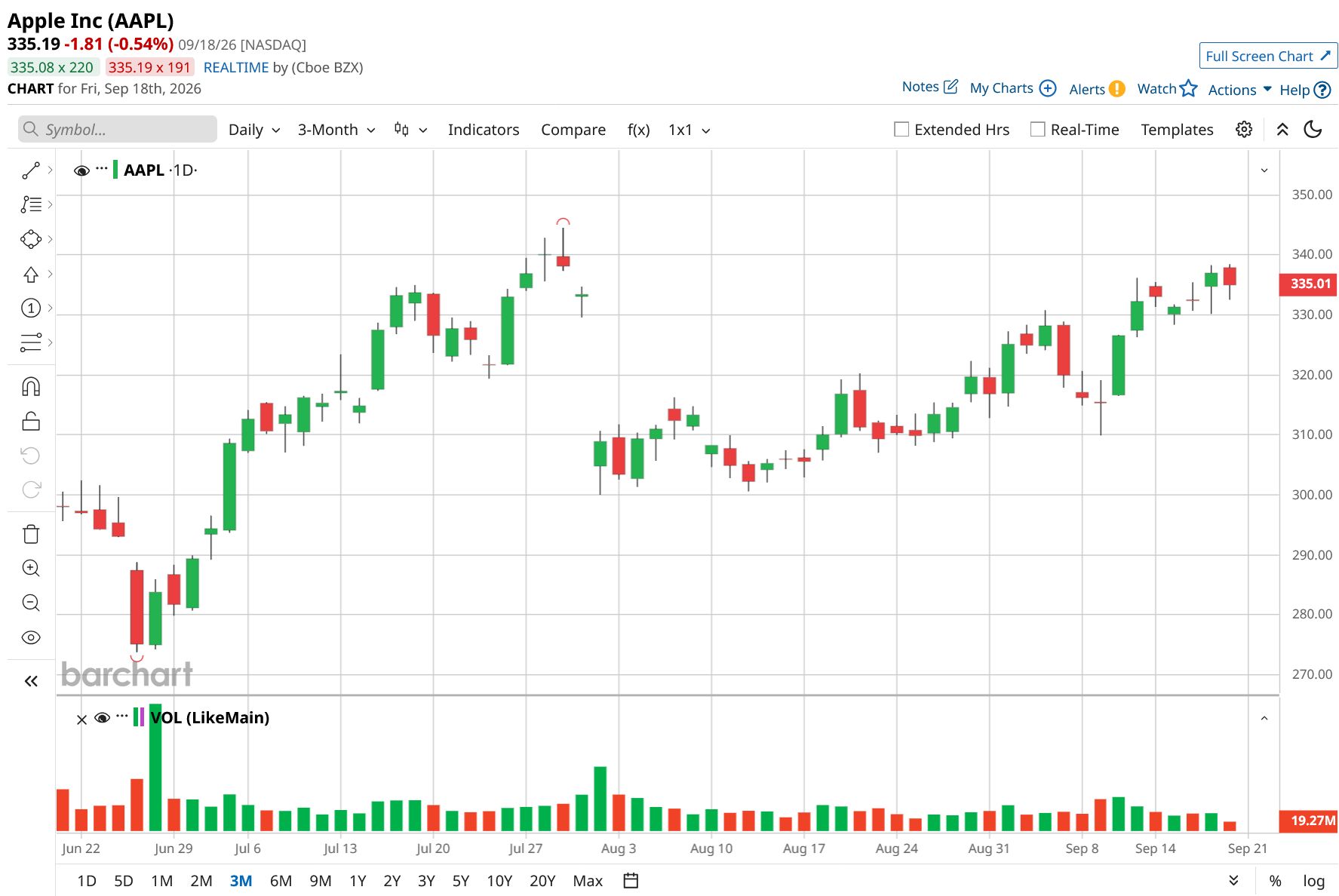
Over the past year, Apple shares have surged 40%, outperforming the S&P 500’s ($SPX) gain of 15% during the same period. Following the launch of its new products on Sept. 9, the company’s shares rose modestly and are currently trading at around $322, up from $315 previously.
 www.barchart.com
 Apple’s stock isn’t cheap right now. Its forward GAAP price-to-earnings (P/E) of 37.59x is 28% above its historical average, and its price-to-sales (P/S) ratio of 10.12x is 33% above. So investors are paying a clear premium for a company expected to grow earnings only in the high single to mid-teens through this decade. That is the tension with the server story. A 2029 product that might get cancelled doesn’t justify the premium.
What supports Apple's valuation is its reliability and $62 billion cash pile. For now, the premium rests on the company’s track record, not its ambition.
Apple's Demand Remains Strong. Its Supply Chain Is the Challenge.
Apple reported its third-quarter fiscal 2026 earnings on July 30. It reported revenue of $109.42 billion, up 16% year-over-year (YoY). The earnings per share came in at $2.20, beating the Wall Street consensus of $1.89. The company’s gross margin was 50.1%, up 80 basis points sequentially, and this included a benefit from tariff refunds. Apple’s operating cash flow for the quarter was $34.4 billion, a June-quarter record. CEO Timothy Cook said the quarterly results were a record in every geographic segment, including the US, China, India, Western Europe, and Japan, despite significant constraints in the supply chain.
Looking forward, Apple guided for fourth-quarter revenue growth of 9% to 11% YoY. For gross margin, the company projected 47% to 48%, while operating expenses are expected to be between $19.1 billion and $19.4 billion. Foreign exchange would be a 2.5 percentage point headwind to growth, and supply constraints would increase significantly from the previous quarter.
What Do Analysts Expect for AAPL Stock?
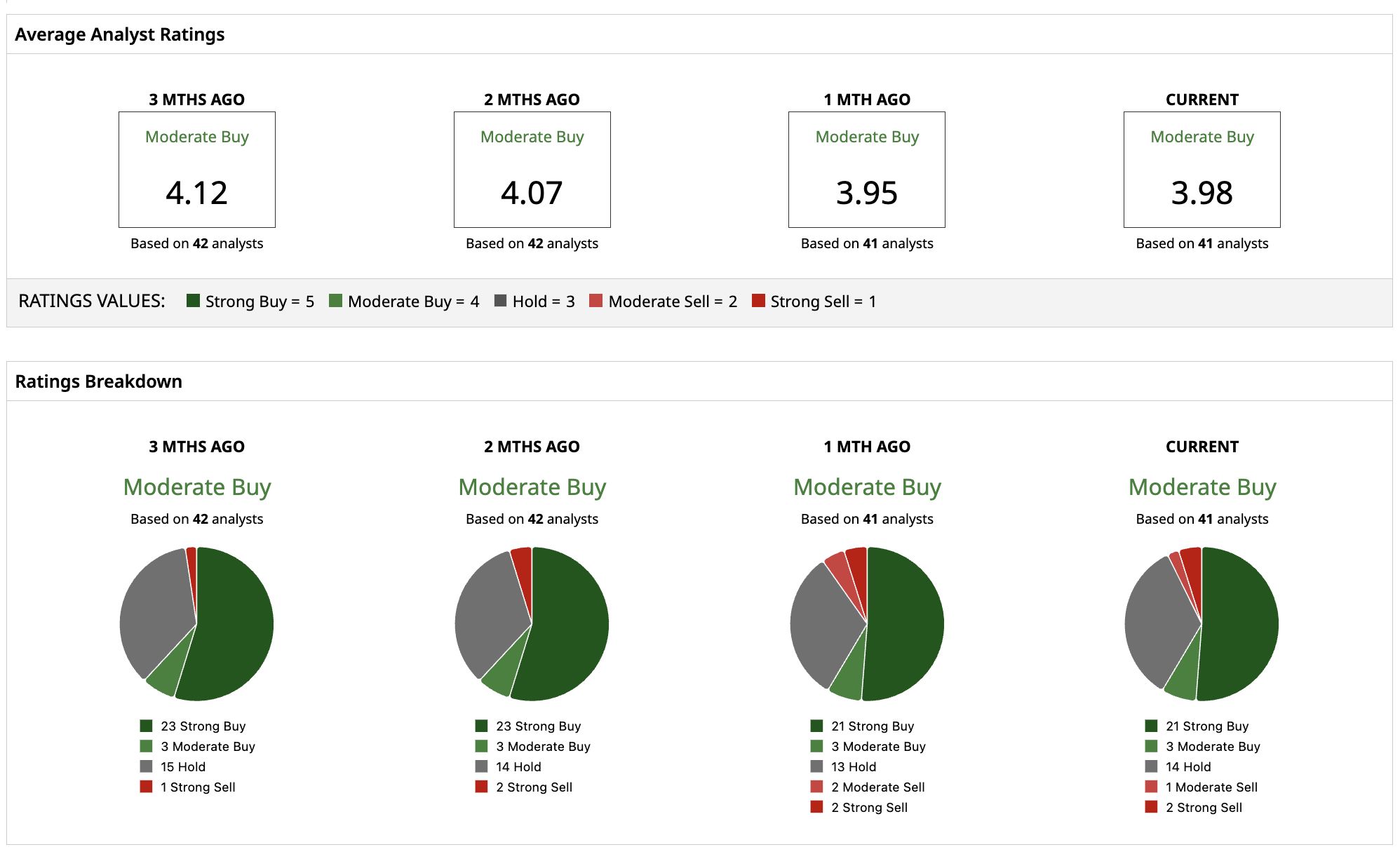
Wall Street remains divided on AAPL stock. On Sept. 14, Bank of America Securities analyst Wamsi Mohan reiterated a “Buy” rating and assigned a price target of $370. The analyst has given a “Buy” rating because he believes early demand for the iPhone 18 Pro and Pro Max appears strong. Shorter delivery times than last year and strong relative availability in China are considered positive for demand despite changes in product mix, pricing, and launch timing this year. In contrast, Barclays analyst Tim Long reiterated a “Sell” rating on Apple with a price target of $245.
AAPL stock is currently covered by 41 Wall Street analysts and carries a consensus “Moderate Buy” rating. According to their estimates, it has a median price target of $330.73, which sits just below the current share price. The high price target of $400 reflects 19% upside from current levels.
 barchart.com
 On the date of publication, Jabran Kundi did not have (either directly or indirectly) positions in any of the securities mentioned in this article. All information and data in this article is solely for informational purposes. For more information please view the Barchart Disclosure Policy here.
More news from Barchart
Apple Wants to Enter the AI Inference Market. It Will Have to Swallow Its Pride First. A Longtime Bear on FuelCell Energy Stock Just Turned Bullish. Here’s What Changed. CoreWeave Rises After Going Live With Vera Rubin Racks. What This Means for CRWV Stock. Social Security’s 2027 COLA Could Be the Biggest in 3 Years: Here’s What Retirees May Actually Keep