

The artificial intelligence (AI) boom has pushed the world’s largest technology companies into an unprecedented spending race. Microsoft (MSFT), Amazon (AMZN), Alphabet (GOOG) (GOOGL), and Meta Platforms (META) are pouring billions into data centers, advanced AI chips, and supporting infrastructure to meet surging demand for AI computing. While that spending has helped fuel optimism about the industry’s long-term growth prospects, it has also raised an increasingly important question for investors: How much financial pressure can these companies absorb before their massive investments begin generating meaningful returns?
A new report from BofA Global Research has brought that question into sharper focus. According to the firm, Microsoft stands apart from its major hyperscaler peers as the only one projected to avoid negative free cash flow (FCF) over the coming year. The distinction comes at a time when investors are paying closer attention to the financial sustainability of the AI infrastructure buildout.
More Top Stocks Daily: Go behind Wall Street’s hottest headlines with Barchart’s Active Investor newsletter.
But does Microsoft’s stronger projected cash flow position necessarily make it the best way to capitalize on the AI boom, or are there significant caveats that deserve consideration? Let’s take a closer look.
About MSFT Stock
Microsoft is one of the world’s largest technology companies, with a diversified business spanning cloud computing, enterprise software, AI, gaming, and personal computing. Its flagship products and services include the Windows operating system, Microsoft 365 productivity suite, Azure cloud platform, Dynamics business applications, LinkedIn, and Xbox gaming ecosystem. The company generates substantial recurring revenue from enterprise subscriptions, cloud services, and software licensing. Microsoft is also a major player in the AI industry, investing heavily in data center infrastructure and integrating AI capabilities across its product portfolio. It has a market cap of $3.95 trillion, making it the fourth-largest publicly traded company in the world by market value.
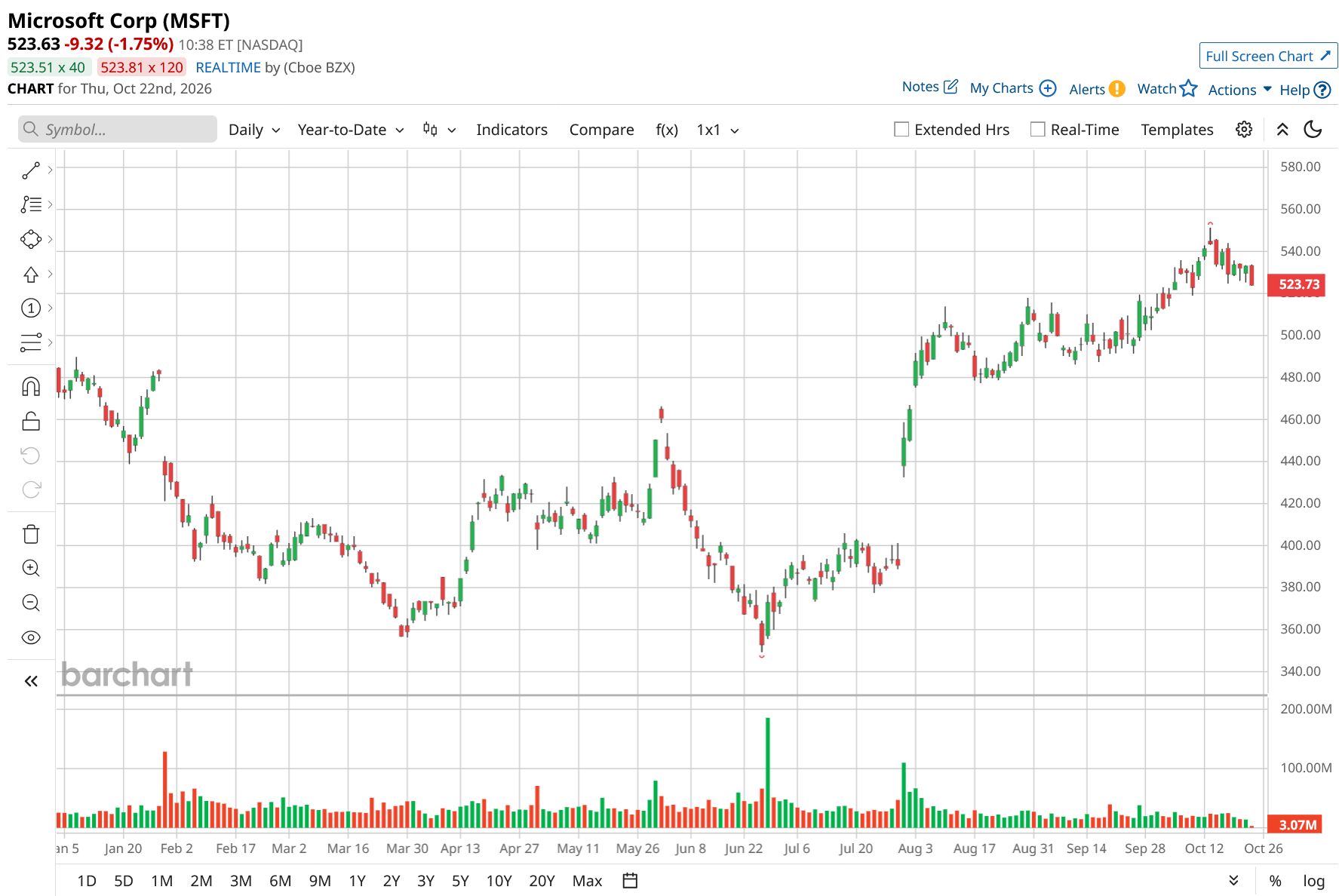
Shares of the tech giant have gained 9% on a year-to-date (YTD) basis. MSFT stock has rallied since late June as investors have grown increasingly optimistic about the company’s AI strategy, with its Azure cloud platform and Copilot AI assistant considered key revenue growth drivers.
 www.barchart.com
Microsoft Is the Only Hyperscaler Expected to Avoid Negative FCF, BofA Says
According to BofA Global Research, Microsoft is the only major hyperscaler not expected to dip into negative FCF over the next 12 months. Amazon, Alphabet, Meta Platforms, and Oracle (ORCL) are all projected to see their FCF turn negative at some point during the forecast period extending into 2027. BofA estimates that each of these hyperscalers will see its NTM FCF fall below -$25 billion at some point between 2026 and 2028.
That difference could become increasingly important as investors scrutinize whether Big Tech’s massive AI investments are generating sufficient returns. BofA’s report underscored a potentially troubling mismatch between AI spending and the financial returns it generates. Year-over-year (YoY) AI capex growth has significantly outpaced AI-related revenue growth this year—50% versus 20%, according to the firm.
With AI-related revenue growth not expected to outpace capex growth until the second half of 2027, hyperscalers’ FCF will remain under pressure, drawing increased scrutiny from investors. And Microsoft appears better positioned to navigate this environment, as its AI expansion is backed by a diversified portfolio of highly profitable businesses generating recurring revenue. Azure, Microsoft 365, Dynamics, cybersecurity products, and other enterprise software generate massive operating cash flow, allowing the company to invest aggressively in AI infrastructure while maintaining positive FCF.
Its latest results reinforce that argument. In FQ4 2026, Microsoft generated $55.4 billion in operating cash flow, up 30% YoY, even as capex reached $41 billion. FCF remained positive at $19.6 billion. Meanwhile, Microsoft Cloud revenue climbed 27% YoY to $59.3 billion, while commercial remaining performance obligations totaled $678 billion, providing substantial visibility into future revenue.
FCF Advantage Could Set It Apart in the AI Race
Microsoft’s ability to fund its AI expansion internally could give it a significant competitive advantage. Here’s why.
According to Bloomberg, hyperscalers (Amazon, Alphabet, Microsoft, and Meta) issued more than $200 billion in bonds through September 2026, a record amount and more than double the $78 billion raised last year. Notably, while Microsoft is included in this group, the company has not undertaken any major debt offerings this year. Meanwhile, Goldman Sachs projects that gross debt issuance by hyperscalers will reach a record $420 billion next year.
And this brings us to a particularly important point. All major bond offerings by hyperscalers took place before the Federal Reserve began its interest-rate hiking cycle. With another 25-basis-point rate hike fully priced in and interest rates expected to remain elevated for longer, hyperscalers could face higher borrowing costs when tapping debt markets. That would increase their interest expenses, put further pressure on already strained FCF positions, and potentially fuel the kind of AI-related debt concerns that have recently weighed heavily on neo-cloud companies. Against this backdrop, Microsoft could emerge as a more attractive play for investors seeking balanced exposure to the AI boom.
However, one significant caveat remains. Positive FCF does not mean Microsoft’s entire AI infrastructure expansion is being funded without future financial obligations. The company has increasingly relied on finance leases to support its data center expansion. For example, in fiscal Q4, its total capex was $41 billion, while cash purchases of property and equipment were $35.8 billion. The difference was largely attributable to finance leases. With that, traditional FCF measures may not fully capture the financial burden of Microsoft’s infrastructure commitments at the time they are made.
Conclusion
Microsoft could offer investors a more balanced way to capitalize on the AI boom, combining significant exposure to cloud computing and enterprise AI with a stronger projected FCF position than its hyperscaler peers. That financial resilience could become increasingly valuable if concerns about AI spending resurface, potentially supporting a valuation premium for MSFT stock.
Still, Microsoft’s ability to remain FCF positive does not necessarily make it the clear winner in the AI race. The projected positive FCF is an advantage, not proof of superior future returns. Moreover, its substantial lease commitments and continued spending increases remain important risks.
Meanwhile, if other hyperscalers generate returns on their AI investments that meet investor expectations, investors will likely look past their weaker FCF positions. The ongoing earnings season should provide greater clarity on that front. Meta reported its Q3 results after the bell on Wednesday, sending its shares higher in after-hours trading, while Microsoft, Alphabet, and Amazon are set to report next week.
On the date of publication, Oleksandr Pylypenko had a position in: MSFT , AMZN , GOOGL , META . All information and data in this article is solely for informational purposes. For more information please view the Barchart Disclosure Policy here.
More news from Barchart
Microsoft May Be the Only Hyperscaler to Stay Cash-Flow Positive. What It Means for MSFT Stock Nvidia vs. Broadcom: One Grew AI Revenue 221% Last Quarter. The Other Grew 117%. Micron’s Taiwan Unit Reached a Deal With the Taichung Union. Here’s What to Know. IBM’s CEO Just Issued a Warning Message on AI Spending. He Ended Up Hurting His Own Stock.