


On the last Friday of July, an Ethereum wallet linked by on-chain analysts to Arthur Hayes suddenly started selling.
Within minutes, 2,364 ETH was sent to Cumberland and Galaxy Digital, two major crypto trading firms. The wallet sold at around $1,821 per ETH, crystallizing a loss of roughly $241,000 on coins it had bought only weeks earlier.
Arthur Hayes( @CryptoHayes ) bought high and sold low again!
— Lookonchain (@lookonchain) August 1, 2026
Over the past 2 hours, he deposited 2,364.38 $ETH into Cumberland and Galaxy Digital, receiving 4.3M $USDC in return.
His selling price was https://twitter.com/lookonchain/status/2083342295995384214,821, resulting in a loss of 1K (-5.3%).
He had previously bought 7,213… pic.twitter.com/4AVZpjANZD
Then came the strange part.
Two days later, the same wallet started buying Ethereum again at roughly $1,869. By Monday evening, on August 3, 2026, it had accumulated around 2,676 ETH — leaving it with more ETH than it held before the sell-off.
Whatever prompted the wallet to exit on Friday appeared to have changed over the weekend.
Why would an experienced crypto investor like Arthur Hayes sell at a loss, only to buy back even more days later?
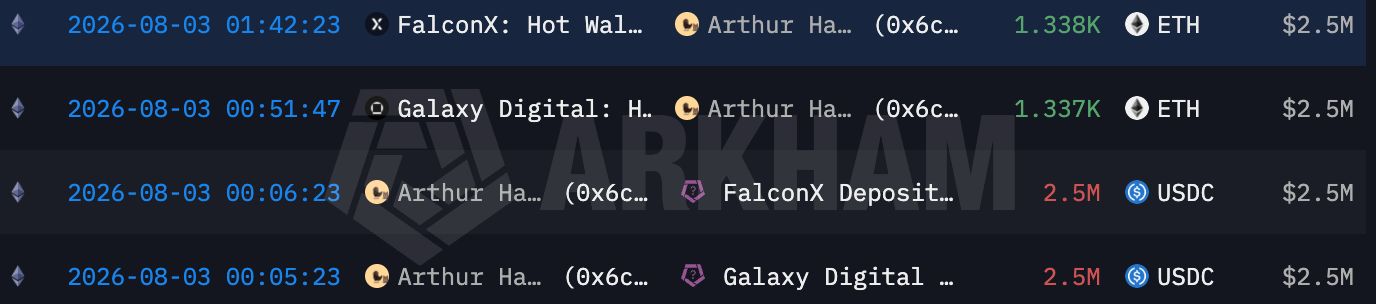 Arthur Hayes Buys More ETH on August 3. Image Source: Arkham
 Lookonchain caught the transactions within hours and posted the line that has followed the BitMEX co-founder for years:
"Arthur Hayes bought high and sold low again!"
That word, "again," carries a serious accusation. It implies a pattern. It implies that crypto's most quoted macro commentator, a man whose essays can move markets, is also its most reliable inverse indicator.
The Jim Cramer of crypto, as the meme goes.
But jokes are cheap. Receipts are not. So BeInCrypto pulled every transaction from the three wallets attributed to Hayes for the past two years and eight months, priced every trade, matched every sell against the buys that came before it, and added it all up.
The answer: the meme is half true. The half that is true cost him about $2.47 million. And the most interesting finding is not where he loses. It is the one place he wins.
The Scoreboard: One Winner, Six Losers
The wallets lost roughly $2.47 million overall. ENA — where Hayes is an adviser and token holder — was the only profitable token, offsetting about $5.5 million in losses elsewhere.
Meanwhile, if you consider just the closed reconstructed trades, the result is a loss of $2.24 million.
Include the open positions our model tracks, roughly 8,165 ETH purchased inside the window at an average of $1,884 and 25.3 million ENA at an average of $0.091, both currently underwater, and the total reaches minus $2.47 million on roughly $92 million put to work.
Note that the wallets hold more than the model tracks, about 10,800 ETH and 28.45 million ENA per Arkham. The gaps are pre-window coins, and 3.1 million ENA received from an Ethena multisig on August 10, none of which has a purchase price in our window, so none enters the profit math.
The trade record: 15 wins, 25 losses.
Token by token, the picture is stark.
ETH lost a reconstructed $2.04 million. SYN lost $1.41 million. LDO lost $1.26 million. ETHFI lost $474,000. PEPE lost $152,000. PENDLE lost $124,000.One token made money: ENA, up $3.23 million.
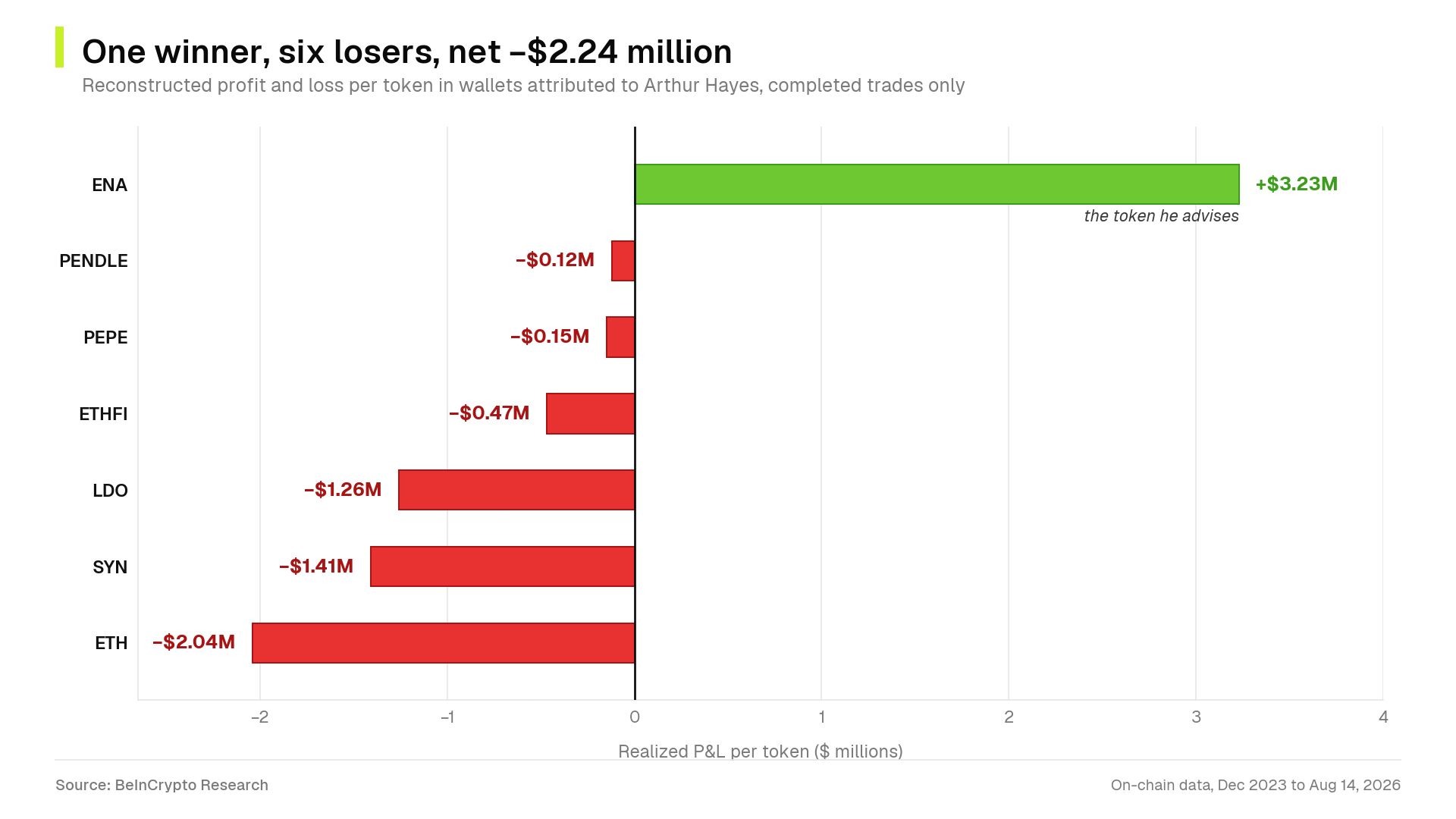 Arthur Hayes Realized PnL Per Token. Image Source: BeInCrypto
 ENA is the governance token of Ethena. It is a project Hayes formally advises, holds vested tokens in, and promotes relentlessly.
On the six tokens where he is just another trader with a strong opinion, the wallets lost about $5.5 million. On the one token where he has an insider's seat, he made $3 million.
The ETH Pattern: Sell Low, Rebuy High
Ethereum is where the meme earns its keep because of the repeated pattern of buying high and selling low. Our findings show that Hayes-linked wallets sold into short-term fear, then bought back after prices recovered, sometimes at a steep premium.
The wallets traded ETH 34 times in our window, and the choreography repeats: sell into fear, watch the market steady, buy back at a worse price.
The clearest example ran through August 2025.
On August 1, with Hayes publicly cautious on the macro picture, the wallet deposited 2,373 ETH to two trading desks, a sale Lookonchain tracked at about $3,507 per coin. Ethereum ignored the fear and ran almost straight up.
On August 10, the same wallet bought 1,500 ETH back at around $4,252. Same asset, roughly $745 per coin more expensive. On the rebought coins alone, the exit and re-entry cost roughly $1.1 million.
Arthur Hayes( @CryptoHayes ) sold 2,373 $ETH (.32M) a week ago when the $ETH price was ~,507.
— Lookonchain (@lookonchain) August 9, 2025
4 hours ago, he moved out 10.5M $USDC to buy back $ETH at a higher price. https://t.co/SUhcOE4I0o pic.twitter.com/VzEBgje7dh
The July 2026 episode that opened this article follows the identical script, compressed into a weekend. Sell 2,364 ETH at a $241,000 realized loss on Friday.
Rebuy more than that by Monday. The loss purchased nothing: no protection, no dry powder, no changed thesis. Both transactions sit on the chain for anyone to verify, including the 1,167 ETH transfer to Cumberland.
Each individual sale had a reason. A scary macro print, a tariff headline, a liquidity worry, all articulated in Hayes's essays. The problem is not any single decision.
It is that his fear operates on a weekend timescale while Ethereum's moves operate on a monthly one. The wallets kept selling dips and rebuying recoveries, and the running total of ETH trading only found new lows.
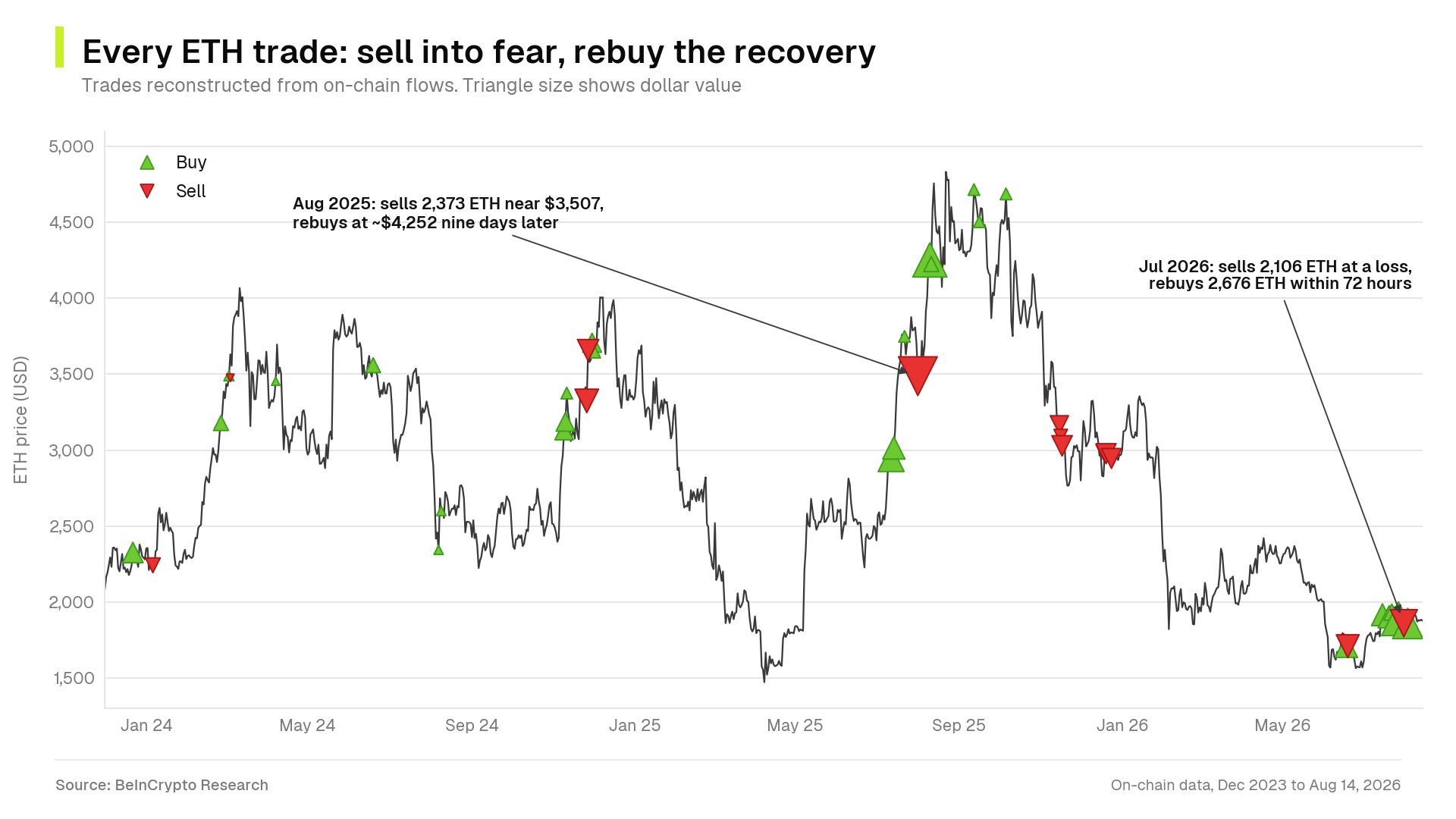 Arthur Hayes ETH Trades. Source: BeInCrypto
 The Counterexample: He Traded ENA Brilliantly, Once
Fairness demands the ENA chapter, because it was a clear exception.
Hayes-linked wallets timed the token far better than other trades, generating millions in profit — though the latest ENA position is already underwater.
In late November 2024, the wallets spent about $11.2 million, accumulating 16.79 million ENA at around $0.67 through Binance, Wintermute, and Flowdesk.
Then, unusually, Hayes waited. Three weeks later, on December 21, two hours after tweeting praise of Ethena, the wallet moved $8.4 million of ENA to Binance and sold near $1.19, roughly 78% above his $0.67 entry a month earlier. Our reconstruction credits about $3.7 million of realized profit on that day's sale.
I could nit pick some things , but a very impressive run down on @ethena_labs. If you are a DeFi protocol and you haven’t integrated USDe or sUSDe, you are fucking up. https://t.co/bFsQB6Uw67
— Arthur Hayes (@CryptoHayes) December 21, 2024
The criticism that followed concerned ethics: promoting a token publicly and selling into the pump within two hours. Nobody called the trade dumb.
Across our full window, his ENA buys were followed by an average 30% outperformance within a month, and his ENA sells preceded 22% underperformance. Both sides of the trade, timed well, repeatedly.
Why is Arthur Hayes Good With ENA Trades?
Two structural reasons. First, proximity. Maelstrom advises Ethena. Second, patience, but only here.
He held the November position for weeks, while his ETH conviction has a shelf life of days.
The 2026 sequel is going worse. Lookonchain data shows he bought 15.8 million ENA at $0.23 in February and sold 3.6 million at $0.14.
And in the few days before publication, the wallets went back in hard. They made a run of market purchases between August 1 and August 6 through Binance, Wintermute, Flowdesk, and Galaxy Digital, totaling roughly 25 million ENA at $0.08 to $0.09, timed directly into Ethena's August 5 unlock of 172 million new tokens.
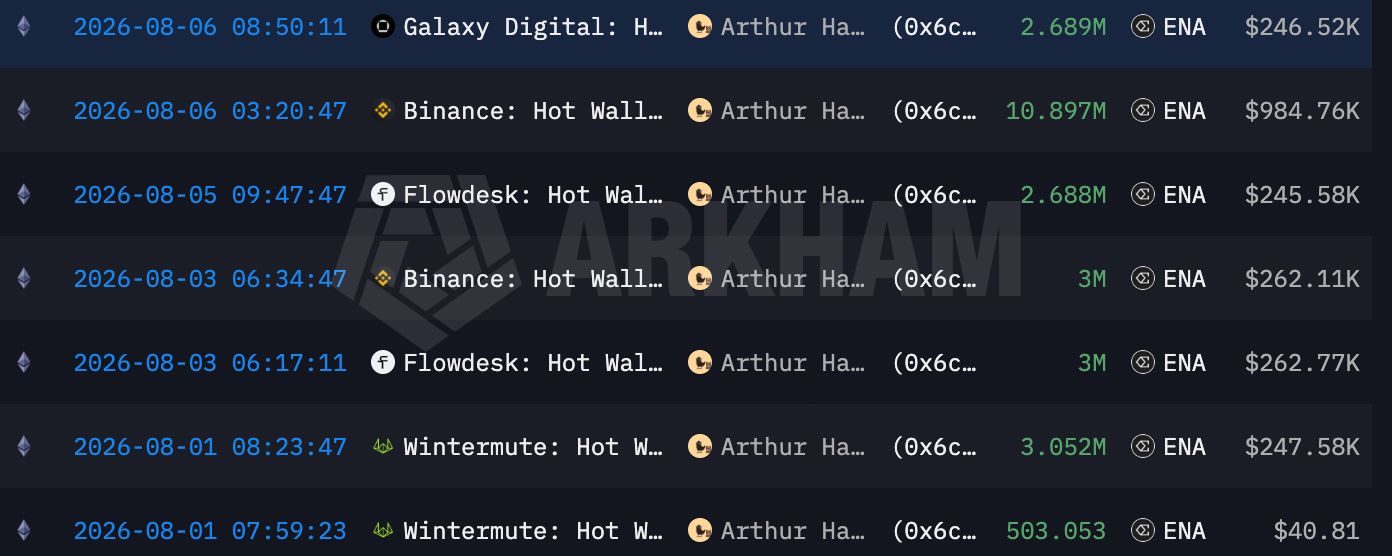 Arthur Hayes Purchases ENA. Source: Arkham
 A further 3.1 million ENA arrived on August 10 from an Ethena multisig, consistent with a vesting distribution, which we exclude from his buys. ENA trades at $0.082 as we publish, 94% below its 2024 peak, and the purchased tranche is already underwater.
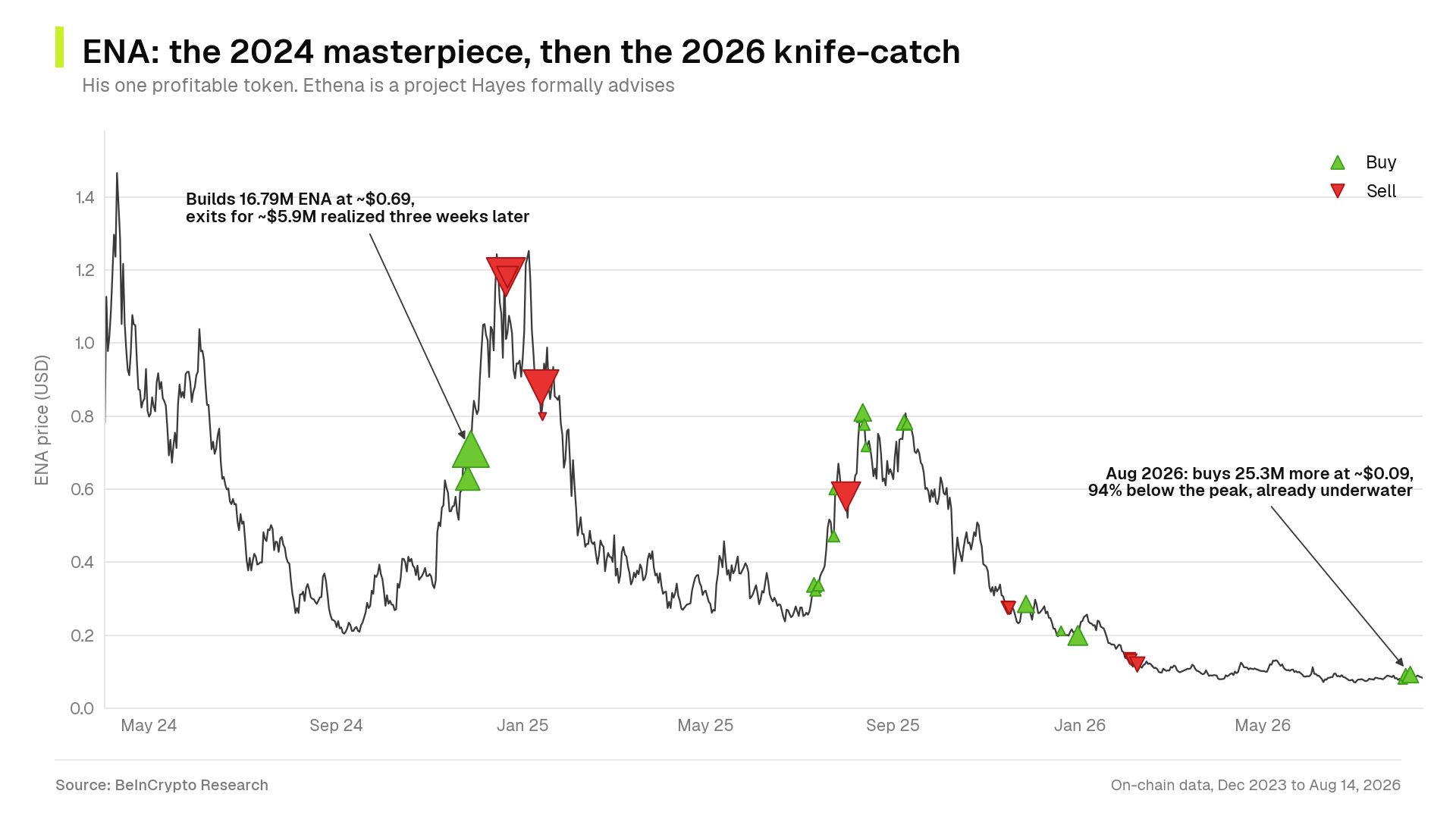 Arthur Hayes' ENA Trades. Source: BeInCrypto
 The Tuition Bills
The smaller trades show the same problem: Hayes-linked wallets repeatedly bought narratives too late or exited too early, turning strong convictions into heavy losses.
The worst single entry in the file is SYN. The wallets put $2 million into Synapse, watched it lose more than half its value against the market within a month, and finally flushed the position on August 1, 2026, selling 6.16 million SYN for $658,000. 33 cents back on every dollar in.
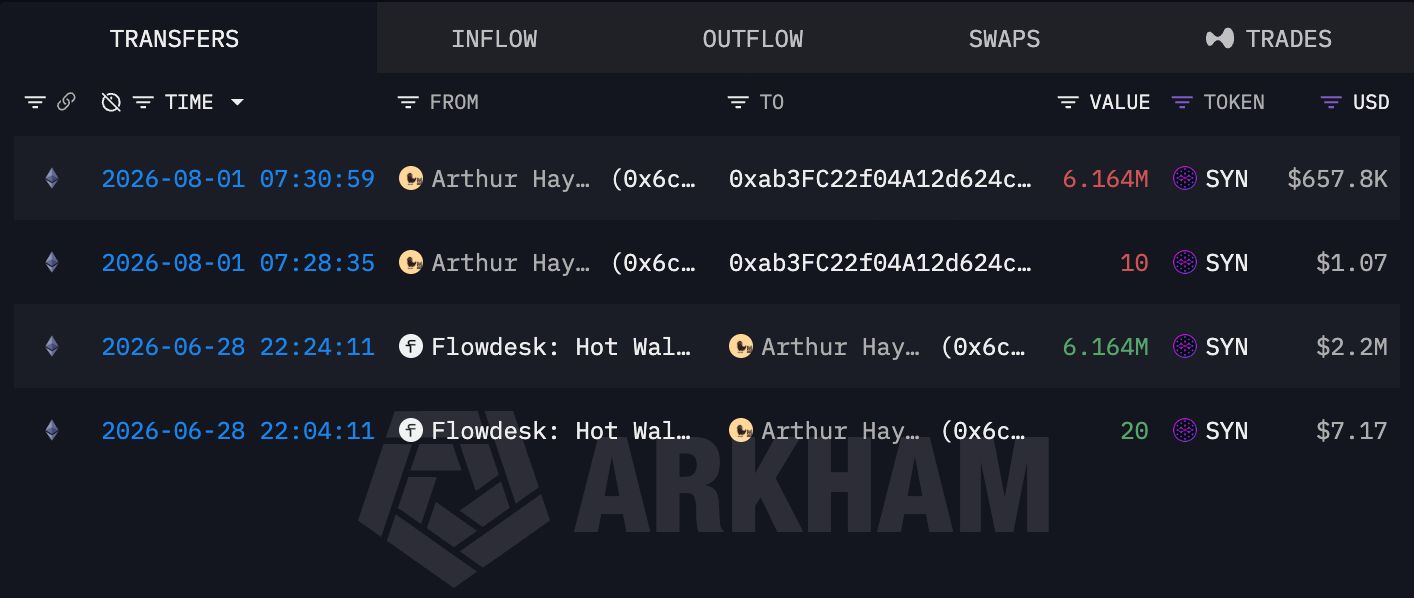 Arthur Hayes SYN Trades. Source: Arkham
 The most Cramer-shaped moment belongs to PENDLE. On September 12, 2024, Hayes tweeted that he was betting PENDLE would reach $10.
Nine days later, the wallets sold 1.2 million PENDLE, about 61% of the position, at around $3.52, including one tranche dumped at a 36% loss. After the sale, PENDLE rallied 24% almost immediately.
The Verdict: Not Cramer, Something More Specific
Here is a twist. Hayes appears to have a real edge when entering trades; his buys outperform over the next month, but poor exits and weak long-term holds repeatedly erase that advantage.
For every purchase in the dataset, we asked one question. What did that token do over the next 30 days, compared with what it usually does?
The comparison matters. Every token has a typical 30-day move across our period, its drift.
Against that bar, Hayes, the buyer, is genuinely good. The tokens he bought went on to beat their own drift by about 10% over the following month, weighted by how much money he put in.
His nose for what is about to run is real. It is also why blindly doing the opposite of Hayes, the strategy Crypto Twitter jokes about, would have worked worse than the joke assumes.
The catch is that the 10% is what his entries were worth if held for a month. He almost never held for a month. The Friday-night sale, the PENDLE dump nine days after his own price target, and the ETH buyback at $4,252. Each of those exits cashed in the edge early or converted it into a realized loss.
And when he did hold on, the market eventually came for him anyway. Stretch the same measurement to 90 days, and it inverts. His buys trailed their drift by 20.5% within a quarter. The strength he buys is real but old. It pays for about a month after he arrives, then dies.
Put those numbers side by side, and you have the whole trader. His instincts run on a 30-day clock. But his nerves run on a 3-day clock. His losses live in the gap between the two.
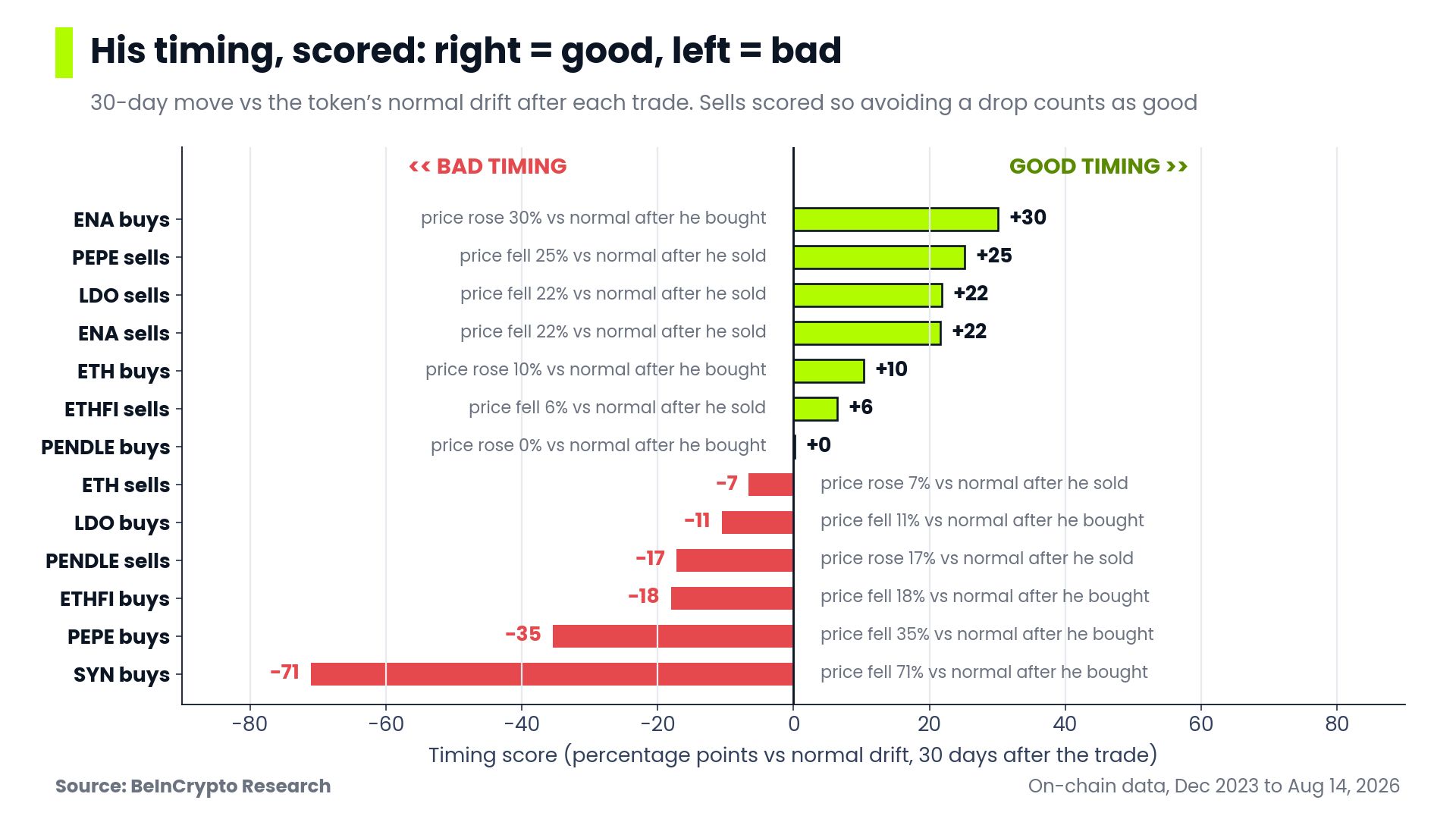 Timing Score of Arthur Hayes Trades. Source: BeInCrypto
 That gap is the scoreboard. The one-month edge makes every individual entry defensible, which is why no single Hayes trade ever looks stupid in isolation. The three-day nerves mean he keeps interrupting his own best ideas.
Is Arthur Hayes Crypto's Jim Cramer?
So is he a profitable trader? On the evidence of the visible wallets, no.
Is he crypto's Jim Cramer? Also, no, and the difference matters.
Cramer's joke is that he is simply wrong. Hayes is not wrong. He is early on a one-month clock and gone either too soon or too late.
One final point of fairness. Whatever his trading record says, Hayes remains structurally long Ethereum.
Beyond the ETH the wallets hold outright, Arkham shows roughly 3,176 eETH and 1,167 weETH in staked positions, taking his total exposure to about 15,200 ETH equivalent, worth around $28.5 million.
He trades around the position badly, but he has never abandoned it. And a $2.47 million trading loss is a rounding error against a net worth Arkham estimates at $200 million to $350 million, most of it built at BitMEX, the exchange he co-founded, which announced on July 23 that it will shut down permanently on September 23 after 11 years.
The wallets we examined hold $33 million as of writing. Hayes never bets enough to get hurt, and nothing here speaks to how Maelstrom's fund, which we cannot see, performs.
His trades are not uniquely bad. They are ordinarily bad, narrated in extraordinary essays, and permanently on display.
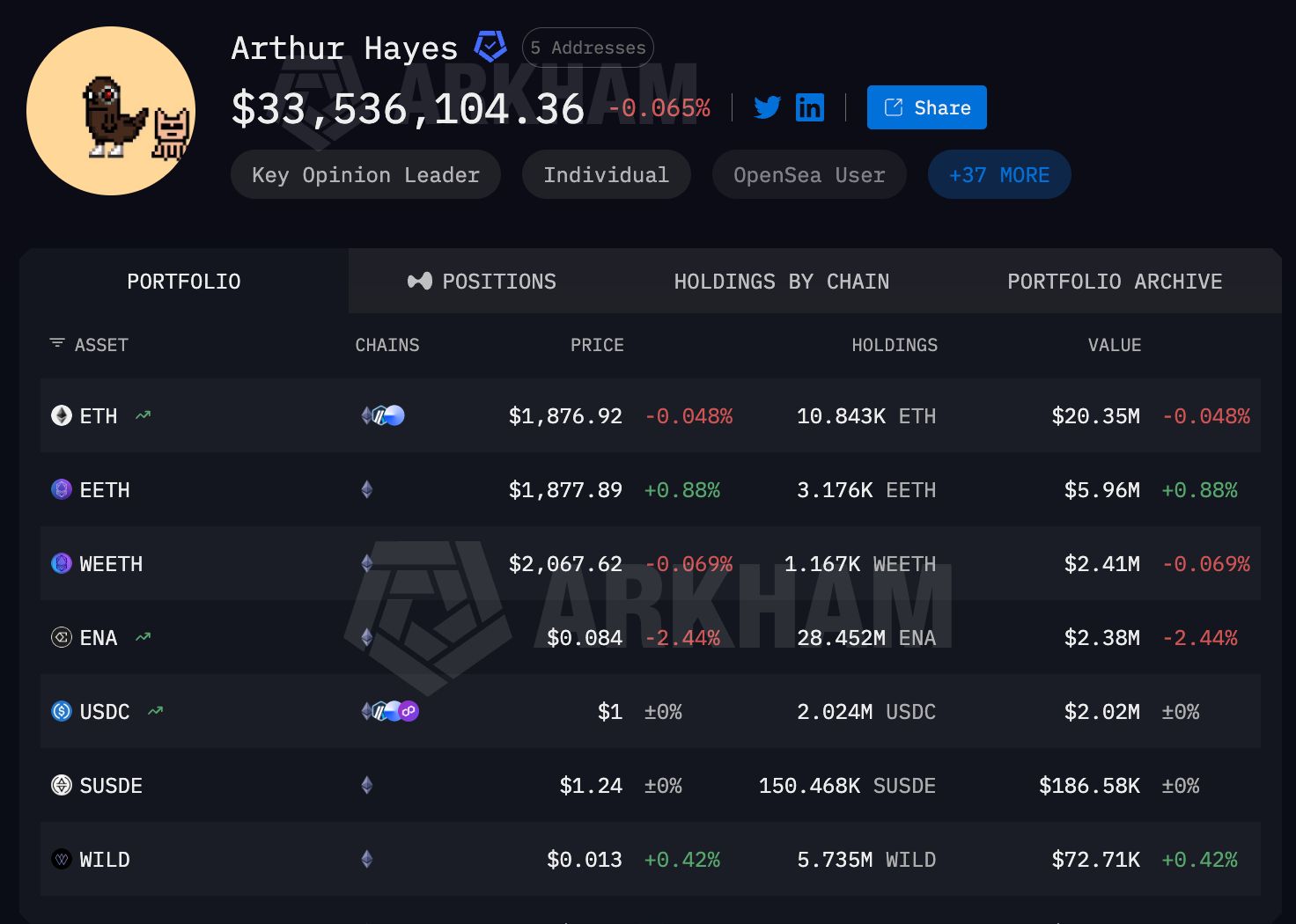 Arthur Hayes On-Chain Portfolio. Source: Arkham
 How we Read Arthur Hayes On-Chain Trades
Everything on a blockchain is public and permanent. We analyzed three Ethereum wallets tagged to Arthur Hayes by Arkham Intelligence, and trackers such as Lookonchain have reported on them as his for over two years:
1. 0x534a0076fb7c2b1f83fa21497429ad7ad3bd7587 2. 0xa86e3d1c80a750a310b484fb9bdc470753a7506f 3. 0x6cd66DbdFe289ab83d7311B668ADA83A12447e21Hayes has replied to posts about these wallets. He has never said they are not his. He has also never formally confirmed ownership, which is why the article describes the "wallets attributed to Hayes" rather than asserting ownership.
We downloaded the complete history of all three wallets, roughly 17,000 transfers, and then cleaned it. Out went thousands of scam deposits from address-poisoning attackers, including 624 fake versions of "USDC" built with lookalike characters.
Out went staking transactions, which move tokens without selling them. Also, out went roughly $35 million of tokens that arrived from vesting contracts, because Hayes advises projects including Ethena and Ether.fi through his fund Maelstrom, and receiving a token salary is not the same as buying with conviction.
What survived were 124 real trades between December 2023 and August 14, 2026. 82 buys worth $92 million. 42 sells worth $73 million, and seven tokens: ETH, ENA, PENDLE, ETHFI, SYN, LDO, and PEPE.
For every sell, we matched the coins against the earliest unsold purchases before it, the standard first-in-first-out method, and asked a simple question. Did this trade make money?
One honest note. We price trades at daily closing prices, and actual fills differ slightly.
Every figure here is a careful reconstruction, not an audit. The direction of the numbers is robust.
BeInCrypto has contacted Hayes and the Maelstrom fund for comment and will update this article with any response.
Disclaimer: This article is based on public blockchain data and third-party attribution. It is provided for informational purposes and is not investment advice.
Read the Original story Is Arthur Hayes Crypto’s Jim Cramer? 124 Trades Show a Clear Pattern by Harsh Notariya at beincrypto.com