


Bitcoin is the largest crypto asset by market value, yet almost all of it sits still. Spark's research counted 91,332 BTC across Bitcoin layer-2 networks in May 2026, or about 0.46% of the circulating supply. Adding every wrapped token and all Babylon staking lifts the share to only about 0.8%.
Most holders who do put BTC to work wrap it first. A custodian keeps the real coins, and a token such as WBTC stands in for them on Ethereum (ETH). Any loan taken against that token then depends on the custodian and its redemption system staying sound.
WBTC holders were reminded of that dependency in August 2024. BitGo said it would shift custody of WBTC to a joint venture with Justin Sun-linked BiT Global.
Aave's Ethereum market held about $2.2 billion in supplied WBTC at the time, according to risk manager Chaos Labs. Coinbase went further and delisted WBTC in December 2024. When BiT Global sued over the decision, Coinbase's court filing cited the risk that control would "fall into the hands of Justin Sun."
Zest Protocol, which runs a Bitcoin lending market on Stacks, is testing a route that leaves the coins on Bitcoin. On September 23, it launched a capped mainnet demo of its Bitcoin Collateral Vaults. It lets holders borrow against BTC on EVM chains without wrapping it.
Bitcoin is the strongest collateral asset ever created, and the least used.
— Zest Protocol (@ZestProtocol) September 11, 2026
Bitcoin Collateral Vaults keep BTC on Bitcoin Layer 1 while its value works elsewhere. Building the capital layer for Bitcoin.
How a Vault on Bitcoin Backs a Loan on EVM Chains
According to the firm, Bitcoin Collateral Vaults are self-custodial vaults on Bitcoin L1. Bitcoin's own rules govern how they can be spent, and the design is intended to support BitVM proof verification.
Each vault holds one user's BTC, and coins from different users are never pooled, according to the documentation. Each vault is a Taproot output with spending paths fixed at the deposit, which limits where the BTC can move.
The loan happens on an EVM chain, which is Ethereum in the demo. On that chain, the Bitcoin vault is represented by a collateral record tied only to it. The borrower uses that record to draw USDC from a connected lending market while the BTC stays in the vault.
Positions can change size after they open. Borrowers can add collateral or withdraw the excess if Bitcoin's price rises. Liquidations can also be partial, settling a pre-set amount and returning the rest to the vault in BTC. Zest says other vault designs can only release collateral in full.
The design also plans for the destination chain failing. If the chain went offline for good, the depositor could still reclaim eligible BTC after a Bitcoin timelock expires. That recovery needs only the user's own key and public vault data, with no signature from Zest.
"We've spent five years on programmable Bitcoin, first on Stacks and now on Bitcoin itself. Today you can put real BTC in a vault on Bitcoin and borrow against it on mainnet," said Tycho Onnasch, founder of Zest Protocol.
Each wallet is subject to a collateral cap until external audits are complete, after which Zest plans to launch to production.
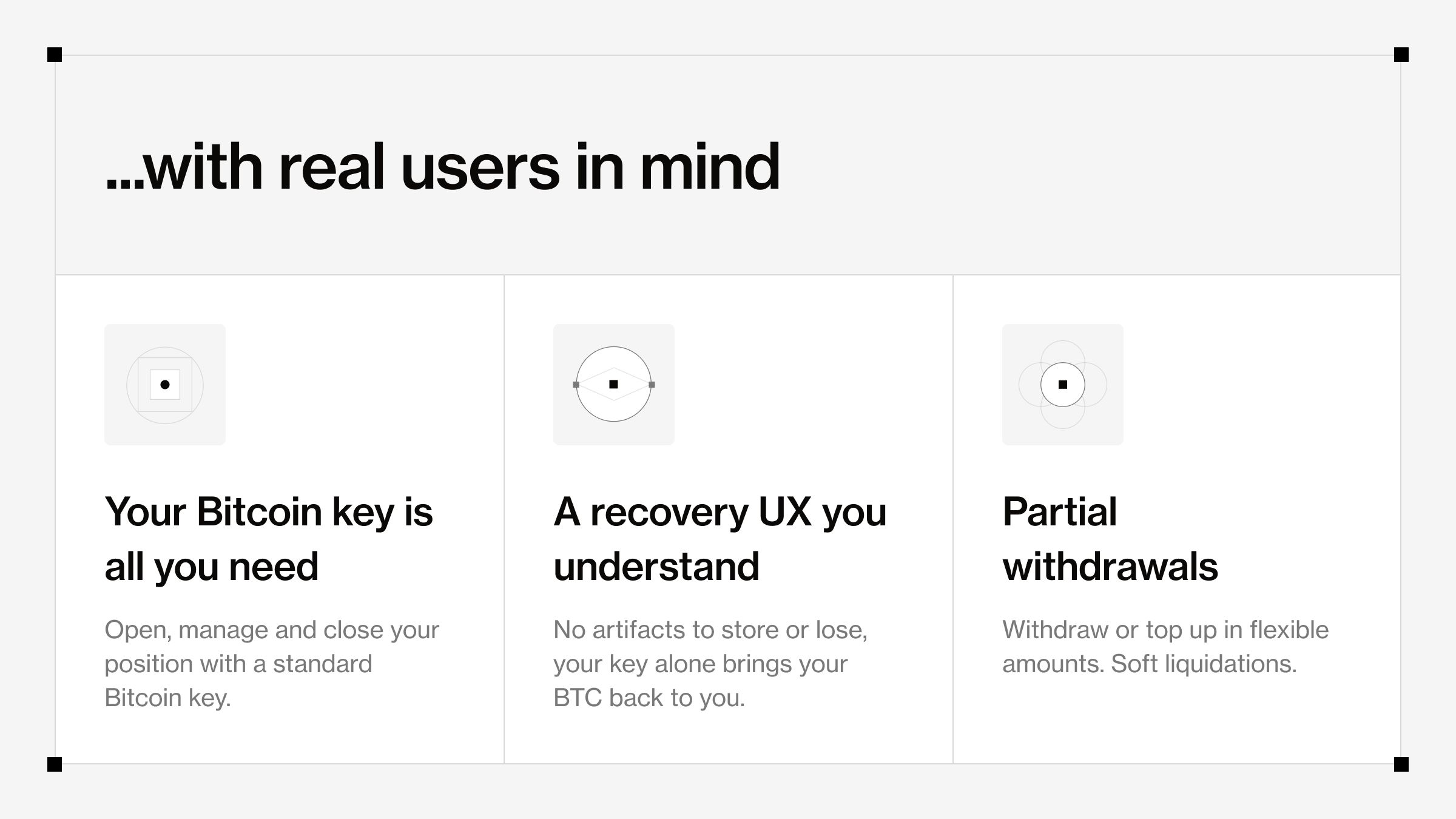 Zest's summary of vault features. Source: Zest Protocol
 Guardians Stand Watch Until BitVM Takes Over
Bitcoin enforces the vault's spending rules, but each settlement still needs a separate check. In the first production phase, independent guardians handle that check, according to Zest.
When an event such as a repayment or liquidation happens on the lending chain, an attestation triggers a settlement that the borrower authorized in advance. Guardians check that settlement, and a quorum of them can reverse an invalid payout during a contest window.
Reversed BTC returns to the vault set out in the rules. The document says no operator can add outcomes, change amounts, or redirect payouts once the vault is set.
Zest plans to shift that role to BitVM, a system for verifying computation on Bitcoin without changing its rules. Under Zest's planned design, a party claiming a repayment or liquidation posts that claim on Bitcoin.
Challengers then have a set window to dispute it, which forces the claimant to submit a zero-knowledge proof. An invalid proof lets the challenger block the withdrawal. The documentation notes that security depends on the construction Zest selects and an honest challenger acting in time.
Zest points to published BitVM3 benchmarks that put onchain costs under $100. Those figures rest on the benchmarks' own assumptions, and earlier designs cost thousands.
A Rival Design Puts Zest's Guardians Under the Spotlight
Zest is one of several teams trying to keep BTC collateral on Bitcoin. Babylon Labs proposed a similar vault system for Aave V4 in May, also built on Taproot outputs. Babylon's proposal says redemption relies on zero-knowledge proofs and challenges, with no custodian or signer group holding discretionary control over the BTC.
Zest's first production phase, by contrast, relies on guardians until its own BitVM verification goes live. The company has not disclosed who the guardians are or how many form a quorum. It also has not detailed how long liquidation timelocks or contest windows last.
Both designs face the same practical tests. One commenter on Babylon's Aave proposal asked how liquidations would hold up during market stress. The same post questioned challenger incentives and how long redemptions on Bitcoin would take. Zest's vaults will face those questions, too, once the caps lift.
Holders who never trusted a wrapper may want the guardians named before locking up more than a test amount.
Read the Original story Zest Bets Bitcoin Can Back Loans Without Ever Leaving Its Own Chain by Kamina Bashir at beincrypto.com