


Binance co-founder Changpeng Zhao, known as CZ, has outlined several possible explanations for the decline, including capital shifting toward Anthropic's upcoming IPO, institutional withdrawals, and growing security concerns. However, he cautioned that no single factor has been established as the cause of the downturn.
Bitcoin Price Today Remains Under Pressure Below $65K
Bitcoin's latest decline extended a difficult period for the cryptocurrency market. BTC dropped to approximately $62,006 on November 15, marking its lowest level in several months before recovering toward $64,500. The asset was trading around $64,581 in the latest TradingView snapshot, keeping it below the psychologically important $65,000 threshold.
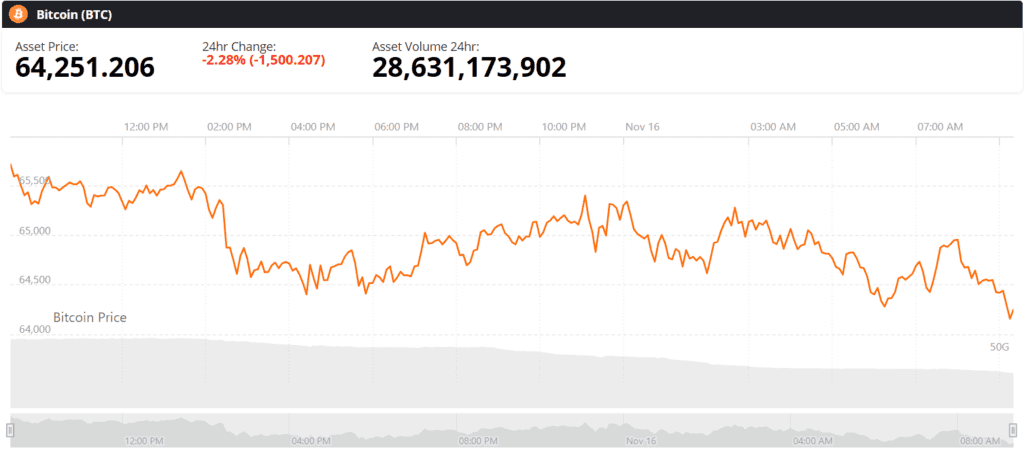
Bitcoin (BTC) price chart. Source: Brave New Coin
The broader correction has also involved heavy selling across other digital assets. Bitcoin's weekly losses approached 15% as selling pressure intensified. Meanwhile, approximately $750 million in Bitcoin positions were liquidated over a 24-hour period, with long positions accounting for nearly 80% of the total. These forced closures added to downward pressure as leveraged traders struggled to maintain their positions.
The latest price movement also reflects deteriorating market conditions beyond the cryptocurrency sector. Weak technology stocks, uncertainty surrounding interest rates, and reduced institutional demand have contributed to a broader shift away from risk-sensitive investments.
CZ Identifies Potential Reasons Behind the Crypto Selloff
CZ addressed the market downturn in a post on X, listing several developments that could be contributing to the decline. He began by highlighting the possibility that investors are moving capital toward Anthropic's planned initial public offering (IPO).

CZ suggests Bitcoin’s decline to $62,006 may be partly driven by capital shifting toward Anthropic’s anticipated multibillion-dollar IPO. Source: @cz_binance via X
The artificial intelligence company is preparing an IPO that could raise up to $64.4 billion, with an estimated fully diluted valuation of approximately $1.4 trillion. Its shares are expected to begin trading on the Nasdaq on November 19 under the ticker ANT. The scale of the offering has attracted considerable investor attention, creating speculation that some capital could be shifting away from other assets ahead of the listing.
However, CZ avoided presenting the IPO as a confirmed explanation for Bitcoin's weakness. He emphasized the uncertainty surrounding the market's movements, stating, "No one knows for sure. Correlation does not prove causation."
He also rejected speculation that Binance had been selling its cryptocurrency holdings. "No, Binance did not sell crypto," CZ wrote, adding that he had personally purchased crypto over the previous few days after receiving stablecoins. He jokingly suggested that his own purchases might have contributed to the decline.
Despite the recent weakness, CZ maintained a positive long-term outlook, stating that crypto would continue to grow over the medium and long term.
Bitcoin ETF Outflows Add to Selling Pressure
Institutional demand has weakened alongside Bitcoin's price decline. U.S. spot Bitcoin ETFs recorded approximately $1.91 billion in net outflows across seven consecutive trading sessions between November 5 and November 13, according to figures reported by crypto.news and The Block.
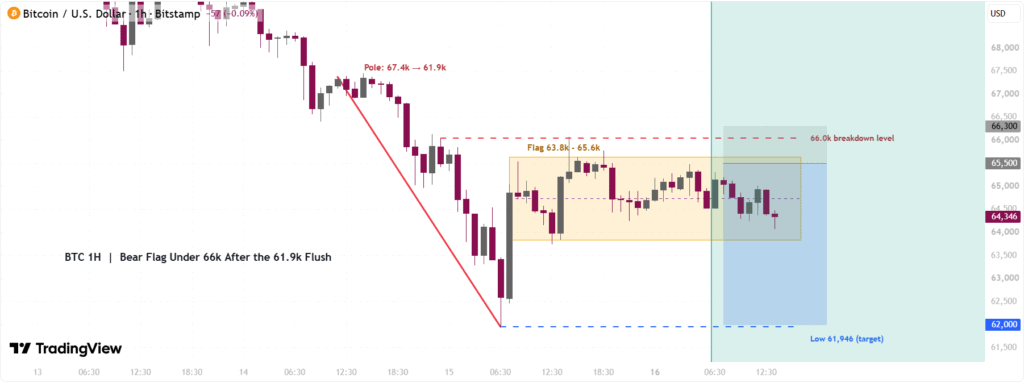
Bitcoin extended its weekend decline from $67,400 to a Sunday low of $61,946 before consolidating sideways in a potential bearish flag pattern on the 1-hour chart. Source: BASE78945 on TradingView
The withdrawals continued throughout the week. On November 13, the funds recorded another $185.4 million in net outflows. BlackRock's iShares Bitcoin Trust (IBIT) accounted for approximately $143.5 million, while Fidelity's Wise Origin Bitcoin Fund (FBTC) recorded withdrawals of $41.9 million.
Ether investment products also experienced persistent withdrawals. U.S. spot Ether ETFs lost approximately $398.9 million during the week, extending their negative flow streak to seven consecutive weeks. The figures suggest that investors have reduced exposure to several cryptocurrency investment products rather than Bitcoin alone.
Leveraged trading activity has added another layer of pressure. According to CoinGlass, total cryptocurrency liquidations approached $1.96 billion over a rolling 24-hour period. Bitcoin accounted for roughly $750 million, with long positions representing approximately 80% of those liquidations.
These figures highlight how declining prices can trigger additional selling through forced position closures. However, ETF withdrawals and liquidations do not independently establish what initially prompted the broader market decline.
Anthropic IPO Revives Comparison With Bitcoin's SpaceX Rally
The potential movement of investment capital toward Anthropic has also drawn attention to a historical comparison involving SpaceX's public listing. Market commentator Matt Cole highlighted similarities between Bitcoin's performance ahead of the two high-profile offerings.
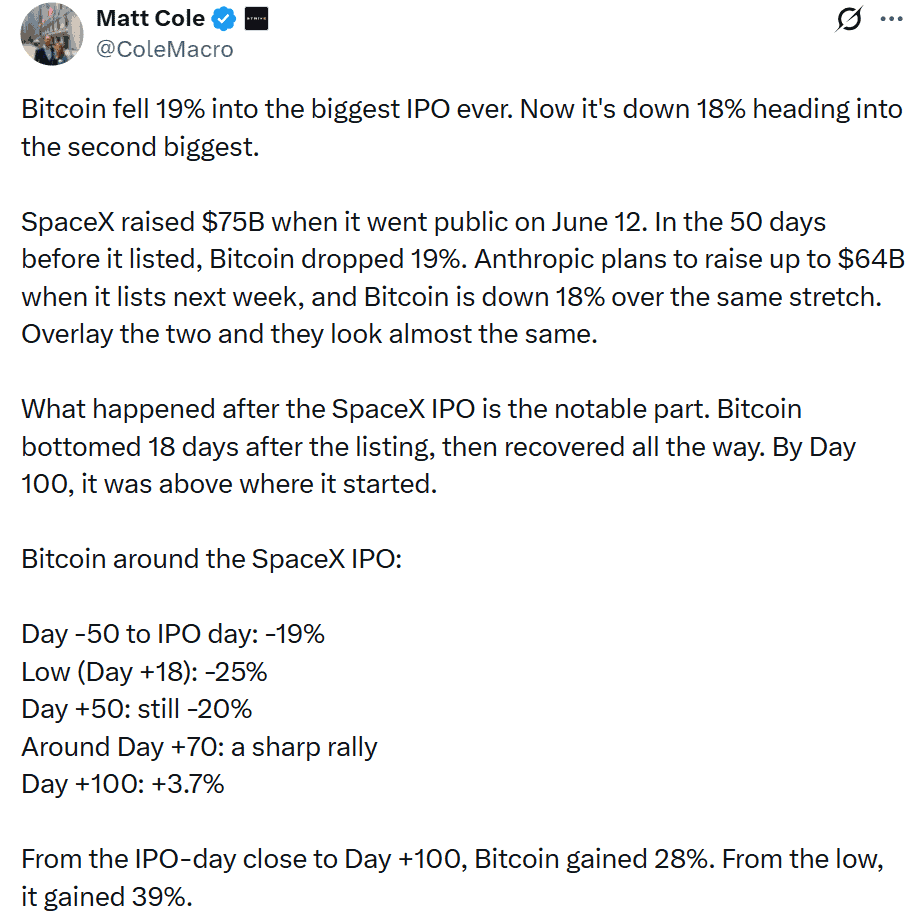
Matt Cole highlights a similar pattern, noting Bitcoin’s 18% decline ahead of Anthropic’s planned $64 billion IPO mirrors its 19% drop before SpaceX’s June 2026 IPO. Source: @ColeMacro/X
Cole noted that Bitcoin declined approximately 19% during the 50 days preceding SpaceX's June 2026 IPO, which raised $75 billion. The cryptocurrency has reportedly fallen around 18% over a similar period ahead of Anthropic's planned listing.
The comparison attracted attention because Bitcoin's performance changed considerably after the SpaceX offering. According to Cole's analysis, BTC reached its lowest point 18 days after the listing, eventually recovering sharply. By the 100th day, Bitcoin had moved approximately 3.7% above its initial starting level.
From the SpaceX IPO closing price, Bitcoin gained roughly 28% over the following 100 days. Its recovery from the post-listing low reached approximately 39%.
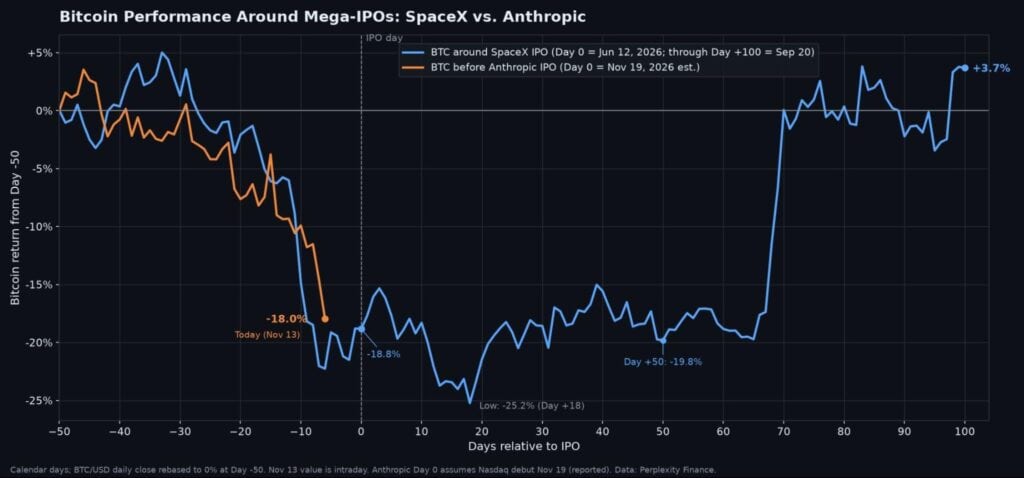
Following the SpaceX IPO, Bitcoin bottomed 18 days after the listing before recovering, eventually trading above its pre-IPO level by Day 100. Source: Matt Cole via X
Cole suggested that a similar pattern could emerge following Anthropic's listing , potentially indicating that much of the recent selling has already occurred. His analysis also places Bitcoin near its 200-week moving average, a technical reference that he considers relevant to the current market structure.
Nevertheless, the comparison remains a historical observation rather than evidence of an established market pattern. The SpaceX and Anthropic offerings involve different companies, market conditions, and investor expectations. Bitcoin's previous recovery also does not guarantee a similar outcome in the coming months.
Security Concerns and U.S. Economic Uncertainty Weigh on Sentiment
CZ also pointed to several security incidents that could influence investors' willingness to hold cryptocurrency. These included the October Binance attack, reports of iPhone-linked crypto wallets being drained, and a Chrome browser exploit.
The Binance incident was particularly significant. On October 31, the FBI attributed the theft of more than $6 billion in virtual assets from Binance on or around October 29 to North Korean actors associated with the TraderTraitor group. The agency reported that the attackers had primarily converted the stolen assets into Ether as part of their laundering activities.
Although the incident does not establish a direct link to Bitcoin's latest decline, high-profile security breaches can raise concerns about the safety of digital assets and cryptocurrency infrastructure. Such developments may influence investor confidence, particularly during periods of broader market uncertainty.
Macroeconomic conditions have provided another potential source of pressure. October's U.S. Consumer Price Index increased 0.4% after rising 0.6% in September, while core inflation advanced 0.3% during the month. The figures have kept attention on the Federal Reserve's monetary policy outlook.
Expectations of another interest rate increase have also weighed on market sentiment. Higher borrowing costs and rising bond yields can reduce the appeal of speculative investments, while a stronger U.S. dollar may create additional headwinds for Bitcoin and other cryptocurrencies.
Political uncertainty following the U.S. midterm elections has added to the concerns. CZ noted that investors may be assessing the possibility of stricter cryptocurrency policies in the country. Changes in the regulatory environment could influence institutional participation and broader market activity.
BTC Technical Outlook Remains Bearish Despite Oversold Signals
TradingView's technical summar y continues to indicate a sell bias for Bitcoin, reflecting the distance between its current price and the broader moving average structure.
At approximately $64,281, BTC remains below nearly all the moving averages in the provided technical snapshot. The 10-day exponential moving average stands near $70,716, while the 20-day EMA is around $73,890. Longer-term indicators also remain above the current price, with the 200-day EMA near $76,032 and the 200-day simple moving average at approximately $72,921.
The moving average summary records 13 sell signals, one neutral reading, and one buy signal. This indicates that the broader trend remains under pressure despite attempts to stabilize after the recent decline.
However, several momentum indicators are beginning to reflect oversold conditions. The Relative Strength Index (RSI) stands at 24, while the Stochastic %K is around 9 and the Williams Percent Range is approximately -84. These readings suggest that Bitcoin has experienced substantial selling over the measured periods and could attract short-term buying interest.
The oscillator summary is comparatively constructive, with six buy signals, four neutral readings, and one sell signal. Nevertheless, the MACD remains negative, indicating that underlying downside momentum has not yet reversed.
Bitcoin's next price movements will likely depend on whether buyers can establish a sustained recovery above the $65,000 threshold and eventually reclaim nearby moving average resistance. Continued weakness could expose the market to another test of the recent $62,006 low.
For now, CZ's comments highlight the difficulty of attributing Bitcoin's decline to a single development. ETF withdrawals, macroeconomic uncertainty, security concerns, and changing investment preferences have all emerged as possible contributors. Whether the upcoming Anthropic IPO marks a turning point for market sentiment remains uncertain, while Bitcoin's technical indicators continue to reflect a cautious near-term outlook .