


The Bitcoin price fell back below $60,000 on Tuesday, cutting short a recovery that had taken the cryptocurrency above $64,000 a day earlier. But perhaps the more troubling development for investors is happening outside the crypto market.
Gold is going through a severe correction of its own, leaving investors in two assets often associated with wealth preservation facing substantial losses.
This is not the first time Bitcoin and gold have struggled simultaneously . What makes the current environment particularly difficult is that neither asset generates income at a time when interest-bearing investments offer an increasingly attractive alternative.
The question is no longer simply whether Bitcoin is digital gold. It is whether investors have enough reason to own either asset under current monetary conditions.
Gold’s Selloff Exposes A Bigger Problem For Bitcoin
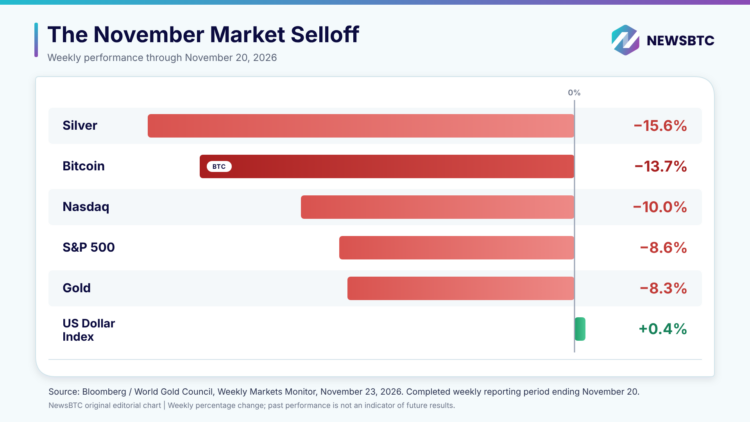
The selling extended well beyond Bitcoin. Figures from the World Gold Council show that Bitcoin lost 13.7%, gold fell 8.3% and the Nasdaq dropped 10%, while the US Dollar Index gained 0.4%. The numbers point to a broader reduction in risk exposure rather than a selloff specific to crypto.
Gold declined 24.6% over the 60 days ending November 23, its steepest loss over such a period since 1982.
The World Gold Council’s latest market assessment , published on Monday, identified several risks facing the precious metal, including pressure on leveraged equity and credit positions, restrictive monetary policy and the possibility of another disappointing US inflation report.
The organization also identified the lack of a clear reduction in speculative positioning as a concern.
This matters for Bitcoin because the argument for buying BTC during a gold correction often assumes that capital leaving one scarce asset will eventually find its way into the other.
There is little reason to assume that happens automatically.
An investor selling gold to reduce leverage or meet a margin requirement is unlikely to replace that exposure immediately with Bitcoin. The priority is raising cash, not finding another store of value.
There is also a difference between selling an asset because its investment thesis has deteriorated and selling because the cost of maintaining a position has become too expensive. The latter can create opportunities for patient buyers, but it rarely provides a reliable indication of when a market will bottom.
Bitcoin’s Recovery Is Still Missing Conviction
Monday’s trading session offered Bitcoin investors some encouragement. The cryptocurrency recovered above $64,000 following the previous week’s decline to its lowest levels in roughly two years.
The move did not hold.
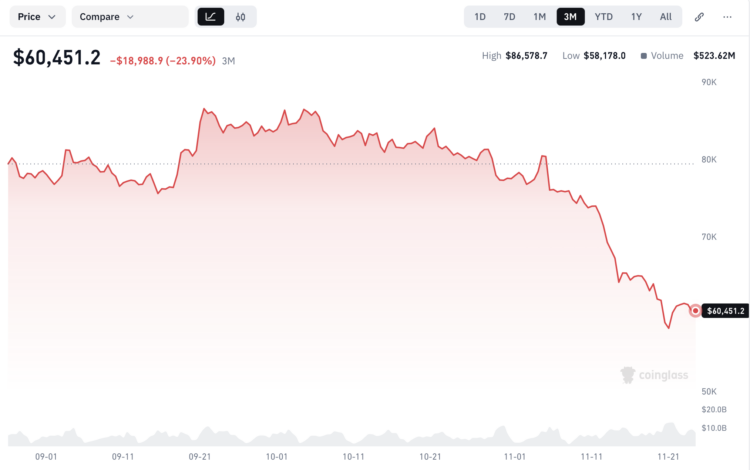
The broader picture is hardly encouraging. Bitcoin has lost nearly 24% over the past three months, falling from a period high of $86,578 to a low of $58,178. Although BTC has since recovered above $60,000, the bounce has done little to change the broader downward trend.
Tuesday’s return below $60,000 raises questions about the strength of the recovery, particularly given the improvement in technology stocks during Monday’s session.
If Bitcoin struggles to sustain gains when conditions improve elsewhere, investors should be careful about assuming that another equity market rally will necessarily pull BTC higher.
There is also an important distinction between a recovery driven by fresh buyers and one driven by traders closing profitable short positions. Both can produce impressive green candles. Only the former demonstrates that investors are willing to commit new capital at higher prices.
Spot trading activity, ETF subscriptions and derivatives positioning will offer a better indication of which type of recovery the market is experiencing.
For now, the failure to retain Monday’s gains makes the rebound less convincing than its initial size suggested.
Does This Undermine Bitcoin’s Digital Gold Thesis?
Bitcoin’s recent performance will inevitably revive criticism of its role as a store of value. However, gold’s own losses make that argument considerably less straightforward.
The metal has been used to preserve wealth for centuries, yet it remains vulnerable to changes in interest rates, investor positioning and the strength of the US dollar.
Bitcoin shares some of those vulnerabilities while carrying considerably different market risks, including its dependence on speculative demand and the availability of leverage across cryptocurrency exchanges.
That does not invalidate Bitcoin’s scarcity argument. Its supply characteristics have not changed because its market price has fallen.
What the current correction does challenge is the assumption that scarcity alone guarantees protection during financial stress.
An asset can have a credible long-term investment case and still be a poor short-term hedge. Bitcoin investors would benefit from separating those two propositions rather than defending both every time the market declines.
The Next Test Comes From The Federal Reserve’s Preferred Inflation Measure
The immediate focus now turns to Wednesday’s US inflation release.
The Bureau of Economic Analysis is scheduled to publish its October personal consumption expenditures (PCE) report on November 25. The previous release showed annual headline PCE inflation of 3.6%, with core inflation at 3.1%.
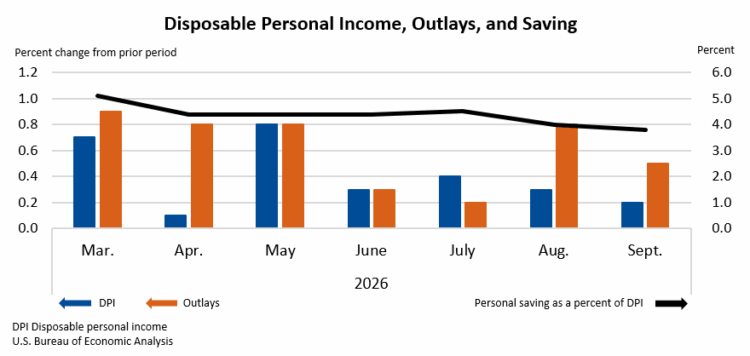
Another stronger-than-expected reading could reinforce expectations of restrictive monetary policy, making conditions more difficult for assets that rely heavily on capital appreciation.
A softer reading, particularly if accompanied by falling Treasury yields, could offer some relief to both Bitcoin and gold.
For Bitcoin, however, recovering $60,000 should be treated as a starting point rather than confirmation of a broader reversal. Monday’s trading high above $64,000 represents a more demanding test of whether buyers are prepared to return.
Until that happens, the market has demonstrated that it can bounce. It has yet to demonstrate that it can sustain a recovery.