
 Русский
 中文
中文 Español
 Português
 日本語
日本語 Deutsch
 한국어
한국어 Français
 Italiano
 Türkçe
Is Portfolio Rationalization the Key to Procter & Gamble's Agility?

The Procter & Gamble Company PG uses portfolio rationalization as a key lever to enhance agility and drive growth, enabling greater strategic focus, improved operational efficiency and constant innovations. The company has streamlined its portfolio by divesting underperforming and non-core brands, reducing organizational complexity and enabling management to focus more effectively on high-growth segments and market-leading categories.
This focused approach enables PG to improve supply-chain efficiency and accelerate decision-making, enabling a more agile response to evolving market conditions and consumer preferences. By reallocating capital and research investments toward core categories, the company strengthens its innovation capabilities, accelerates product development and enhances its competitive positioning.
Procter & Gamble is focused on strengthening its presence in winning areas, prioritizing high-growth markets and improving organizational focus. The company’s recent portfolio choices have been made to position it in categories and regions with robust long-term growth potential. The strategy also reflects efforts to allocate resources toward growth drivers, including expanding its e-commerce capabilities in high-potential markets and capturing long-term opportunities.
However, portfolio rationalization does not solely guarantee sustained agility. The company must continue investing in innovation, productivity, digital transformation, consumer engagement and pricing strategies to stay competitive in a dynamic market landscape. While streamlining brands enhances efficiency and responsiveness, the company remains influenced by external factors such as intense competition, evolving consumer preferences and broader economic pressures that can impact its overall performance.
Overall, portfolio rationalization is not only about divesting weaker brands but also about optimizing geographic exposure, strengthening category positioning and aligning organizational structure with growth priorities. At the core, portfolio rationalization serves as a critical agility lever, but it is more effective with broader strategic initiatives to aid long-term growth and organizational flexibility.
PG’s Competition
Colgate-Palmolive Company CL is focused on streamlining its product offerings to sharpen growth, optimize margins and improve operational efficiency. CL concentrates resources on high-performing, globally recognized brands like Colgate toothpaste, Palmolive and Hill’s Pet Nutrition, while divesting or scaling back underperforming or niche products. Colgate has built flexibility into its business model and sourcing strategies, leveraging productivity initiatives to optimize supply chains, enhance digital capabilities and support growth investments.
The Clorox Company CLX is going through a transformation and maneuvering a dynamic landscape. The strategy has bolstered its digital backbone and opened new value streams. CLX is focused on resilience and adaptability, navigating effectively with the benefits of ramping up the operations. Hence, flexibility in sourcing and business models helps navigate cost inflation, supporting Clorox’s long-term strategic priorities.
PG’s Price Performance, Valuation and Estimates
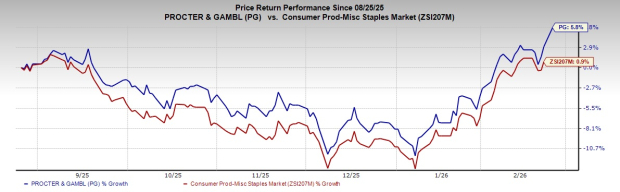
Procter & Gamble’s shares have risen 5.8% in the past six months compared with the industry’s 0.9% growth.
Image Source: Zacks Investment Research
From a valuation standpoint, PG trades at a forward price-to-earnings ratio of 22.97X compared with the industry’s average of 19.86X.
Image Source: Zacks Investment Research

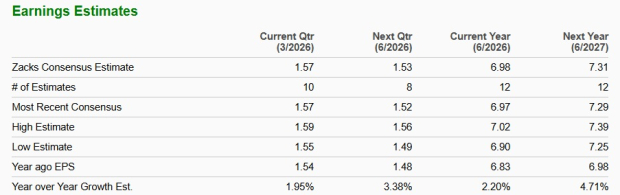
The Zacks Consensus Estimate for PG’s fiscal 2026 and fiscal 2027 EPS reflects year-over-year growth of 2.2% and 4.7%, respectively. The company’s EPS estimate for fiscal 2026 has been stable while that of fiscal 2027 has moved north in the past seven days.
Image Source: Zacks Investment Research
Procter & Gamble carries a Zacks Rank #3 (Hold).
You can see the complete list of today’s Zacks #1 Rank (Strong Buy) stocks here.
Radical New Technology Could Hand Investors Huge Gains
Quantum Computing is the next technological revolution, and it could be even more advanced than AI.
While some believed the technology was years away, it is already present and moving fast. Large hyperscalers, such as Microsoft, Google, Amazon, Oracle, and even Meta and Tesla, are scrambling to integrate quantum computing into their infrastructure.
Senior Stock Strategist Kevin Cook reveals 7 carefully selected stocks poised to dominate the quantum computing landscape in his report, Beyond AI: The Quantum Leap in Computing Power .
Kevin was among the early experts who recognized NVIDIA's enormous potential back in 2016. Now, he has keyed in on what could be "the next big thing" in quantum computing supremacy. Today, you have a rare chance to position your portfolio at the forefront of this opportunity.
See Top Quantum Stocks Now >>Want the latest recommendations from Zacks Investment Research? Today, you can download 7 Best Stocks for the Next 30 Days. Click to get this free report
Procter & Gamble Company (The) (PG): Free Stock Analysis Report
Colgate-Palmolive Company (CL): Free Stock Analysis Report
The Clorox Company (CLX): Free Stock Analysis Report
This article originally published on Zacks Investment Research (zacks.com).