


In this environment, operators with scale, strong digital infrastructure and diversified revenue streams are better positioned to manage rising costs and pricing pressure. Walmart Inc. WMT and The Kroger Co. KR remain well-placed to benefit from these evolving industry dynamics.
About the Industry
The Zacks Retail – Supermarkets industry includes supermarket retailers that offer grocery, health and beauty aids, household chemicals, electronics, stationery, automotive accessories, hardware and paint, sporting goods, fabrics and crafts, entertainment products, home furnishings and more. Players in this industry operate through various formats such as supermarkets, multi-department stores, retail stores, discount stores, supercenters, hypermarkets and warehouse clubs. Food retail accounts for a chunk of their business. The industry has undergone a significant transformation over the years, with e-commerce playing a strong role. Given consumers’ rising preference for online shopping, industry participants have enhanced pickup and delivery services and are offering easy payment options.
Major Trends Shaping the Future of the Supermarket Industry
Rapid Digital and Operational Transformation: Supermarket players are accelerating investments in technology to modernize operations and improve customer engagement. The integration of advanced analytics, automation and AI is helping retailers refine inventory management, reduce waste and improve supply-chain efficiency. At the same time, omnichannel capabilities such as online ordering, curbside pickup and home delivery are becoming essential components of the shopping experience. These capabilities are enabling supermarket companies to meet evolving consumer expectations around convenience and speed. The growing use of customer data is supporting personalized promotions and targeted marketing initiatives. Collectively, these efforts are not only driving operational efficiencies but also opening up new revenue opportunities, strengthening long-term competitiveness for well-positioned players.
Diversified Growth Platforms & Food Innovation: A favorable trend in the supermarket space is the industry’s push to build growth beyond traditional grocery aisles. Leading players are expanding into higher-value businesses such as retail media, data-driven advertising, private brands and loyalty-led personalization, creating revenue streams that are more stable and less related to routine pricing pressure in core food categories. At the same time, supermarket companies are strengthening differentiation through fresh, prepared and health-focused offerings that align with consumer demand for convenience, quality and wellness. This combination is helping retailers deepen customer engagement, encourage repeat visits and improve basket quality. Over time, a broader business mix and stronger food innovation should support earnings stability, reinforce brand relevance and sharpen competitive positioning.
Value-Seeking Behavior and Elevated Cost Pressures Hurt Margins: The increasing consumer inclination toward value-focused shopping, while supportive of traffic, is creating sustained pressure on supermarket companies’ margins. Retailers are compelled to maintain sharp pricing, frequent promotions and competitive private-label offerings to retain customers in an environment where affordability remains a top priority. This limits their ability to pass on costs and constrains pricing power. At the same time, supermarkets continue to face elevated expenses related to labor, supply-chain operations and ongoing investments in digital and omnichannel capabilities. The combination of price sensitivity and rising operational costs is compressing profitability across the sector. As a result, maintaining margin stability is becoming more challenging, particularly for players that lack scale or strong cost management efficiencies.
Zacks Industry Rank Indicates Strong Prospects
The Zacks Retail – Supermarkets industry is housed within the broader Zacks Retail – Wholesale sector. The industry currently carries a Zacks Industry Rank #81, which places it in the top 33% of more than 250 Zacks industries.
The group’s Zacks Industry Rank, which is basically the average of the Zacks Rank of all the member stocks, indicates bright near-term prospects. Our research shows that the top 50% of the Zacks-ranked industries outperform the bottom 50% by a factor of more than 2 to 1.
Let’s look at the industry’s performance and current valuation.
Industry Versus Broader Market
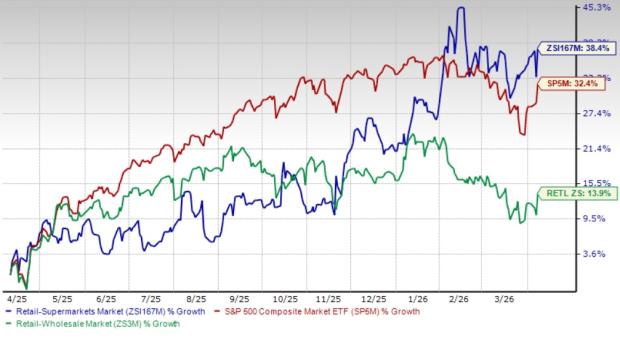
The Zacks Retail – Supermarkets industry has outperformed the S&P 500 and the broader Zacks Retail – Wholesale sector in the past year.
The industry has rallied 38.4% over this period compared with the S&P 500’s growth of 32.4%. Meanwhile, the broader sector has advanced 13.9% in the said time frame.
One-Year Price Performance
Industry's Current Valuation
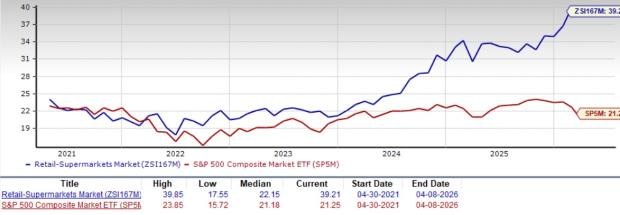
On the basis of forward 12-month price-to-earnings (P/E), which is commonly used for valuing retail stocks, the industry is currently trading at 39.21X compared with the S&P 500’s 21.25X and the sector’s 24.54X.
Over the last five years, the industry has traded as high as 39.85X and as low as 17.55X, with the median being at 22.15X, as the chart below shows.
Price-to-Earnings Ratio (Past 5 Years)
2 Supermarket Stocks to Keep a Close Eye On
Walmart: The company’s performance continues to be driven by its well-integrated omnichannel strategy, which effectively combines its expansive store network with growing digital capabilities. By leveraging stores as fulfillment hubs, the Zacks Rank #3 (Hold) company is enhancing delivery speed and convenience, supporting strong e-commerce momentum and broader customer reach. Walmart is also gaining traction across income groups, including higher-income consumers, reflecting the strength and scalability of its value proposition. You can see the complete list of today’s Zacks #1 Rank (Strong Buy) stocks here.
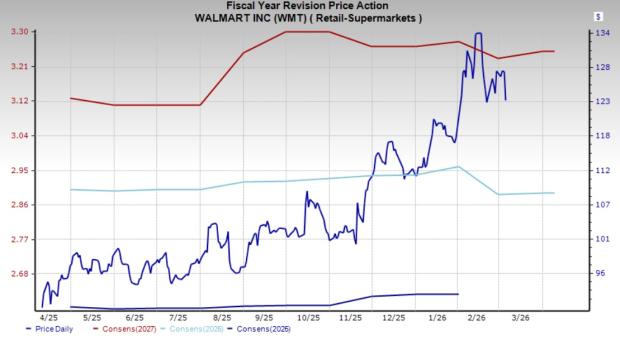
The company is steadily building higher-margin revenue streams through its advertising and membership platforms. Operationally, investments in automation, AI and supply-chain efficiencies are improving productivity, optimizing inventory and supporting margin stability, reinforcing Walmart’s competitive strength. The Zacks Consensus Estimate for WMT’s current fiscal year earnings per share (EPS) has remained unchanged at $2.89 in the past 30 days, with the consensus mark indicating growth of 9.5% from the prior-year period. Shares of Walmart have rallied almost 33% in the past year.
Price and Consensus: WMT
The Kroger Co.: Kroger’s strength lies in its disciplined customer-centric strategy, strong execution and expanding omnichannel capabilities. The company continues to deepen shopper loyalty through personalized engagement, a well-established private-label portfolio and a focus on value, quality and convenience. Its “Our Brands” offering remains a key differentiator, strengthening customer retention and enhancing merchandise mix. At the same time, the Zacks Rank #3 company’s growing digital ecosystem, including faster delivery options and membership-based offerings, is supporting e-commerce momentum and improving long-term profitability.
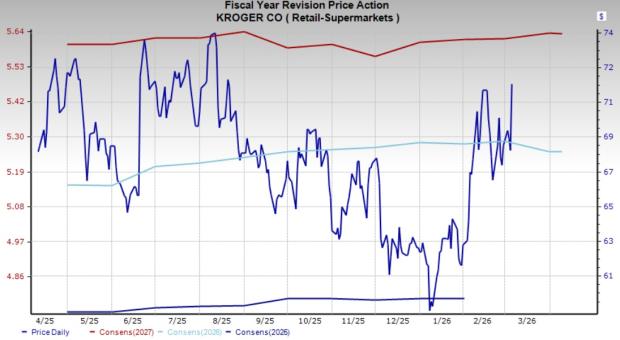
Additional strength comes from its pharmacy and health-related businesses, which broaden revenue streams. Improved operational discipline, supply-chain efficiencies and more targeted capital allocation are further enhancing overall performance and competitive positioning. The Zacks Consensus Estimate for KR’s current fiscal-year EPS has declined, though just by a penny to $5.25 in the past 30 days, and the consensus mark suggests 8.3% growth from the year-ago period reported figure. Kroger shares have jumped 4.9% in the past year.
Price and Consensus: KR
Zacks Names #1 Semiconductor Stock
This under-the-radar company specializes in semiconductor products that titans like NVIDIA don't build. It's uniquely positioned to take advantage of the next growth stage of this market. And it's just beginning to enter the spotlight, which is exactly where you want to be.
With strong earnings growth and an expanding customer base, it's positioned to feed the rampant demand for Artificial Intelligence, Machine Learning, and Internet of Things. Global semiconductor manufacturing is projected to explode from $452 billion in 2021 to $971 billion by 2028.
See This Stock Now for Free >>Want the latest recommendations from Zacks Investment Research? Today, you can download 7 Best Stocks for the Next 30 Days. Click to get this free report
Walmart Inc. (WMT): Free Stock Analysis Report
The Kroger Co. (KR): Free Stock Analysis Report
This article originally published on Zacks Investment Research (zacks.com).